NOVANEWS
By Jesse Bacon
My friend asked me, only half-jokingly “What if you have to change your name for your blog?”
I wish a swift and durable success to the people’s movements in Cairo. I was just coming of age
when the Berlin Wall fell (my “camp” was actually a nerdy kids Current Events class in June
of 1989.) I was starting to wonder if I would ever see another wave of revolutions like that,
sweeping aside regimes that everyone assumed were ominpotent only a short time before.
The answer to my friend is that the title of this blog is a question. Because democracy
is a conversation, and there have always been other voices raised in the various countries
of the Middle East. But for years, people have hurled the autocratic nature of many Arab
regimes at me, as if to suggest that Palestinians don’t deserve the democracy that was denied
the people who speak their language. Why don’t you speak out against Saudi Arabia?
I am asked, as if one crime justifies another.
Well the moment that previously existed only as a hypothetical is arriving. And I”m
thrilled by the jubilation, the inspiration being drawn from the Egyptians, the Tunisians
who in turn inspired them, and several other nations. I feel that we have been privileged
after years of criticizing U.S. and Israeli policy in support of dictators, to bask a tiny bit in
the hard-earned victory of the brave people staring down a far more invasive security
apparatus than we face in the West.
But what of the braggarts of Israel’s democracy? I am amazed how much fear and bitterness
pervade their reaction, furthering the divide between those who have to justify every Israeli
action and those who don’t. I read a solicitation for blogposts from a local Jewish website
“debunking” of the idea that Palestinains have anything to do with Egyptians, even though
Am I to tell them to NOT feel a connection with their neighbors finally gaining freedom? or to
discovered.
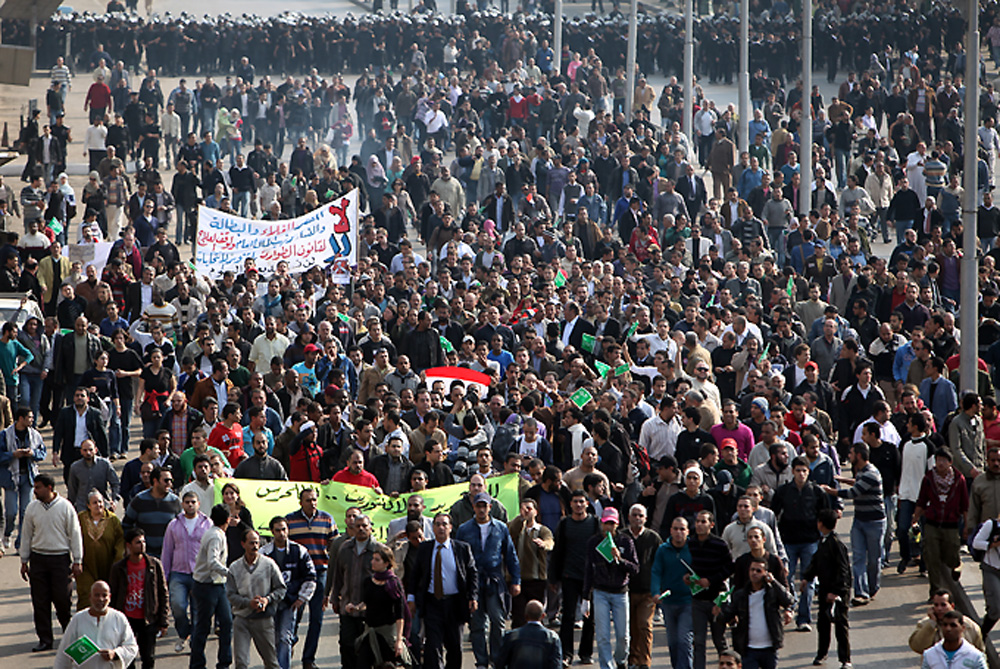
People in the street confronting police and army soldiers with revolutionary
aspirations. Some youth throw stones in symbolic acts of resistance as the
elders try to calm down their rage and focus on chants of unity. Armed forces
reply with tear gas and rubber-coated steel bullets. This is a regular occurrence
in the West Bank in villages like Nabi Saleh, Ni’ilin and Beit Umar. Over the past
week, it has been unfolding on the streets of Cairo, Suez and Alexandria as well.
From Ni’ilin to Cairo, the tear gas that is being employed against demonstrations
is made in the United States.
the list with this:
4. The Loss of Israel’s ‘Special Status’…But if genuine democracy takes hold in Egypt—
or anywhere else in the Middle East—it could also spell the end of Israel’s monopoly
on righteousness and endanger this special status, along with the lucrative benefits
that have come with it. Among them: gargantuan amounts of U.S. military aid
(which Sen. Rand Paul has justproposed eliminating) and the U.S. veto at the U.N.
Security Council, which has consistently parried any substantial attempts at
condemning Israel in the world body. Finally, and possibly most disheartening for
many Israelis, there is the chance that a genuine Arab democracy might raise the
bar for Israel and prompt international calls for it to get its own democracy in order,
end the occupation of Palestinian territories, and amend its discriminatory policies
toward its Arab minority.
So it turns out that Israel’s government can only carry on with a backdrop of more
obviously autocratic regime. It didn’t just require disenfranchisement of Palestinians
but millions in neighboring countries. And so the wall between more open minded
people in the Jewish community and in Israel and those who cannot take any pleasure
in another’s freedom will grow greater, and Israel will for a time look more like its ally
to the West. But all dictators will meet the same fate, I believe again.
More Recent Articles
|
|
