Over the last couple of months President Donald Trump and his administration have launched a series of outrageous attacks against American freedom of speech and academic freedom, and critics have often denounced these as examples of McCarthyism, the notorious anti-Communist political movement of the 1950s.
This prompted me to carefully investigate that important historical topic and publish a trilogy of long articles on the subject:
One important aspect of my analysis was noting that the “Red Scare” of the late 1940s and 1950s may have partially represented a retaliatory campaign of political payback reacting to the “Brown Scare” of a few years earlier, with the roles of victims and victimizers having been switched.
During the late 1930s and early 1940s, the Roosevelt Administration and its leftist allies had orchestrated a sweeping ideological purge of conservatives and right-wingers. But those important events have generally been ignored or minimized in most of our later histories, so that the possible connection to the anti-Communist campaigns that followed a few years later has been lost.
Ironically enough, much of the repressive political machinery that was so widely employed against Communists and leftists in that latter campaign had originally been created to attack the opposite side of the political spectrum and was heavily used for that purpose. This included the notorious House Un-American Activities Committee (HUAC) and the Smith Act.
As I explained in my article, that earlier campaign of censorship and political suppression targeting right-wingers had actually been far more extreme and dramatic than what came afterwards at the hands of McCarthy and his ideological allies. But since that former history receives so little attention in our standard textbooks or mainstream media stories, few are aware of those important facts.
One of the leading figures driven from public life in that earlier purge had been Father Charles Coughlin of Michigan, the popular anti-Communist radio priest of the 1930s, who usually rated just a sentence or two in my standard history textbooks.
Although I’d certainly been aware of Coughlin, I realized that until last month his name had never once appeared in any of the many articles that I had published over the last couple of decades dealing with political or ideological matters. Furthermore, as I explored Coughlin’s story I discovered that he had actually been a vastly more popular and important figure in American political life that I had ever imagined. I drew most of this new information from the award-winning 1982 book Voices of Protest by the distinguished historian Alan Brinkley, along with Coughlin’s 7,500 word Wikipedia article.
Launched in the late 1920s, Coughlin’s syndicated weekly radio show eventually became political and grew tremendously popular. At his 1930s peak Coughlin had amassed an enormous national audience estimated at 30 million regular listeners, amounting to roughly one-quarter of the entire American population, probably making him the world’s most influential broadcaster. By 1934 the priest was receiving over 10,000 letters of support each day, considerably more than President Franklin Roosevelt or anyone else…
In March 1936 he began publishing a weekly political newspaper called Social Justice and it reportedly reached a peak circulation of about a million subscribers in the late 1930s, making it one of the most widely read publications in America, having more than ten times the combined circulation of the Nation and the New Republic, the leading liberal weeklies.
In 1955 Daniel Bell published The New American Right, a collection of essays by leading mainstream American academics, and in 1963 he reissued that same work in much expanded form as The Radical Right. McCarthyism was a major part of the analysis and the last two essays by sociologist Seymour Martin Lipset totaled more than 140 pages with both of these focused upon that subject. Lipset demonstrated that the political campaign of the Wisconsin senator shared many of its ideological roots and much of its social base with the earlier 1930s movement of Father Charles Coughlin, a hugely popular anti-Communist radio priest from neighboring Michigan.
Indeed, McCarthyism heavily drew its support from Midwesterners, Catholics, and particular ethnic groups such as Irish-Americans and German-Americans, with McCarthy himself falling into all these categories. But less than a decade earlier, these exact same groups had also been the strongest supporters of Coughlin and his own anti-Communist movement.
Liberals, leftists, and Communists had led the sweeping political purges that began in the early 1940s, with much of America’s Anglophile East Coast WASP establishment also heavily involved in such attacks. Millions of Coughlin’s erstwhile followers enlisted in McCarthy’s anti-Communist crusade when it began a few years later, and these exact same groups were his primary targets. So surely many of the ordinary Americans who supported the senator must have regarded his campaigns as political payback.
Not long before Coughlin was suppressed and eventually purged by the legal actions of the Roosevelt Administration, he had probably been America’s most powerful and influential media figure. His regular radio audience may have been the largest in the world when he was gradually driven from the airwaves, while his weekly political newspaper had one of our country’s largest circulations when it was banned.
Obviously none of the victims purged by the later anti-Communist campaigns of McCarthy or his political allies ever had a media presence even remotely on that scale.
In reading the various books on McCarthy and McCarthyism, I noticed that those friendly towards the Wisconsin senator went to great lengths to disassociate him from Coughlin, despite the considerable similarities between those two populist anti-Communist crusaders and the social base that they shared, and although their political activities were separated by less than a decade.
The obvious reason for this major effort to avoid linking the two men was because of the single ideological element in which they so sharply differed.
During the 1950s, an overwhelming majority of American Jews were liberals or leftists, with a very large fraction of all our Communists and Soviet agents also having that ethnic background. Partly for those reasons, Jews were the group most hostile and suspicious of McCarthy and his anti-Communist political crusade.
But despite the enormous antipathy McCarthy encountered from Jews and Jewish groups, he himself remained strongly philosemitic. His top aide Roy Cohn was Jewish, as were some of his most important public supporters such as George Sokolsky, a right-wing Hearst columnist and broadcaster, and Alfred Kohlberg, an influential business executive regarded as the leader of “the China Lobby.”
In very sharp contrast, by the late 1930s Coughlin had become intensely hostile towards Jews and Jewish influence, even endorsing and serializing the notorious Protocols of the Elders of Zion in the pages of his weekly Social Justice newspaper. Coughlin’s fierce anti-Semitism was certainly one of the major factors leading to his censorship and suppression,
Coughlin had originally begun his radio career as neutral or friendly towards Jews, but by the mid-1930s that began to change. A couple of weeks ago I briefly sketched out Coughlin’s evolving views on that controversial subject:
Over the years that followed, Coughlin grew increasingly critical of Jews and Jewish influence, given their hugely disproportionate role as Wall Street bankers, whose activities he regarded as so damaging to the interests of the ordinary American workers whom he championed…
Coughlin had always been hostile to Communism, and after the outbreak of the Spanish Civil War in July 1936, he began strongly supporting the anti-Communist Nationalist forces, who were also backed by Hitler and Mussolini. Meanwhile, Jewish groups overwhelmingly supported the opposing Loyalist side, heavily backed both by foreign Communists and by Stalin’s Soviet Union. This further increased Coughlin’s suspicion of Jews.
During this same period, Jewish groups and most of the American mainstream media began harshly condemning Nazi Germany for the persecution of its tiny 1% Jewish minority, and these public attacks reached a crescendo after dozens of Jews were killed in the November 1938 Kristallnacht riots, probably orchestrated by some Nazi leaders.
But Coughlin claimed that Jewish bankers had played a crucial role in the 1917 Bolshevik Revolution that brought Soviet Communism to power, while the very heavily Jewish regime thereby established had been responsible for the deaths of many millions of Christians, easily explaining the Nazi hostility toward Jews and their influence. Coughlin was naturally outraged that our media focused so much of its attention upon the dozens of Jewish deaths at the hands of German Nazis rather than the millions of Christian deaths at the hands of Bolshevik Jews…
In 1938 Coughlin established a new anti-Communist political organization called the Christian Front, and according to Wikipedia it soon attracted several thousand members, mostly Irish-American men in New York City and other East Coast urban centers. Around that same time, Coughlin was regularly vilified as a fascist sympathizer and the Roosevelt Administration began making efforts to remove him from the airwaves. These efforts intensified after World War II broke out in September 1939 and Coughlin become a leading opponent of American intervention in that military conflict.
In January 1940, the FBI raided the Brooklyn headquarters of the Christian Front and arrested 18 men on charges of plotting to overthrow the U.S. government. But although one defendant committed suicide, the trials of all the others ended in acquittals or hung juries, thus humiliating the federal prosecutors.
But pressure continued and by September 1940 Coughlin was forced to end his radio broadcasts. Then in April 1942 the Espionage Act of 1917 was invoked to ban his Social Justice newspaper from the mails, effectively eliminating nearly all his national media influence. Thus, government action had been used to silence the voice of America’s leading broadcaster and also ban the distribution of one of our largest national newspapers, actions vastly more serious than anything done during the anti-Communist domestic campaigns of the Korean War era a decade later.
This extreme crackdown on Coughlin continued as FDR’s Attorney General Francis Biddle soon convened a federal grand jury to indict him and his publication on charges of sedition. Biddle then worked out a deal with Coughlin’s ecclesiastical superior Archbishop Edward Mooney, promising that the U.S. Justice Department would drop its prosecution of the priest if he closed Social Justice and permanently ceased all his political activities. With Mooney threatening to suspend his ministry, Coughlin agreed to those severe terms. Although he remained the pastor of his local church and lived until 1979, his political and media activities had come to a final end.
Even regardless of any personal views that McCarthy might have had towards Jews, he obviously would have been extremely concerned about avoiding Coughlin’s political fate, and in the postwar era in which he operated, anti-Semitic sentiments had become far more marginalized and toxic than had been the case during Coughlin’s 1930s heyday.
Furthermore, in last week’s article, I even presented the striking possibility that McCarthy’s entire anti-Communist crusade had been planned by the Jewish leadership of an organization called the American Jewish League Against Communism (AJLAC), which had apparently quietly recruited the Wisconsin senator for a starring role as its American front-man.
Brinkley’s highly-regarded history had done an excellent job of covering the earlier years of Coughlin’s career, but its narrative largely ended with the 1936 presidential campaign, a huge failure in which the radio priest had supported a third party candidate who performed miserably. The author then allocated only half of his last chapter and his epilogue to the remaining five years of Coughlin’s subsequent political activity.
However, those years were actually among the most interesting and controversial for the radio priest, as he increasingly left the political mainstream, instead veering sharply into the anti-Semitic politics of the far right and was therefore regularly denounced as a fascist-sympathizer. Such ideological transgressions ultimately led to his removal from the airwaves, his banning from the mails, and finally the permanent forced renunciation of all his political activity.
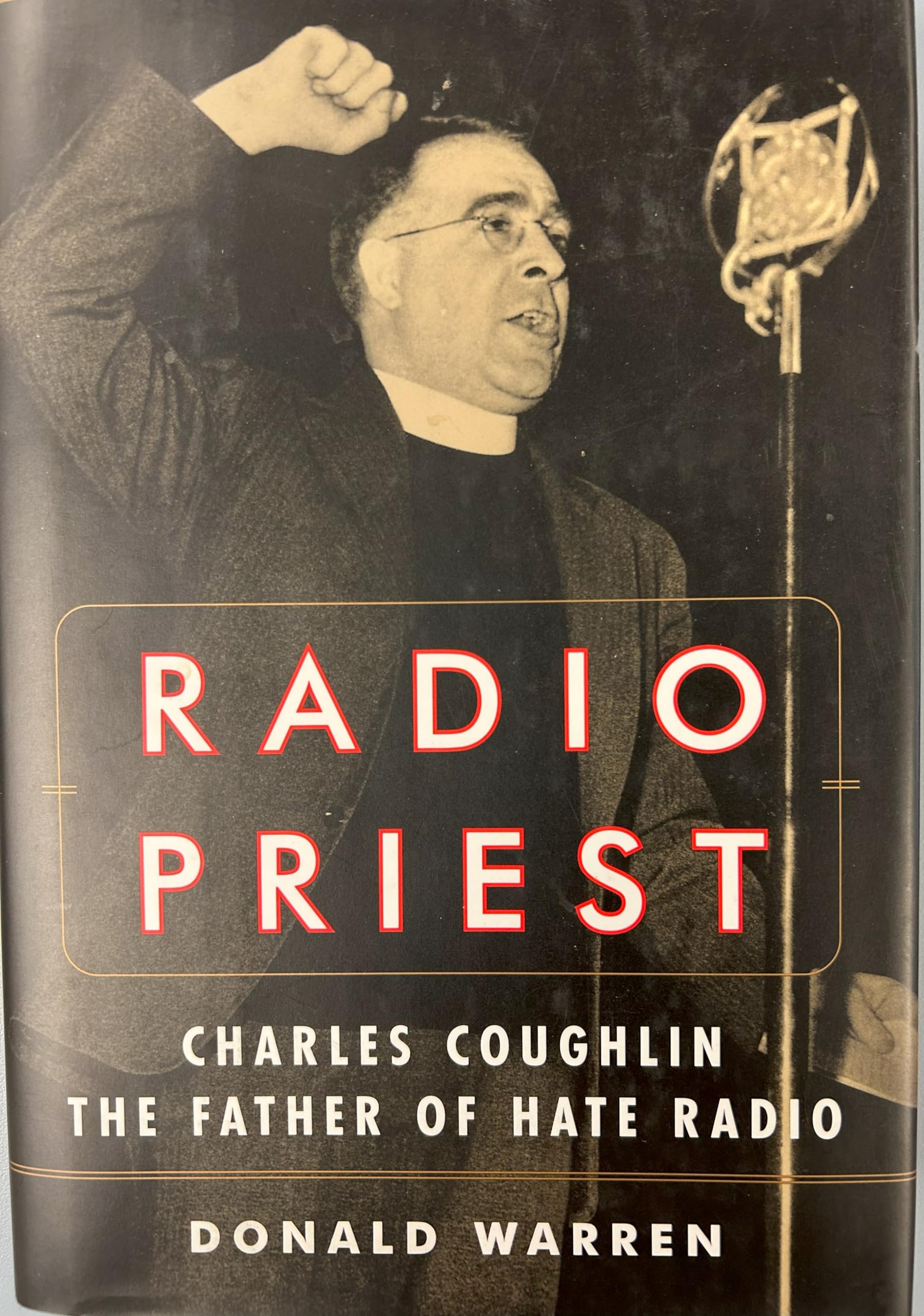
In the early 1990s, the rapid rise of conservative talk radio soon helped foster the growth of a new wave of right-wing American extremism, and this apparently led Michigan sociology professor Donald Warren to publish Radio Priest in 1996, focused exactly on that aspect of Coughlin’s career, carrying the harsh subtitle “Charles Coughlin, the Father of Hate Radio.”
Warren even opened his book with a discussion of the 1995 Oklahoma City Bombing, the worst domestic terrorist attack in American history. Right-wing militant Timothy McVeigh was eventually convicted and executed for that crime, and the author associated that 1990s incident with the 1940 arrest of eighteen members of Coughlin’s paramilitary Christian Front organization.
Warren was obviously intensely hostile to Coughlin for ideological reasons, but he was quite willing to concede the formidable political influence of his subject, explaining that some of the latter’s most successful achievements came even after his 1936 election debacle.
For example, Warren explained that in early 1938 FDR asked Congress to pass a major restructuring of the federal government called the Reorganization Act, and this legislation initially enjoyed fairly strong support in that overwhelmingly Democratic body. But once Coughlin went on the airwaves to denounce it, a “staggering” 100,000 angry telegrams flooded into Washington against the proposal, completely overwhelming the wire services, while major rallies were held in New York City and popular delegations poured into DC to lobby against it. So the bill went down to defeat, with even the New York Times conceding that the outcome marked one of Coughlin’s greatest political victories, and other observers suggested that it had dealt “a shattering blow to FDR’s prestige.”
Warren also described the extensive network of members of Congress who were close to the radio priest, and these included Pat McCarran of Nevada and Everett Dirksen of Illinois, both of whom later became leading political figures associated with McCarthy. Whenever Coughlin visited DC, he was invited to stay at the home of Vice President John Nance Garner. Meanwhile, starting in the early 1930s a long parade of prominent foreign figures had regularly visited Coughlin’s church in political pilgrimages, including a German chancellor, Randolph Churchill, and the newly designated premier of Alberta, Canada. One of Britain’s leading literary figures, Catholic conservative Hilaire Belloc, later began writing an exclusive series of articles for Coughlin’s Social Justice.
The outbreak of the bitter Spanish Civil War in July 1936 soon became a major test of power between rival leftist and right-wing international coalitions, as fascists, anarchists, and Communists lined up against each other. Coughlin became a strong supporter of Gen. Francisco Franco’s anti-Communist Nationalists, who steadily gained ground against the Loyalist forces of the Spanish Republic. The latter suffered from the arms embargo imposed by existing American law, so in early 1939 a major Congressional effort was made to repeal it. But Coughlin’s “particularly stirring radio address” reportedly produced an outpouring of 150,000 angry telegrams to Capitol Hill along with petitions containing an estimated 1.75 million signatures, so the legislation went down to defeat, helping to seal the fate of the Spanish Republic. By this point, Coughlin was regularly declaring his sympathy for Mussolini’s political model of “the Corporate State,” and sometimes suggested that it should be implemented in America as a means of “perfecting democracy.”
According to Warren, during 1937 and into 1938, Coughlin’s radio broadcasts and the pages of Social Justice had increasingly begun attacking Jewish financial control. Although he was always careful to include some Gentile names in his regular denunciations of “international bankers,” many observers strongly suspected that merely constituted a fig-leaf and his accusations were obviously referring to Jews.
But as fears of another European war began rising, Coughlin’s anti-Semitic views became far more explicit, and in summer 1938 he began serializing the notorious Protocols of the Elders of Zion in the pages of his very popular national newspaper, provoking huge hostility from Jewish groups around the country.
Such Jewish antipathy grew even more severe following the November 1938 anti-Jewish Kristallnacht riots in Nazi Germany. While nearly every mainstream American media outlet fiercely condemned those violent incidents, Coughlin seemed to excuse the attacks to his radio audience of many millions. He described Nazism as “a defense mechanism against Communism,” and argued that nearly the entire Soviet government had long been Jewish, murdering “more than 20 million Christians” between 1917 and 1938. If the Nazis had recently confiscated $400 million of Jewish property in their own country, the overwhelmingly Jewish Bolsheviks had previously done the same with $40 billion of Christian property in Russia.
One of Coughlin’s most important radio outlets was station WMCA in New York City and its Jewish owner began refusing to air some of Coughlin’s subsequent broadcasts. This led to widespread picketing by local supporters of the priest, sometimes involving up to 5,000 protesters, many of them chanting anti-Communist and anti-Jewish slogans and urging boycotts of Jewish shops. Although the typical daily number of street pickets was far lower, the mass protests continued for weeks, with the Coughlinites sometimes violently clashing with counter-protesters or even allegedly attacking Jews on the street. According to Warren, some of the related mass meetings in Brooklyn featured rhetoric similar to that of Nazi rallies in Berlin. A prominent liberal NYC journalist published an article in the Nation describing this situation with the title “The Coughlin Terror.”
In early 1939, the German-American Bund organization held a massive rally of 20,000 supporters at Madison Square Garden, featuring both the Stars and Stripes and Nazi banners, and although Coughlin was not personally involved, his name was repeatedly cheered. The radio priest’s subsequent broadcasts expressed some sympathy for this organization, noting that numerous large Communist rallies had previously been held without drawing much media scrutiny. Similarly, proposals to boycott Jewish businesses merely echoed years of extremely sweeping Jewish-organized boycotts of German and Italian firms.
All of these developments naturally drew the strong attention of the Roosevelt Administration, and this accelerated once World War II broke out in September 1939. FDR soon began seeking to involve America in the conflict while Coughlin became one of the most powerful voices on the other side, doing his best to support maintenance of the Neutrality Acts that blocked American military sales to the Allies. According to leading liberal journalists, by far the greatest pressure on Congress came from Coughlinites, who produced the lion’s share of the constituent mail and also the many delegations of citizens who constantly visited DC, “storming Capitol Hill” to lobby their representatives. Warren even claimed that during the late 1930s Coughlin often “seemed invincible.”
By mid-1938, Coughlin had begun advocating the creation of a militant “Christian Front,” organized into “platoons,” saying that he had borrowed the term from Spain’s Franco, who had established it as a counter-force to the Communist-backed “Popular Front.” Although Coughlin denied any direct connection with the organization, he praised the local leaders who had established such units in New York City, Boston, and other East Coast urban centers, while his rhetoric sometimes became increasingly wild, saying that the membership of the Christian Front needed to “invade” additional cities. These local activists were apparently drawn from the poorer members of Irish-American and German-American neighborhoods and they had formed the picketing army that surrounding the NYC radio station after it dropped Coughlin’s broadcasts.
The FBI eventually planted an informer in the Brooklyn unit, and in early 1940 the federal government struck, with national headlines reporting that 18 Christian Front members had been seized in a plot to overthrow the U.S. government. A weapons cache was found, reportedly including homemade bombs, rifles, and thousands of rounds of ammunition. Coughlin initially disassociated himself from the defendants, but a week later came to their ringing defense, both in his broadcasts and in the pages of Social Justice, denouncing the government for supporting a Communist plot aimed at smearing young Christians and anti-Communists.
One German-born defendant committed suicide, but otherwise the nine week Brooklyn trial turned into a debacle for the government prosecutors. All the key supporters were local, with a highly popular former magistrate serving as the main defense attorney. The efforts of the defense team were heavily covered and endorsed by Brooklyn’s leading Catholic newspaper, while a local crowd gathered each day at the Federal Courthouse, cheering the defendants. Meanwhile, none of the prosecutors came from the area. The end result was that a large majority of the defendants were acquitted of all charges, while the remainder were freed by hung juries. The Coughlin forces naturally claimed complete vindication.
Despite that legal victory, Coughlin was heavily losing ground on other fronts. In 1939, heavy lobbying persuaded the National Association of Broadcasters to adopt a new rule tightly restricting the sale of radio time to “spokesmen of controversial public issues,” a measure directly aimed at the radio priest. Once it went into effect, Coughlin began having a very difficult time renewing his annual contracts as they came up during 1940, gradually losing most of the larger stations that carried him. Faced with the loss of most of his national audience, he finally abandoned his radio broadcasts in fall of that year.
Coughlin’s media activities were now reduced to Social Justice, and the FBI, the ADL, and his many other opponents made great efforts to find evidence that he was secretly receiving German funding for his publication, thereby providing a legal excuse for the government to shut it down. At the same time, the Roosevelt Administration kept up its steady pressure to persuade Coughlin’s ecclesiastical superiors to silence him.
In the early years of Social Justice, the publication had carried quite a number of signed articles by Congressional leaders and other prominent public figures, but by 1940 and 1941 heavy government and media pressure gradually drove away all of those contributors, and most published articles lacked any byline.
Once the December 7, 1941 attack on Pearl Harbor brought America directly into the war, efforts to suppress Social Justice intensified, and in April 1942 the Espionage Act of 1917 was invoked to ban the distribution of the newspaper on grounds that it was obstructing the war effort, while Coughlin and the other individuals involved in the publication were threatened with an indictment. At the same time, the Detroit archbishop supervising Coughlin was successfully pressured into threatening to have the priest defrocked unless he put a complete end to all his political activities, and he finally did so.
In order to gain a better understanding of Coughlin and his views, I located a collection of his radio discourses from 1931-1932, the early years of the Great Depression, and lightly skimmed it, though nothing dramatic jumped out at me.
About twenty years ago, I’d digitized the archives of a hundred-odd major American publications, and this included a complete run of Social Justice, apparently constituting the only such resource available anywhere on the Internet, so I glanced through a few of the issues.
Social Justice • March 13, 1936 to April 20, 1942 7 Years, 316 Issues, 4,578 Articles, 6,034 Pages
During 1939, Coughlin’s publication still seemed to have retained a great deal of respectable, mainstream credibility, with the April 24, 1939 issue carrying pieces by U.S. Senators William E. Borah, Harry F. Byrd, and Tom Connally, as well as U.S. Representatives Everett M. Dirksen and Martin F. Smith. A few months later, the July 24, 1939 issue featured articles by U.S. Senators Bennett C. Clark, Claude Pepper, and Robert R. Reynolds, as well as U.S. Representatives Jerry Voorhis, Frank O. Horton, and Martin L. Sweeney.
I found it interesting that all these prominent elected officials figures still apparently felt comfortable appearing in the publication over a year after it had begun running a serialized edition of the Protocols of the Elders of Zion. Indeed, around that same time, the British Catholic writer Hilaire Belloc, one of his country’s leading man of letters, publishing some 25 columns in Social Justice. During late 1938 there had also been a different embarrassing incident in which an article by Coughlin himself seemed to have heavily plagiarized a foreign policy speech given by Nazi Propaganda Minister Joseph Goebbels.
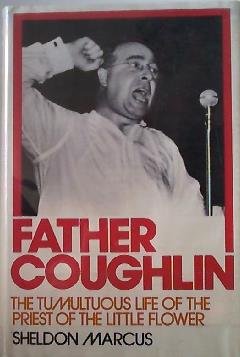
Both the Brinkley and the Warren books significantly relied upon one of the first serious biographies of the radio priest, Father Coughlin, published in 1973 by Sheldon Marcus. That work greatly benefited from the author’s personal interviews with Coughlin in April 1970, the first that the latter had granted to any biographer since 1933. Marcus also gained access to extensive primary source material, including Coughlin’s private letters and personal papers, a complete collection of the Social Justice archives, the ADL files on Coughlin, and numerous other documents.
Based upon his name, Marcus was likely Jewish, but he presented Coughlin in an even-handed and fair-minded manner, with his treatment not being remotely as hostile as that of Warren’s political biography published nearly a quarter century later. Although details and emphasis certainly differed here and there, the narrative that Marcus told both of Coughlin’s early years and of his later ones seemed reasonably similar to those provided by Brinkley and Warren, hardly surprising since the latter authors had significantly relied upon Marcus’ original research.
The author seemed to respect and admire much of Coughlin’s work of the early 1930s, but then gradually grew appalled about the later years, clearly feeling that the priest had somehow slipped into believing and promoting the most extreme sort of anti-Semitic conspiratorial lunacy. But for me, some of the most interesting portions of the book came in several of the author’s extremely lengthy end notes to the chapter called “Social Justice,” covering that latter period, end notes that ran nearly as long as the notes to all the other chapters combined.
Although Marcus regarded Coughlin as espousing beliefs that seemed almost insane and ridiculous, the author did his best to bend over backwards to be fair to his subject. So whereas nearly all the notes for the other chapters were of the short, standard footnote variety, merely citing a document and a page, some of these other notes ran many long paragraphs. Most of them dealt with the tangled finances and ownership structure of the newspaper, but others seemed to constitute a sincere attempt to summarize, analyze, and evaluate what seemed to be Coughlin’s totally lunatic historical notions, especially those regarding Jews and Communism, which were generally interwoven with the portions of the Protocols that he published.
For example, one of the longest such chapter notes was n. 16, running nearly two pages of very small print. It described how the August 8, 1938 issue of Social Justice had yet again presented the outrageous claim that Jewish banking houses had financed the Russian Revolution and that nearly all of the top Bolshevik leaders were Jews.
Marcus explained that a careful investigation by the noted Catholic scholar John A. Ryan in the December 30, 1938 edition of Commonweal had found that Coughlin’s bizarre beliefs on those matters came from a book entitled The Mystical Body of Christ in the Modern World written by Father Denis Fahey, a notoriously anti-Semitic priest, who drew his information from an anti-Semitic London weekly called the Patriot. That latter outlet had cited a French publication called Documentation Catholique of Paris, which in turn had relied upon an alleged report provided by “the American Secret Service” to the French High Commissioner. However, Ryan explained that on November 28, 1938, the head of the U.S. Secret Service declared that an exhaustive search of his organization’s records found no evidence of any such report. This seemed to demonstrate that Coughlin’s controversial claims had no basis in reality, but instead echoed Nazi propaganda published a couple of years earlier.
Marcus went on to note that standard historical documents showed that only a single early Soviet leader, Leon Trotsky, was Jewish, while other evidence revealed that the overwhelming majority of Russian Jews opposed Bolshevism, and instead suffered greatly from the triumph of that revolutionary movement.
Thus, Marcus concluded that Coughlin had been taken in by anti-Semitic or even Nazi propaganda. The priest then regularly promoted those dangerous, delusional beliefs to his many hundreds of thousands of readers, an unfortunate situation that obviously helped justify the subsequent government suppression of his publication.
Marcus published his biography in 1973, and later that same decade I’d developed a strong interest in Soviet and Communist history, reading many of the standard, major works in that subject. I’d never heard of Marcus nor his book and had only slight awareness of Coughlin, but if I’d happened to read the biography at the time, I certainly would have nodded my head at the obvious lunacy of that notorious radio priest who died in 1979 at the age of 88.
But as I explained in a 2018 article, I subsequently discovered that my understanding of that historical era was severely mistaken:
Allegedly Jacob Schiff, America’s leading Jewish banker, had been the crucial financial supporter of the Bolshevik Revolution, providing the Communist revolutionaries with $20 million in funding.
My first reaction was that such a notion was utterly ridiculous since a fact so enormously explosive could not have been ignored by the many dozens of books I had read on the origins of that revolution. But the source seemed extremely precise. The Knickerbocker columnist in the February 3, 1949 edition of The New York Journal-American, then one of the leading local newspapers, wrote that “Today it is estimated by Jacob’s grandson, John Schiff, that the old man sank about 20,000,000 dollars for the final triumph of Bolshevism in Russia.”
Once I checked around a little, I discovered that numerous mainstream accounts described the enormous hostility of Schiff towards the Czarist regime for its ill-treatment of Jews, and these days even so establishmentarian a source as Wikipedia’s entry on Jacob Schiff notes that he played a major role financing the Russian Revolution of 1905, as was revealed in the later memoirs of one of his key operatives. And if you run a search on “jacob schiff bolshevik revolution” numerous other references come up, representing a wide variety of different positions and degrees of credibility. One very interesting statement appears in the memoirs of Henry Wickham Steed, editor of The Times of London and one of the foremost international journalists of his era. He very matter-of-factly mentioned that Schiff, Warburg and the other top Jewish international bankers were among the leading backers of the Jewish Bolsheviks, through whom they hoped to gain an opportunity for the Jewish exploitation of Russia, and he described their lobbying efforts on behalf of their Bolshevik allies at the 1919 Paris Peace Conference following the end of the First World War.
Even the very recent and highly skeptical analysis in Kenneth D. Ackerman’s 2016 book Trotsky in New York, 1917 notes that U.S. Military Intelligence reports of the period directly made that astonishing claim, pointing to Trotsky as the conduit for the heavy financial backing of Schiff and numerous other Jewish financiers. In 1925 this information was published in the British Guardian and was widely discussed and accepted throughout the 1920s and 1930s by numerous major media publications, long before Schiff’s own grandson provided a direct confirmation of those facts in 1949. Ackerman rather cavalierly dismisses all of this considerable contemporaneous evidence as “anti-Semitic” and a “conspiracy story,” arguing that since Schiff was a notorious conservative who had never shown any sympathy for socialism in his own American milieu, he surely would not have funded the Bolsheviks.
Now admittedly, a few details might easily have gotten somewhat garbled over time. For example, although Trotsky quickly became second only to Lenin in the Bolshevik hierarchy, in early 1917 the two men were still bitterly hostile over various ideological disputes, so he certainly was not then considered a member of that party. And since everyone today acknowledges that Schiff had heavily financed the failed 1905 Revolution in Russia, it seems perfectly possible that the $20 million figure mentioned by his grandson refers to the total invested over the years supporting all the different Russian revolutionary movements and leaders, which together finally culminated in the establishment of Bolshevik Russia. But with so many seemingly credible and independent sources all making such similar claims, the basic facts appear almost indisputable.
Consider the implications of this remarkable conclusion. I would assume that most of Schiff’s funding of revolutionary activities was spent on items such as stipends for activists and bribes, and adjusted for the average family incomes of that era, $20 million would be as much as $2 billion in present-day money. Surely without such enormous financial support, the likelihood of any Bolshevik victory would have been far lower, perhaps almost impossible.
When people casually used to joke about the total insanity of “anti-Semitic conspiracy theories” no better example was ever tossed around than the self-evidently absurd notion that the international Jewish bankers had created the worldwide Communist movement. And yet by any reasonable standard, this statement appears to be more or less true, and apparently was widely known at least in rough form for decades after the Russian Revolution, but had never been mentioned in any of the numerous more recent histories that shaped my own knowledge of those events. Indeed, none of these very comprehensive sources had ever even mentioned Schiff’s name, although it was universally acknowledged that he had funded the 1905 Revolution, which was often discussed in enormous detail in many of those very weighty books. What other astonishing facts might they similarly be concealing?…
In 1999, Harvard University published the English edition of The Black Book of Communism, whose six co-authors devoted 850 pages to documenting the horrors inflicted upon the world by that defunct system, which had produced a total death toll they reckoned at 100 million. I have never read that book and I have often heard that the alleged body-count has been widely disputed. But for me the most remarkable detail is that when I examine the 35 page index, I see a vast profusion of entries for totally obscure individuals whose names are surely unknown to all but the most erudite specialist. But there is no entry for Jacob Schiff, the world-famous Jewish banker who apparently financed the creation of the whole system in the first place. Nor one for Olaf Aschberg, the powerful Jewish banker in Sweden, who played such an important role in providing the Bolsheviks a financial life-line during the early years of their threatened regime, and even founded the first Soviet international bank.
Moreover, even back in the 1970s I’d always carefully read between the lines of my standard Soviet history books, and certainly noticed that a huge fraction of the top Bolshevik leadership had been Jewish, while all subsequent information has merely confirmed that reality. In a later 2018 article, I emphasized that this fact had huge, obvious implications:
Indeed, the topic of Communism raises a far larger issue, one having rather touchy implications. Sometimes two simple compounds are separately inert, but when combined together may possess tremendous explosive force. From my introductory history classes and readings in high school, certain things had always seemed glaringly obvious to me even if the conclusions remained unmentionable, and I once assumed they were just as apparent to most others as well. But over the years I have begun to wonder whether perhaps this might not be correct.
Back in those late Cold War days, the death toll of innocent civilians from the Bolshevik Revolution and the first two decades of the Soviet Regime was generally reckoned at running well into the tens of millions when we include the casualties of the Russian Civil War, the government-induced famines, the Gulag, and the executions. I’ve heard that these numbers have been substantially revised downwards to perhaps as little as twenty million or so, but no matter. Although determined Soviet apologists may dispute such very large figures, they have always been part of the standard narrative history taught within the West.
Meanwhile, all historians know perfectly well that the Bolshevik leaders were overwhelmingly Jewish, with three of the five revolutionaries Lenin named as his plausible successors coming from that background. Although only around 4% of Russia’s population was Jewish, a few years ago Vladimir Putin stated that Jews constituted perhaps 80-85% of the early Soviet government, an estimate fully consistent with the contemporaneous claims of Winston Churchill, Times of London correspondent Robert Wilton, and the officers of American Military Intelligence. Recent books by Alexander Solzhenitsyn, Yuri Slezkine, and others have all painted a very similar picture. And prior to World War II, Jews remained enormously over-represented in the Communist leadership, especially dominating the Gulag administration and the top ranks of the dreaded NKVD.
Both of these simple facts have been widely accepted in America throughout my entire lifetime. But combine them together with the relatively tiny size of worldwide Jewry, around 16 million prior to World War II, and the inescapable conclusion is that in per capita terms Jews were the greatest mass-murderers of the twentieth century, holding that unfortunate distinction by an enormous margin and with no other nationality coming even remotely close. And yet, by the astonishing alchemy of Hollywood, the greatest killers of the last one hundred years have somehow been transmuted into being seen as the greatest victims, a transformation so seemingly implausible that future generations will surely be left gasping in awe.
Just as Marcus and his sources explained, there never had been any American Secret Service report making those shocking claims about the Bolshevik Revolution, its origins, and its leadership. But the very lengthy chain of information that he described included translation from English to French and back again, so it’s easy to understand how technical names might have gotten a little garbled in that process, especially since all the publications involved were produced by activists and situated on the political fringe.
More than a quarter century after Marcus published his biography, a very weighty academic book appeared and its contents might surely have shocked the author if he ever saw it, as I explained in a long 2019 article:
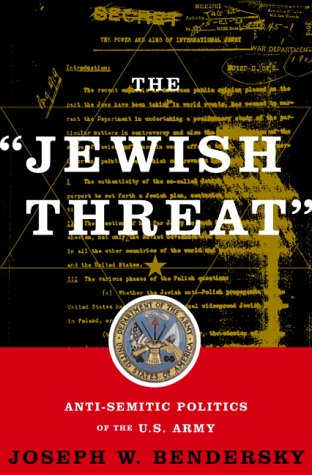
These thoughts recently came to my mind when I decided to read a remarkable analysis of the American military by Joseph W. Bendersky of Virginia Commonwealth University, a Jewish historian specializing in Holocaust Studies and the history of Nazi Germany. Last year, I had glanced at a few pages of his text for my long article on Holocaust Denial, but I now decided to carefully read the entire work, published in 2000.
Bendersky devoted ten full years of research to his book, exhaustively mining the archives of American Military Intelligence as well as the personal papers and correspondence of more than 100 senior military figures and intelligence officers. The “Jewish Threat” runs over 500 pages, including some 1350 footnotes, with the listed archival sources alone occupying seven full pages. His subtitle is “Anti-Semitic Politics of the U.S. Army” and he makes an extremely compelling case that during the first half of the twentieth century and even afterward, the top ranks of the U.S. military and especially Military Intelligence heavily subscribed to notions that today would be universally dismissed as “anti-Semitic conspiracy theories.”
Put simply, U.S. military leaders in those decades widely believed that the world faced a direct threat from organized Jewry, which had seized control of Russia and similarly sought to subvert and gain mastery over America and the rest of Western civilization.
In these military circles, there was an overwhelming belief that powerful Jewish elements had financed and led Russia’s Bolshevik Revolution, and were organizing similar Communist movements elsewhere aimed at destroying all existing Gentile elites and imposing Jewish supremacy throughout America and the rest of the Western world. While some of these Communist leaders were “idealists,” many of the Jewish participants were cynical opportunists, seeking to use their gullible followers to destroy their ethnic rivals and thereby gain wealth and supreme power. Although Intelligence officers gradually came to doubt that the Protocols of the Elders of Zion was an authentic document, most believed that the notorious work provided a reasonably accurate description of the strategic plans of the Jewish leadership for subverting America and the rest of the world and establishing Jewish rule.
Although Bendersky’s claims are certainly extraordinary ones, he provides an enormous wealth of compelling evidence to support them, quoting or summarizing thousands of declassified Intelligence files, and further supporting his case by drawing from the personal correspondence of many of the officers involved. He conclusively demonstrates that during the very same years that Henry Ford was publishing his controversial series The International Jew, similar ideas, but with a much sharper edge, were ubiquitous within our own Intelligence community. Indeed, whereas Ford mostly focused upon Jewish dishonesty, malfeasance, and corruption, our Military Intelligence professionals viewed organized Jewry as a deadly threat to American society and Western civilization in general. Hence the title of Bendersky’s book…
The bulk of the fascinating material that Bendersky cites comes from Intelligence reports and official letters contained in permanent military archives. Therefore, we must keep in mind that the officers producing such documents would surely have chosen their words carefully and avoided putting all their controversial thoughts down on paper, raising the possibility that their actual beliefs may have been far more extreme. A particular late 1930s case involving one top general provides insight into the likely opinions and private conversations of some of those individuals.
Although his name would mean nothing today, Deputy Chief of Staff George Van Horn Moseley spent most of the 1930s as one of America’s most highly-regarded generals, having been considered for the top command of our armed forces and also serving as a personal mentor to Dwight D. Eisenhower, future Secretary of State George C. Marshall, and numerous other leading military figures. He seems to have been well-liked within our military establishment, and had an excellent personal reputation.
Moseley also had very strong opinions on the major public issues of the day, and after his retirement in 1938 freed him from military discipline, he began to aggressively promote these views, going on a nationwide speaking tour. He repeatedly denounced Roosevelt’s military buildup and in an early 1939 speech, he declared that “The war now being proposed is for the purpose of establishing Jewish hegemony throughout the world.” He stated that only Jews would profit from the war, claimed that leading Wall Street Jews had financed the Russian Revolution, and warned Americans not to let history repeat itself. Although Moseley’s outspokenness soon earned him a reprimand from the Roosevelt Administration, he also received private letters of support from other top generals and former president Herbert Hoover.
In his Congressional testimony just before the outbreak of World War II, Moseley became even more outspoken. He declared that the “murder squads” of Jewish Communists had killed “millions of Christians,” but that “fortunately, the character of the German people was aroused” against these traitors within their midst and that therefore “We should not blame the Germans for settling the problem of the Jew within their borders for all time.” He even urged our national leaders to “benefit” from the German example in addressing America’s own festering domestic Jewish problem.
As might be expected, Moseley’s 1939 praise of Germany’s Jewish policy in front of Congress provoked a powerful media backlash, with a lead story in The New Republic denouncing him as a Nazi “fifth columnist” and The Nation attacking him in similar fashion; and after war broke out, most public figures gradually distanced themselves. But both Eisenhower and Marshall continued to privately regard him with great admiration and remained in friendly correspondence for many years, strongly suggesting that his harsh appraisal of Jews had hardly been a deep secret within his personal circle.
Bendersky claims that Moseley’s fifty boxes of memoirs, private papers, and correspondence “embody every kind of anti-Semitic argument ever manifested in the history of Western civilization,” and based on the various extreme examples he provides, few would dispute that verdict. But he also notes that Moseley’s statements differed little from the depictions of Jews expressed by General George S. Patton immediately after World War II, and even maintained by some retired generals well into the 1970s…
Let us take a step back and place Bendersky’s findings in their proper context. We must recognize that during much of the era covered by his research, U.S. Military Intelligence constituted nearly the entirety of America’s national security apparatus—being the equivalent of a combined CIA, NSA, and FBI—and was responsible for both international and domestic security, although the latter portfolio had gradually been assumed by J. Edgar Hoover’s own expanding organization by the end of the 1920s.
Bendersky’s years of diligent research demonstrate that for decades these experienced professionals—and many of their top commanding generals—were firmly convinced that major elements of the organized Jewish community were ruthlessly plotting to seize power in America, destroy all our traditional Constitutional liberties, and ultimately gain mastery over the entire world.
Probably the single most embarrassing decision Coughlin made in Social Justice was to take seriously and publish the Protocols of the Elders of Zion, which Marcus and his entire intellectual circle surely regarded as utterly self-discrediting. Yet that infamous document makes an intriguing appearance in Bendersky’s lengthy volume:
The Venona Project constituted the definitive proof of the massive extent of Soviet espionage activities in America, which for many decades had been routinely denied by many mainstream journalists and historians, and its findings also played a crucial secret role in dismantling that hostile spy network during the late 1940s and early 1950s. But Venona was nearly snuffed out just a year after its birth. In 1944 Soviet agents became aware of the crucial code-breaking effort, and soon afterwards arranged for the Roosevelt White House to issue a directive ordering the project shut down and all efforts to uncover Soviet spying abandoned. The only reason that Venona survived, allowing us to later reconstruct the fateful politics of that era, was that the determined Military Intelligence officer in charge of the project risked a court-martial by directly disobeying that explicit Presidential order and continuing his work.
That officer was Col. Carter W. Clarke, but his place in Bendersky’s book is a much less favorable one, being described as a prominent member of the anti-Semitic “clique” who constitute the villains of the narrative. Indeed, Bendersky particularly condemns Clarke for still seeming to believe in the essential reality of the Protocols as late as the 1970s, quoting from a letter he wrote to a brother officer in 1977:
If, and a big—damned big IF, as the Jews claim the Protocols of the Elders of Zion were f—- cooked up by Russian Secret Police, why is it that so much they contain has already come to pass, and the rest so strongly advocated by the Washington Post and the New York Times.
Our historians must surely have a difficult time digesting the remarkable fact that the officer in charge of the vital Venona Project, whose selfless determination saved it from destruction by the Roosevelt Administration, actually remained a lifelong believer in the importance of the Protocols of the Elders of Zion.
Coughlin was merely an ordinary priest, lacking the specialized expertise in historical or national security matters necessary to lend credibility to his dramatic claims. Yet it is quite interesting to compare his own views, broadcast or published to his enormous public audience, with those privately held during those same years by so many of the top officers in American Military Intelligence.