Tuesday, November 17FROM THE RIVER TO THE SEA, PALESTINE WILL BE FREE

Articles

Julian Assange: A Thousand Days in Belmarsh
Human Rights, United Kingdom, USA

Julian Assange: A Thousand Days in Belmarsh

BY BINOY KAMPMARK Photograph Source: Marco Verch – https://creativecommons.org/licenses/by/2.0/ Julian Assange has now been in the maximum-security facilities of Belmarsh prison for over 1,000 days.  On the occasion of his 1,000th day of imprisonment, campaigners, supporters and kindred spirits gathered to show their support, indignation and solidarity at this political detention most foul. Alison Mason of the Julian Assange Defence Committee reiterated those observations long made about the imprisonment at a gathering outside the Australian High Commission in London on that day.  The WikiLeaks founder was wrongfully confined “for publishing the war crimes of the US military leaked to him by whistleblower Chelsea Manning.”  She, along with s...

What’s Driving the UK’s Shortage of Medical Doctors?
Health, United Kingdom

What’s Driving the UK’s Shortage of Medical Doctors?

BY PATRICK COCKBURNFacebookTwitterRedditEmail Photograph Source: DFID – UK Department for International Development – CC BY 2.0 At the beginning of the first lockdown two years ago a friend told me about a relative of his who was a nurse in a London hospital who had caught Covid-19. She said that her manager had told her “to go home and tell nobody about it”. His response to bad news was to hide it, which is in keeping with secretive traditions of the NHS, as it is with all large institutions protecting their own interests. In the case of the NHS, the secrecy may be less obvious because a sympathetic media has been giving wall-to-wall coverage to its heroic efforts to treat victims of the pandemic. Reporting today focuses largely on the shortage of doctors and nurses...
Worshiping Markets, Genuflecting to Grand Fortune
USA

Worshiping Markets, Genuflecting to Grand Fortune

BY SAM PIZZIGATI l Photograph Source: concrete&fells – CC BY 2.0 Our conventional political wisdom, here in the United States, tends to see utopians as lefty egalitarians of one sort or another, clueless reformers and revolutionaries who just don’t understand how the “real world” operates. But today’s most clueless utopians, suggest recent reflections from political economist Abby Innes, actually hail from the right end of our political spectrum. These utopians see the marketplace as humanity’s only “sphere of true freedom” and government as the most direct threat to that freedom, an outlook on the world that most typically goes by the label of “neoliberalism.” This “neoliberal” tag, for most Americans, could hardly be more confusing. “Neolibe...
Think Big to Overcome Losing Big to Corporatism
USA

Think Big to Overcome Losing Big to Corporatism

BY RALPH NADER The progressive citizen groups, that in the sixties and seventies, drove through Congress the key environmental, worker, and consumer legislation, since unmatched, must feel nostalgic. Those were the years when legislation throwing cruel companies on the defensive was signed by arch-corporatist, President Richard Nixon, because he read the political tea leaves. These bills included the creation of the Environmental Protection Agency (EPA) and environmental laws, the establishment of the Occupational Safety and Health Administration (OSHA) for worker health and safety, the Consumer Product Safety Commission (CPSC), the Freedom of Information Act (FOIA), and worker pension protection, among others. Alas, Richard Nixon was the last Republican president to be ...
Exodus: Vayakhel
ZIO-NAZI

Exodus: Vayakhel

After a political rupture, rituals of repetition can attempt to restore normalcy—or throw it into question. Raphael Magarik Statue from the permanent collection of the Museum of Jewish People at Beit Hatfutsot in Tel Aviv, Israel. Photo: ביקורת VayakhelExodus 35:1 – 38:20 Read previous entries of Slow Burn: Quarantine Edition here. Oakland, CA Dear Rereaders, All readings are rereadings, Vladimir Nabokov thought. Maybe so—but some more than others. Jews, of course, cycle through a Torah scroll each year, then rewind and repeat. Readers of Vayakhel, the tenth parsha of Exodus, may feel especially strongly that they are watching a rerun, because this parsha duplicates material nearly verbatim from Terumah, four parshas earlier, about the construction of th...
“I Campaigned on Right, Not on Fear”
Palestine Affairs, USA, ZIO-NAZI

“I Campaigned on Right, Not on Fear”

If he loses due to his support for BDS, Florida congressional candidate Omari Hardy says his “conscience will be clear.” Alex Kane Florida State Representative Omari Hardy. Courtesy of Omari Hardy When Florida State Rep. Omari Hardy got a call from the right-leaning news outlet Jewish Insider earlier this month, he did something unusual for a politician running for Congress: He declared his support for Boycott, Divestment, and Sanctions (BDS), the movement to pressure Israel economically over its violations of Palestinian human rights. The statement was all the more surprising given the makeup of Florida’s 20th Congressional District, which Hardy is running to represent. While the South Florida district is majority-Black, 6% of its population is Jewis...
The Making of Satmar Williamsburg
ZIO-NAZI

The Making of Satmar Williamsburg

In a new history of the Hasidic “fortress in Brooklyn,” a community’s struggle for the right to the city is not always waged in the common interest. Samuel Stein A city block in Hasidic Williamsburg.Alberto Paredes/Alamy Discussed in this essay: A Fortress in Brooklyn, by Nathaniel Deutsch and Michael Casper. Yale University Press, 2021. 408 pages. THERE IS A LONGSTANDING ASSOCIATION between Jews and cities, including both positive connotations (Jews at home in the shtetl and the shuk) and negative stereotypes (Jews as “rootless cosmopolitans,” per the Stalinist slur). Jewish texts are full of treatises on the city and its discontents. The unique complications of urban religious life are even discussed in the Babylonian Talmud, which instructs us t...
Who Owns American Judaism?
USA

Who Owns American Judaism?

Lila Corwin Berman’s new book traces the explosion of the American Jewish philanthropic sector over the past 70 years—and its corrosive effect on contemporary Jewish life. Raphael Magarik A Lion of Judah brooch, which signals a substantial donor to the Jewish Federation. Photo courtesy of the Jewish Federation. This article appears in our Spring 2021 issue. Discussed in this essay: The American Jewish Philanthropic Complex: The History of a Multibillion-Dollar Institution, by Lila Corwin Berman. Princeton University Press, 2020. 280 pages.IN THE WINTER OF 2018, I found myself in a summer camp in the Santa Monica mountains, learning to ask for money. The weekend program, called “Retreatology: The Art of Jewish Retreat-Making,” was organized by Moishe House—a ...
Meir Kahane’s Long Shadow
ZIO-NAZI

Meir Kahane’s Long Shadow

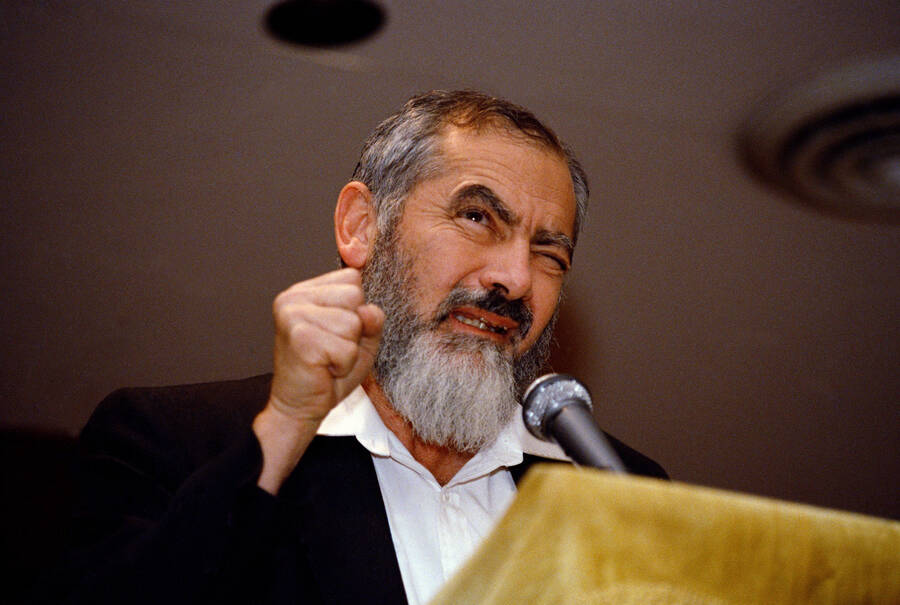
The far-right activist and politician died in disgrace, but Shaul Magid’s new book argues that his ideas have shaped mainstream American Judaism. Raphael Magarik Meir Kahane addresses a gathering at the Silver Spring Jewish Center in Maryland, on October 27th, 1988.AP Photo/Doug Mills Meir Kahane, founder of the Jewish Defense League (JDL), a far-right American militant group that once boasted 15,000 members, is now mostly remembered as a marginal, unsavory provocateur. After years of promoting Jewish self-assertion, attacking liberal big-city mayors and Black radicals for supposed antisemitism, and advocating on behalf of Soviet Jewry, Kahane was convicted of manufacturing explosives in 1971, and he immigrated to Israel in disgrace. There he struggled to build a new pol...
A Logic of Elimination
Human Rights, Palestine Affairs, West Bank, ZIO-NAZI

A Logic of Elimination

Historian Lorenzo Veracini discusses settler colonialism, Zionism, and decolonial futures. Abe Silberstein Men work on a new housing project in the West Bank settlement of Modi'in Ilit in 2019.Ariel Schalit/AP There are few terms in the discourse on Israel/Palestine more contentious than settler colonialism. Faithfully describing the experience of violent dispossession endured by Palestinians before, during, and after the Nakba in 1948—when Zionist forces expelled an estimated 700,000 Palestinians from their homes—stokes the anxiety many Zionists feel about the legitimacy of the State of Israel. For decades, pro-Israel activists have attempted to refute this account by asserting that Israel cannot be the result of a colonial project because the early Zionists lacked...