For the last decade or so, Tucker Carlson has reigned as the unchallenged monarch of the conservative media world, with his influence and audience only growing stronger after FoxNews forced him to resign in 2023 and he quickly established his own Tucker Carlson Network. The increasing maturity of the Internet allowed Carlson to easily create his own media outlet, a possibility that would have been unimaginable a decade or two earlier.
Two weeks ago, Carlson interviewed Nick Fuentes, a young right-wing podcaster who had become notorious for his strident criticism of Jews and Israel, someone whose highly controversial views had led to years of massive demonization by mainstream media outlets. But Fuentes’ audience had been growing rapidly, and perhaps partly as a consequence, the media began to take him much more seriously in recent months, with the New York Times featuring him in a major profile that was far less hostile than might have been expected and other elite outlets also giving him heavy coverage. For years, Fuentes had been shunned and boycotted by almost all other conservative or right-wing podcasters, but a number of these had recently interviewed him, prompting Carlson to do the same.
In the past, Carlson had casually dismissed Fuentes in rather insulting fashion and Fuentes had angrily retaliated, repeatedly leveling all sorts of bitter accusations against the powerful media figure. But once they came together face to face for more than two hours of conversation, they seemed to get along quite well, and each regretted some of the things he had previously said about the other. During that long joint appearance, Fuentes toned down some of his more strident positions and Carlson emphasized that his own views sometimes sharply differed, but both of them treated the other in very respectful and even friendly fashion.
This was the longest video segment I’d ever seen of Fuentes, indeed probably longer than all the others combined, and I thought he came across quite well. Most importantly, he seemed completely sincere, perhaps putting to rest some of the dark suspicions that had been circulating on the Internet.
That long interview has been viewed 5.7 million times on YouTube, with many millions of additional views on Twitter and other video platforms, so it will surely provide an important boost to Fuentes’ public visibility and stature.
Perhaps regretful over its long and less than fully hostile profile of Fuentes from a couple of months ago, the Times quickly unleashed five far harsher articles on the young podcaster, with the coverage rapidly accelerating in the last few days.
But the strongest reaction to the Carlson interview came from conservative figures who expressed total horror, especially those who were committed Jewish activists or fervent partisans of Israel.
Mark Levin is a prominent conservative host on FoxNews and a staunch advocate for his own Jewish community and the State of Israel. He had long regarded Fuentes as someone whose unabashed anti-Semitism had placed him entirely beyond the pale, so Levin was outraged when Carlson had provided him such a large and friendly platform and was equally outraged that the president of the influential Heritage Foundation defended rather than denounced Carlson.
Speaking in Las Vegas at the annual leadership conference of the wealthy and powerful Republican Jewish Coalition, Levin launched a wave of remarkably strident attacks against Fuentes, Carlson, and various others in their camp, denouncing them as deranged “Jew-haters” who must be driven off all media platforms and totally destroyed. In a tirade so emotional it seemed almost unhinged, he identified them with Neo-Nazis, Klansmen, White Supremacists, Islamic Jihadists, and almost every other favorite bugaboo of the ADL and similar Jewish activist groups.
I’d only been very slightly aware of Levin or his beliefs and background. But watching his speech, he struck me as someone whose entire view of the world had been formed by the conventional historical narrative that our mainstream media and academic community have constructed over the last three or four generations.
Levin is sixty-eight and most of the historical reality that he accepts without question was created before he was even born and afterwards remained completely unchallenged until the appearance of the Internet and the new sources of information that it provided. Given that he has spent his entire life sheltered within the cocoon of that media-created reality, how could he ever consider any other possibility?
Meanwhile, Fuentes, Carlson, and others have sometimes articulated a very different view of history, so Levin’s extremely angry reaction was hardly surprising. From childhood, many sincere Soviet Communists spent their entire lives worshipping at the altar of Joseph Stalin, so they often reacted with outrage and disbelief when others later offered a contrary perspective of that all-powerful Soviet leader.
During the last couple of weeks, I’ve published two long articles explaining how a number of highly credible but almost totally unknown books would completely transform our understanding of World War II and many other important events of the last one hundred years. I very much doubt that Levin has ever heard of any of these works let alone actually read them. But in the unlikely event that he ever did so with an open mind, I think he would be astonished at the facts that he discovered about the true history of our modern world.
Almost a decade ago, very early in my American Pravda series, I described the extremely warped version of reality that our media often creates, and our standard histories merely represent a congealed version of those same media misrepresentations:
We naively tend to assume that our media accurately reflects the events of our world and its history, but instead what we all too often see are only the tremendously distorted images of a circus fun-house mirror, with small items sometimes transformed into large ones, and large ones into small. The contours of historical reality may be warped into almost unrecognizable shapes, with some important elements completely disappearing from the record and others appearing out of nowhere. I’ve often suggested that the media creates our reality, but given such glaring omissions and distortions, the reality produced is often largely fictional. Our standard histories have always criticized the ludicrous Soviet propaganda during the height of Stalin’s purges or the Ukrainian famine, but in its own way, our own media organs sometimes seem just as dishonest and absurd in their own reporting. And until the availability of the Internet, it was difficult for most of us to ever recognize the enormity of this problem.
If Levin or others in his circle were to read those recent articles on unknown books and the important historical facts they reveal, they would probably react with disbelief or even horror. But given the intense ideological focus of such individuals, I think that their reaction would be strongest with regard to the numerous elements that related to Jews, the Zionist movement, and Israel.
For example, Prof. John Beaty spent his long career as a well-regarded academic scholar but during World War II he served in Military Intelligence, tasked with producing the daily briefing reports that informed the White House and our other top leaders of important wartime events, including secret ones. This gave Beaty an unequaled understanding of that conflict, and after the war he spent six years researching and writing The Iron Curtain Over America, a book that he hoped would dispel many harmful myths held by the American people and reveal the true facts of what had happened. He then published it independently, free from any editorial restrictions on its contents.
As he told the story, subversive Jews had played a central role in forcing America into a completely unnecessary war against Hitler’s Nazi Germany, a country that had long sought good relations with our own. He also warned that those same Jews were gaining a stranglehold over our media and publishing industries, thereby preventing American citizens from learning the truth about many vital matters, producing “an iron curtain over America.”
Despite such extremely controversial contents, Beaty’s book was strongly endorsed by many of our top generals and became a huge conservative bestseller. But our entire media totally boycotted it, so it lapsed into obscurity after a decade or so, becoming almost entirely forgotten for the last two or three generations.
In 2000, Prof. Joseph Bendersky, a very mainstream historian specializing in Holocaust Studies, published The “Jewish Threat.” Based upon his ten years of exhaustive archival research, he demonstrated that during the first half of the twentieth century, most of our Military Intelligence officers and many of their top commanding generals firmly held a wide variety of beliefs that would today be automatically dismissed as bizarre “anti-Semitic conspiracy theories.”
Thus, the controversial ideas that Beaty had presented in his book were actually quite similar to those privately expressed by so many of his former Military Intelligence colleagues. Although Bendersky was a reputable scholar and his book was released by a mainstream press, it attracted few reviews and remains almost totally unknown today.
Or consider the long-hidden Nazi-Zionist economic partnership of the 1930s that was finally revealed and documented by Lenni Brenner in his 1983 book Zionism in the Age of the Dictators. Surely Levin and others like him would be stunned to discover that Nazi Germany played such a crucial role in Israel’s creation, or that the Zionist faction led by a future Israeli prime minister had eagerly sought to enlist in Hitler’s Axis military alliance during World War II. Moreover, the notorious SS officer Adolf Eichmann had been a leading figure in that Zionist alliance, studying Hebrew, visiting the Middle East as a Zionist guest, and being widely regarded as a strong philo-Semite.
I think that these undeniable, fully documented facts might lead an individual such as Levin to feel that he was losing his sense of reality, experiencing a sense of intellectual vertigo as the solid ground beneath his feet seemed to dissolve into dust.
Sometimes absolutely mainstream and fully respectable books from a century ago written by renowned scholars took positions that today would be regarded as insane or at least incendiary.
For example, one of our most prominent public intellectuals in the early years of the twentieth century was David Starr Jordan, founding president of Stanford University and the author of some ninety-odd books. Among those was Unseen Empire published in 1912, in which Jordan argued that although the major countries of Europe still retained their nominal sovereignty, nearly all of them had quietly fallen under the political control of a number of intermarried Jewish banking families led by the Rothschilds, who together constituted the “unseen empire” of his title.
The most notorious lynching in American history was that of Leo Frank, a Jewish factory owner accused of raping and murdering one of his young female employees in 1913, and his trial led to the creation of the ADL. For more than one hundred years, almost all accounts of that case have portrayed Frank as the innocent victim of the anti-Semitism of the Deep South of that era, and his killing has been the subject of Hollywood films, television series, and stage plays, an infamous crime frequently mentioned in our introductory history textbooks.
But in 2016 the Nation of Islam published The Leo Frank Case: The Lynching of a Guilty Man, a very deeply researched study that conclusively demonstrated that Frank had been guilty as charged. Frank’s very wealthy Jewish backers had spent enormous sums of money to save him from his just punishment, using bribery and perjured testimony to falsely implicate various completely innocent black men in that murder and attempt to orchestrate their lynching. So seen in its proper light, the Frank case did indeed represent one of the most important criminal trials in American history, but with its meaning being exactly opposite to how it had been portrayed for more than one hundred years by all the many Jewish writers who have told the story.
There also exist other important books almost totally unknown today that would further deepen our understanding of the true history of modern times, revealing many additional dangerous Jewish secrets.
One of Beaty’s wartime colleagues had been fellow academic Revilo P. Oliver, a noted Classicist at the University of Illinois who had led a large code-breaking division in the War Department and been decorated for his outstanding service.
In 1981 he published America’s Decline, a collection of his essays and memoirs. By then Oliver had become an obscure, retired academic with such extremely far right views that his writing could only appear in very low circulation fringe publications.
But years before he had been one of the leading early figures in both National Review and the John Birch Society, two of the most important conservative organizations of the 1950s and 1960s. So although his book was published by a tiny London press and I suspect that he himself had to pay for the print-run, it contained a great deal of important material. I discussed all of this in a 2019 article:
Unlike most right-wingers, then or now, Oliver was a militant atheist, holding scathing views towards Christianity, and he instead placed racial conflict at the absolute center of his world-view, making him exactly the sort of outspoken Social Darwinist not uncommon in the early years of the twentieth century, but long since driven into hiding. A good indication of the explicit harshness of Oliver’s sentiments appears on the very first page of his preface, when he ridicules the total ineffectiveness of conservatives in combating “the existing situation, which has resulted from the invasion of their country by hordes of aliens who are, by a biological necessity, their racial enemies.” This sort of statement would have been unimaginable in Beaty, who emphasized Christian charity and goodwill.
However, Oliver completely shared all of Beaty’s views on the origins of our military involvement in World War II and the nefarious role of the subversive Jews who had gained control of much of our government and many other key chokepoints in our society. But he had also spent many years in a leading early role at William F. Buckley, Jr.’s National Review and the John Birch Society, and I found that the stories he told about the true origins of those important right-wing organizations were quite interesting and very different than what had been presented in our standard histories.
Oliver’s discussion of the Second World War provides remarkably vivid rhetorical flourishes and some intriguing details, but his basic analysis is not so different from that of Beaty or numerous other writers. Moreover, Beaty had a far superior vantage point during the conflict, while his book was published just a few years after the end of fighting and was also far more widely endorsed and distributed. So although Oliver’s extreme candor may add much color to our historical picture, I think his memoirs are probably more useful for their other elements, such as his unique insights into the origins of both National Review and the John Birch Society, two of the leading right-wing organizations established during the 1950s.
Oliver opens his book by describing his departure from DC and wartime government service in the fall of 1945, fully confident that the horrific national treachery he had witnessed at the top of the American government would soon inspire “a reaction of national indignation that would become sheer fury.” As he puts it:
That reaction, I thought, would occur automatically, and my only concern was for the welfare of a few friends who had innocently and ignorantly agitated for war before the unspeakable monster in the White House successfully tricked the Japanese into destroying the American fleet at Pearl Harbor. I wondered whether a plea of ignorance would save them from the reprisals I foresaw!
He spent the next decade entirely engaged in his Classical scholarship and establishing an academic career, while noting some of the hopeful early signs of the political uprising that he fully expected to see:
In 1949 Congressman Rankin introduced a bill that would recognize as subversive and outlaw the “Anti-“Defamation League of B’nai B’rith, the formidable organization of Jewish cowboys who ride herd on their American cattle…In both the Houses of Representatives and the Senate committees were beginning investigations of covert treason and alien subversion…Then Senator McCarthy undertook a somewhat more thorough investigation, which seemed to open a visible leak in the vast dike of deceit erected by our enemies, and it was easy to assume that the little jet of water that spurted through that leak would grow hydraulically until the dam broke and released an irresistible flood.
However, by 1954 he recognized that McCarthy’s political destruction was at hand, and the opposing forces he so despised had gained the upper hand. He faced the crucial decision of whether to involve himself in politics, and if so, what form that might take.
One of his friends, a right-wing Yale professor named Wilmoore Kendall, argued that a crucial factor in the Jewish domination of American public life was their control over influential opinion journals such as The Nation and The New Republic, and that launching a competing publication might be the most effective remedy. For this purpose, he had recruited a prize student of his named William F. Buckley, Jr., who could draw upon the financial resources of his wealthy father, long known in certain circles for his discreet sponsorship of various anti-Jewish publications and “his drastic private opinion about the aliens’ perversion of our national life.”
In support of Oliver’s surprising claims, when I read the lengthy 1988 biography William F. Buckley, Jr. by journalist John B. Judis a couple of years ago, I noted the very brief statement that the elder Buckley “would frequently rail against the Jews as interlopers within a Christian nation.” This clearly indicates that fierce hostility towards Jews must have completely permeated life in the wealthy Buckley family. But although that Buckley biography ran well over 500 pages and William F. Buckley, Sr. was obviously the central figure in his son’s life as well as the primary initial funder of National Review, that crucial information was confined to merely a sentence or two near the beginning of the text.
A few years earlier, H.L. Mencken’s famous literary monthly The American Mercury had fallen on hard times and been purchased by one of America’s wealthiest men, Russell Maguire, who hoped to use it partly as a vehicle for his extremely strong anti-Jewish sentiments. Indeed, one of Maguire’s senior staffers for a couple of years was George Lincoln Rockwell, best known for later founding the American Nazi Party. But according to Oliver, enormous concerted pressure by Jewish interests upon both newsstands and printers had caused great difficulties for that publication, which eventually forced Maguire to abandon the effort and sell the magazine.
Kendall and Oliver hoped that Buckley’s new effort might succeed where Maguire’s was failing, perhaps by avoiding any direct mention of Jewish issues and instead focusing upon threats from Communists, socialists, and liberals, who were far less dangerous targets to attack. Buckley had previously gained some journalistic experience by working at the Mercury for a couple of years, so he was probably well aware of the challenging political environment he might face.
Although L. Brent Bozell, another one of his young Yale proteges, would also be working with Buckley on the new venture, Kendall told Oliver that he had failed to locate a single university professor willing to risk his name as a contributor. This prompted Oliver to take up the challenge with such determination that more of his pieces appeared in National Review during the 1950s than almost any other writer, even ahead of Kendall himself. Apparently Oliver had already become friendly with Buckley, having been a member of the latter’s 1950 wedding party.
But from Oliver’s perspective, the project proved a dismal failure. Against all advice, Buckley founded his magazine as a profit-making enterprise, circulating a prospectus, selling stock and debentures, and promising his early backers an excellent financial return. Instead, like every other political magazine, it always lost money and was soon forced to plead for donations, greatly irritating his initial investors.
Another concern was that just before launch, a couple of Jewish former Communists then running an existing conservative magazine caught wind of the new publication and offered to betray their employer and bring over all their existing subscribers if they were given senior roles. Although they were duly brought on board, their planned coup at The Freeman failed, and no promised bounty of subscribers appeared. In later hindsight, Oliver became deeply suspicious of these developments and how the publication had been so quickly diverted from its intended mission, writing:
…it was only long after Professor Kendall had been shouldered out of the organization and I had severed my connections with it that I perceived that whenever a potentially influential journal is founded, it receives the assistance of talented “conservative” Jews, who are charged with the duty of supervising the Aryan children and making certain that they play only approved games.
Oliver also emphasized the severe dilemma faced by the magazine and all other organizations intended to combat the influence of Jews and Communists. For obvious reasons, these almost invariably centered themselves around strong support for Christianity. But Oliver was a militant atheist who detested religious faith and therefore believed that such an approach inevitably alienated “the very large number of educated men who…were repelled by the hypocrisy, obscurantism, and rabid ambitions of the clergy.” Thus, Christian anti-Communist movements often tended to produce a large backlash of sympathy for Communism in elite circles.
Small ideological publications are notorious for their bitter intrigues and angry disputes, and I have made no effort to compare Oliver’s brief sketch of the creation of National Review with other accounts, which would surely provide very different perspectives. But I think his basic facts ring true to me.
By 1958 Oliver had established himself as one of National Review‘s leading contributors, and he was contacted by a wealthy Massachusetts businessman named Robert Welch, who had been an early investor in the magazine but was greatly disappointed by its political ineffectiveness, so the two men corresponded and gradually became quite friendly. Welch said he was concerned that the publication focused largely on frivolity and pseudo-literary endeavors, while it increasingly minimized or ignored the conspiratorial role of the Jewish aliens who had gained such a degree of control over the country. The two men eventually met, and according to Oliver seemed to be entirely in agreement about America’s plight, which they discussed in complete candor.
Late that same year, Welch described his plans for regaining control of the country by the creation of a semi-secret national organization of patriotic individuals, primarily drawn from the upper middle classes and prosperous businessmen, which eventually became known as the John Birch Society. With its structure and strategy inspired by the Communist Party, it was to be tightly organized into individual local cells, whose members would then establish a network of front organizations for particular political projects, all seemingly unconnected but actually under their dominant influence. Secret directives would be passed along to each local chapter by word of mouth via coordinators dispatched from Welch’s central headquarters, a system also modeled after the strict hierarchical discipline of Communist movements.
Welch privately unveiled his proposal to a small group of prospective co-founders, all of whom with the exception of Oliver were wealthy businessmen. He candidly admitted his own atheism and explained that Christianity would have no role in the project, which cost him a couple of potential supporters; but about a dozen committed themselves, notably including Fred Koch, founding father of Koch Enterprises. Minimal emphasis was to be placed upon Jewish matters, partly to avoid drawing media fire and partly in hopes that a growing schism between Zionist and non-Zionist Jews might weaken their powerful adversary, or if the former gained the upper hand, perhaps help ensure the removal of all Jews to the Middle East.
As the project moved forward, a monthly magazine called American Opinion was launched and Oliver took responsibility for a large portion of each issue. Given his academic and political prominence, he also became one of the leading speakers for the organization in public venues and also an influential visitor to many of its local chapters.
Although Oliver remained a top figure in the organization until 1966, in later years he concluded that Welch’s serious mistakes had doomed the project to failure within just a couple of years after its establishment. Very early on, a Jewish journalist had obtained a copy of some of Welch’s secret, controversial writings and their public disclosure had panicked one of the most prominent Birch leaders, soon producing a major media scandal. Welch repeatedly vacillated between defending and denying his secret manuscript, forcing his associates to take contradictory positions, and making the entire leadership seem both dishonest and ridiculous, a pattern that was to be repeated in future years.
According to Oliver, nearly eighty thousand men and women enlisted in the organization during the first decade, but he feared that their energetic efforts and commitment were entirely wasted, producing nothing of any value. As the years went by, the organization’s ineffectiveness became more apparent, while Welch’s autocratic control blocked any necessary changes from within since his executive council functioned merely as a powerless fig-leaf. Although Oliver remained convinced that Welch had been sincere when he began the effort, the accumulation of so many unnecessary missteps eventually led him to suspect deliberate sabotage. He claimed that his careful investigation revealed that the organization’s financial problems had forced Welch to turn in desperation to outside Jewish donors, who then became his secret overlords, eventually leading Oliver to rancorously break with the organization in 1966 and denounce it as a fraud. Although I have no easy means of verifying most of Oliver’s claims, his story hardly seems implausible.
Oliver also makes an important point about the severe dilemma produced by Welch’s strategy. One of the central goals of the organization had been to combat organized Jewish influence in America, but any mention of Jews was forbidden, so the officially designed term for their subversive foes was the “International Communist Conspiracy.” Oliver admitted that the usage of that ubiquitous phrase became “forced” and “monotonous,” and indeed it or its variants appear with remarkable regularity in his articles reprinted from the Birch magazine.
According to Oliver, the intent was to encourage members to draw their own logical conclusions about who was really behind the “conspiracy” they opposed while allowing the organization itself to maintain plausible deniability. But the result was total failure, with Jewish groups fully understanding the game being played, while intelligent individuals quickly concluded that the Birch organization was either dishonest or delusional, hardly an unreasonable inference. As an example of this situation, the late investigative journalist Michael Collins Piper in 2005 told the story of how at the age of sixteen he had embraced a ‘One-Minute’ Membership in the John Birch Society. Indeed, by the late 1960s, any public expressions of anti-Semitism by Birch members became grounds for immediate expulsion, a rather ironic situation for an organization originally founded just a decade earlier with avowedly anti-Semitic goals.
Oliver claimed that both National Review and the John Birch Society were originally established with the secret objective of opposing the Jewish power and influence that had grown so formidable during the 1930s and 1940s. That description differs starkly from what was presented in all the many mainstream books I have read about those organizations, but I find his account quite credible.
For example, the anti-Communist crusade of Sen. Joseph McCarthy had heavily dominated American political life during the early 1950s, just prior to the founding of Buckley’s magazine. A few months ago, I explained how McCarthy and his entire movement had been the creation of Jewish organizations, who had used it to successfully divert populist right-wingers away from the controversial past and present activities of their own community.
Given those facts, it seems very plausible that similar Jewish efforts would have been undertaken to gradually gain effective control over any other rising conservative organizations that might pose a major threat to Jewish influence, exactly as Oliver had claimed in his memoirs.
As the years and the decades went by, Oliver recognized the complete victory of his Jewish opponents and he became increasingly bitter over the total failure of all these efforts to restrict or even merely reveal the continuing growth of Jewish power. This was reflected in the strident tone of his later views.
In his very angry tirade a few days ago, Mark Levin seemed to generally avoid use of the word “anti-Semite,” instead preferring to denounce the targets of his wrath with the far more dramatic term “Jew-hater.”
Applying such a label to Tucker Carlson or even Nick Fuentes seems totally absurd, but it might have eventually become applicable to Oliver. Indeed, the latter probably would have even proudly embraced that characterization.
For example, in some of his later writings, Oliver mused about throwing all of America’s Jews down disused mine-shafts. Earlier than that, his final rancorous 1966 break with the John Birch Society came when he gave a public ballroom address in Boston entitled “Conspiracy or Degeneracy” to more than a thousand of its leading members that included some extremely provocative remarks. At one point, Oliver casually mentioned the notion that “if all the Jews were vaporized at dawn tomorrow” most of America’s problems would immediately disappear. Although Oliver suggested that he was merely expressing the hypothetical opinion of others, those remarks naturally provoked considerable controversy when they came to light.
According to a subsequent article in the New York Times, Oliver received “a roaring, standing ovation at the end of his speech by the 1,000 persons in the ballroom” and he later said that he had also been immediately praised by Welch, the top national leader. But the ADL and other Jewish groups began publicizing Oliver’s remarks and then applied enormous pressure, so Oliver was soon forced out of the organization.
Oliver’s later views obviously fell at one extreme end of the spectrum. But for more than three generations, any American expressions of sharp criticism directed towards Jews or Jewish behavior has usually been branded with the stinging epithet of “anti-Semitism,” and our heavily-Jewish media has heavily demonized such sentiments, conditioning us to desperately avoid that label.
However, in our common parlance, the term anti-Semitism has at least two distinct meaning, though these are often deliberately conflated.
On the one hand, it can mean a seething, irrational hatred of Jews, and this is the meaning usually articulated by the ADL and many other Jewish activist organizations.
But on the other hand, it can also mean criticizing Jews or Jewish behavior on rational, objective grounds, based upon their improper actions.
There is also a third definition, courtesy of the late Joseph Sobran, once a leading conservative writer for National Review, but someone who was then purged and destroyed for his alleged “anti-Semitism.” He famously quipped that “An anti-Semite used to mean a man who hated Jews. Now it means a man who is hated by Jews.”
Yet oddly enough, although Jews have lived in Western societies for thousands of years, that term is only of relatively recent origin. It was coined in the late nineteenth century by Wilhelm Marr, a German journalist and politician strongly opposed to growing Jewish influence, though each of his three wives was apparently of Jewish ancestry. In 1879, Marr wrote a pamphlet denouncing Jewish power in his country and also founded what he called “the League of Anti-Semites.”
Though examples of hostility towards Jews must surely have antedated Marr’s time, no specific term apparently existed, any more than hostility towards Frenchmen, Italians, or Greeks has ever been described by a specific commonly-used word. But in less than 150 years, our media and academic worlds—both under heavy Jewish influence—have not only reversed the sense of the term invented by Marr from positive to negative, but also endowed it with enormous, emotive power.
Given that much of my historical research had touched upon Jewish themes, soon after beginning my American Pravda series I decided to carefully explore the concept of anti-Semitism in some depth, doing so in a 2018 article:
All of us obtain our knowledge of the world by two different channels. Some things we discover from our own personal experiences and the direct evidence of our senses, but most information comes to us via external sources such as books and the media, and a crisis may develop when we discover that these two pathways are in sharp conflict. The official media of the old USSR used to endlessly trumpet the tremendous achievements of its collectivized agricultural system, but when citizens noticed that there was never any meat in their shops, “Pravda” became a watchword for “Lies” rather than “Truth.”
Now consider the notion of “anti-Semitism.” Google searches for that word and its close variants reveal more than 24 million hits, and over the years I’ve surely seen that term used tens of thousands of times in my books and newspapers, and heard it endlessly reported in my electronic media and entertainment. But thinking it over, I’m not sure I can ever recall a single real-life instance that I’ve personally encountered, nor have I heard of almost any such cases from my friends or acquaintances. Indeed, the only persons I’ve ever come across making such claims were individuals who bore unmistakable signs of serious psychological imbalance. When the daily newspapers are brimming with lurid tales of hideous demons walking among us and attacking people on every street corner, but you yourself have never actually seen one, you may gradually grow suspicious.
Over the years some of my own research has uncovered a sharp contrast between image and reality. As recently as the late 1990s, leading mainstream media outlets including The New York Times were still denouncing a top Ivy League school such as Princeton for the supposed anti-Semitism of its college admissions policy, but a few years ago when I carefully investigated that issue in quantitative terms for my lengthy Meritocracy analysis I was very surprised to reach a polar-opposite conclusion. According to the best available evidence, white Gentiles were over 90% less likely to be enrolled at Harvard and the other Ivies than were Jews of similar academic performance, a truly remarkable finding. If the situation had been reversed and Jews were 90% less likely to be found at Harvard than seemed warranted by their test scores, surely that fact would be endlessly cited as the absolute smoking-gun proof of horrendous anti-Semitism in present-day America.
It has also become apparent that a considerable fraction of what passes for “anti-Semitism” these days seems to stretch that term beyond all recognition. A few weeks ago an unknown 28-year-old Democratic Socialist named Alexandria Ocasio-Cortez scored a stunning upset primary victory over a top House Democrat in New York City, and naturally received a blizzard of media coverage as a result. However, when it came out that she had denounced the Israeli government for its recent massacre of over 140 unarmed Palestinian protesters in Gaza, cries of “anti-Semite” soon appeared, and according to Google there are now over 180,000 such hits combining her name and that harsh accusatory term. Similarly, just a few days ago the New York Times ran a major story reporting that all of Britain’s Jewish newspapers had issued an “unprecedented” denunciation of Jeremy Corbyn’s Labour Party, describing it as an “existential threat” to the Jewish community for the anti-Semitism it was fostering; but this apparently amounted to nothing more than its willingness to sharply criticize the Israeli government for its long mistreatment of the Palestinians.
One plausible explanation of the strange contrast between media coverage and reality might be that anti-Semitism once did loom very large in real life, but dissipated many decades ago, while the organizations and activists focused on detecting and combating that pernicious problem have remained in place, generating public attention based on smaller and smaller issues, with the zealous Jewish activists of the Anti-Defamation League (ADL) representing a perfect example of this situation. As an even more striking illustration, the Second World War ended over seventy years ago, but what historian Norman Finkelstein has so aptly labeled “the Holocaust Industry” has grown ever larger and more entrenched in our academic and media worlds so that scarcely a day passes without one or more articles relating to that topic appearing in my major morning newspapers. Given this situation, a serious exploration of the true nature of anti-Semitism should probably avoid the mere media phantoms of today and focus on the past, when the condition might still have been widespread in daily life.
Many observers have pointed to the aftermath of the Second World War as marking a huge watershed in the public acceptability of anti-Semitism both in America and Europe, so perhaps a proper appraisal of that cultural phenomenon should focus on the years before that global conflict. However, the overwhelming role of Jews in the Bolshevik Revolution and other bloody Communist seizures of power quite naturally made them objects of considerable fear and hatred throughout the inter-war years, so the safest course might be to push that boundary back a little further and confine our attention to the period prior to the outbreak of the First World War. The pogroms in Czarist Russia, the Dreyfus Affair in France, and the lynching of Leo Frank in the American South come to mind as some of the most famous examples from that period.
As I explained, this led me to read and consider the work of a prominent academic who had written two major books on that important topic.
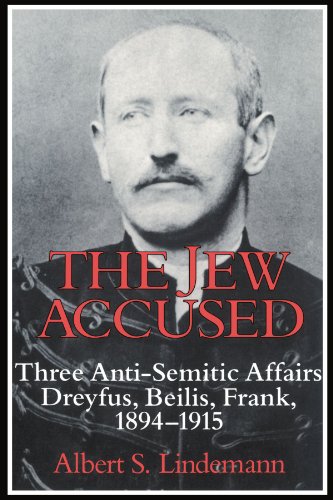
In 1991 Cambridge University Press published The Jew Accused by Albert Lindemann, a noted scholar of European ideological movements, and his book focused on exactly that era and those sorts of incidents. Although the text is quite short, running less than 300 pages, Lindemann built his discussion upon a huge foundation of secondary literature, with his footnotes drawn from the 200 works included in his extensive bibliography. As far as I could tell, he seems a very scrupulous scholar, generally providing the multiple, often conflicting accounts of a given incident, and coming to his own conclusions with considerable hesitation.
This approach is certainly demonstrated in the first of his major cases, the notorious Dreyfus affair of late 19th century France, probably one of history’s most famous anti-Semitic incidents. Although he concludes that Captain Alfred Dreyfus was very likely innocent of the charge of espionage, he notes the seemingly strong evidence that initially led to his arrest and conviction and finds—contrary to myth-making by numerous later writers—absolutely no indications that his Jewish origins played any role whatsoever in his predicament.
However, he does provide some of the underlying social context to this fierce political battle. Although only one Frenchman in a thousand was Jewish, just a few years earlier a group of Jews had been the leading culprits behind several huge financial scandals that had impoverished large numbers of small investors, and the swindlers afterward escaped any punishment by means of political influence and bribery. Given this history, much of the outrage of the anti-Dreyfusards probably arose from their fears that a Jewish military spy from a very wealthy family might be able to walk free using similar tactics, and the public claims that Dreyfus’s brother was offering enormous bribes to win his release certainly strengthened this concern.
Lindemann’s discussion of the 1913 Leo Frank Affair, in which a wealthy Northern Jew working in Atlanta was accused of sexually-assaulting and murdering a young girl, is even more interesting. Once again, he notes that contrary to the traditional narrative, there seems absolutely no hint that Frank’s Jewish background played any role in his arrest or conviction. Indeed, at his trial it was instead his very highly-paid defense attorneys who unsuccessfully sought to “play the race card” with the jurors by crudely attempting to deflect suspicion upon a local black worker by means of racially-charged invective.
Although Lindemann regards Frank as probably innocent, my own reading of the evidence he presents suggests the overwhelming likelihood of his guilt. Meanwhile, it seems undeniable that the outpouring of popular anger against Frank was produced by the vast ocean of outside Jewish money—at least $15 million or more in present-day money—that was committed to the legal efforts to save the life of someone widely regarded as a brutal murderer. There are strong suggestions that far more improper means were also employed, including bribery and influence-peddling, so that after Frank was convicted by a jury of his peers and thirteen separate legal appeals were denied, a governor with strong personal ties to the defense lawyers and Jewish interests chose to spare Frank’s life a few months before leaving office. Under these circumstances, the lynch-mob that hung Frank was viewed by the community as merely enforcing his official death sentence by extra-judicial means.
I also discovered that the leading figures in the anti-Frank movement had views far more nuanced than I had expected. For example, populist writer Tom Watson had previously been a strong defender of Jewish anarchist Emma Goldman, while ferociously denouncing the Rockefellers, Morgans, and Goulds as the “true destroyers” of Jeffersonian democracy, so his outrage that Frank might escape punishment for murder seemed motivated by the extreme wealth of Frank’s family and his supporters rather than any pre-existing anti-Semitic sentiments.
The unmistakable conclusion of Lindemann’s analysis is that if the defendants in both the Dreyfus and Frank cases had not been Jewish, they would have suffered identical arrests and convictions, but lacking any wealthy and politically mobilized Jewish community to rally around them, they would have received their punishments, just or unjust, and immediately been forgotten. Instead, Theodor Herzl, the founding father of Zionism, later claimed that the massive anti-Semitism revealed by the Dreyfus Affair was the basis of his personal ideological awakening, while the Frank Affair led to the establishment of America’s Anti-Defamation League. And both these cases have entered our history books as among the most notorious examples of pre-World War I anti-Semitism.
Lindemann’s discussion of the often difficult relations between Russia’s restive Jewish minority and its huge Slavic majority is also quite interesting, and he provides numerous instances in which major incidents, supposedly demonstrating the enormously strong appeal of vicious anti-Semitism, were quite different than has been suggested by the legend. The famous Kishinev Pogrom of 1903 was obviously the result of severe ethnic tension in that city, but contrary to the regular accusations of later writers, there seems absolutely no evidence of high-level government involvement, and the widespread claims of 700 dead that so horrified the entire world were grossly exaggerated, with only 45 killed in the urban rioting. Chaim Weizmann, the future president of Israel, later promoted the story that he himself and some other brave Jewish souls had personally defended their people with revolvers in hand even as they saw the mutilated bodies of 80 Jewish victims. This account was totally fictional since Weizmann happened to have been hundreds of miles away when the riots occurred.
Although a tendency to lie and exaggerate was hardly unique to the political partisans of Russian Jewry, the existence of a powerful international network of Jewish journalists and Jewish-influenced media outlets ensured that such concocted propaganda stories might receive enormous worldwide distribution, while the truth followed far behind, if at all.
For related reasons, international outrage was often focused on the legal confinement of most of Russia’s Jews to the “Pale of Settlement,” suggesting some sort of tight imprisonment; but that area was the traditional home of the Jewish population and encompassed a landmass almost as large as France and Spain combined. The growing impoverishment of Eastern European Jews during that era was often assumed to be a consequence of hostile government policy, but the obvious explanation was extraordinary Jewish fecundity, which far outstripped that of their Slavic fellow countrymen, and quickly led them to outgrow the available spots in any of their traditional “middleman” occupations, a situation worsened by their total disinclination to engage in agriculture or other primary-producer activities. Jewish communities expressed horror at the risk of losing their sons to the Czarist military draft, but this was simply the flip-side of the full Russian citizenship they had been granted, and no different from what was faced by their non-Jewish neighbors.
Certainly the Jews of Russia suffered greatly from widespread riots and mob attacks in the generation prior to World War I, and these did sometimes have substantial government encouragement, especially in the aftermath of the very heavy Jewish role in the 1905 Revolution. But we should keep in mind that a Jewish plotter had been implicated in the killing of Czar Alexander II, and Jewish assassins had also struck down several top Russian ministers and numerous other government officials. If the last decade or two had seen American Muslims assassinate a sitting U.S. President, various leading Cabinet members, and a host of our other elected and appointed officials, surely the position of Muslims in this country would have become a very uncomfortable one.
As Lindemann candidly describes the tension between Russia’s very rapidly growing Jewish population and its governing authorities, he cannot avoid mentioning the notorious Jewish reputation for bribery, corruption, and general dishonesty, with numerous figures of all political backgrounds noting that the remarkable Jewish propensity to commit perjury in the courtroom led to severe problems in the effective administration of justice. The eminent American sociologist E.A. Ross, writing in 1913, characterized the regular behavior of Eastern European Jews in very similar terms.
Lindemann also allocates a short chapter to discussing the 1911 Beilis Affair, in which a Ukrainian Jew was accused of the ritual murder of a young Gentile boy, an incident that generated a great deal of international attention and controversy. Based on the evidence presented, the defendant seems likely to have been innocent, although the obvious lies he repeatedly told police interrogators hardly helped foster that impression, and “the system worked” in that he was ultimately found innocent by the jurors at his trial. However, a few pages are also given to a much less well-known ritual murder case in late 19th century Hungary, in which the evidence of Jewish guilt seemed far stronger, though the author hardly accepted the possible reality of such an outlandish crime. This reticence was quite understandable since the publication of Ariel Toaff’s remarkable volume on the subject was still a dozen years in the future.
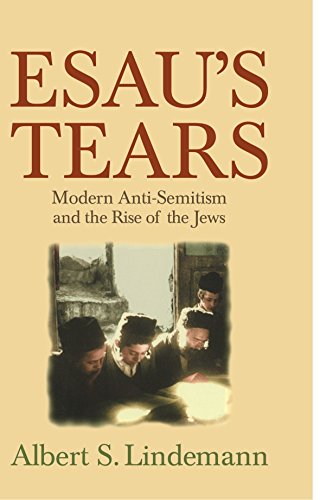
Lindemann subsequently expanded his examination of historical anti-Semitism into a much broader treatment, Esau’s Tears, which appeared in 1997. In this volume, he added comparative studies of the social landscape in Germany, Britain, Italy, and several other European countries, and demonstrated that the relationship between Jews and non-Jews varied greatly across different locations and time periods. But although I found his analysis quite useful and interesting, the extraordinarily harsh attacks his text provoked from some outraged Jewish academics seemed even more intriguing.
For example, Judith Laikin Elkin opened her discussion in The American Historical Review by describing the book as a “545-page polemic” a strange characterization of a work so remarkably even-handed and factually-based in its scholarship. Writing in Commentary, Robert Wistrich was even harsher, stating that merely reading the contents had been a painful experience for him, and his review seemed filled with spittle-flecked rage. Unless these individuals had somehow gotten copies of a different book, I found their attitudes simply astonishing.
I was not alone in such a reaction. Richard S. Levy of the University of Illinois, a noted scholar of anti-Semitism, expressed amazement at Wistrich’s seemingly irrational outburst, while Paul Gottfried, writing in Chronicles, mildly suggested that Lindemann had “touched raw nerves.” Indeed, Gottfried’s own evaluation quite reasonably criticized Lindemann for perhaps being a little too even-handed, sometimes presenting numerous conflicting analyses without choosing between them. For those interested, a good discussion of the book by Alan Steinweis, a younger scholar specializing in the same topic, is conveniently available online.
The remarkable ferocity with which some Jewish writers attacked Lindemann’s meticulous attempt to provide an accurate history of anti-Semitism may carry more significance than merely being an exchange of angry words in low-circulation academic publications. If our mainstream media shapes our reality, scholarly books and the articles they influence tend to set the contours of that media coverage. And the ability of a relatively small number of agitated and energetic Jews to police the acceptable boundaries of historical narratives may have enormous consequences for our larger society, deterring scholars from objectively reporting historical facts and preventing students from discovering them.
The undeniable truth is that for many centuries Jews usually constituted a wealthy and privileged segment of the population in nearly all the European countries in which they resided, and quite frequently they based their livelihood upon the heavy exploitation of a downtrodden peasantry. Even without any differences in ethnicity, language, or religion, such conditions almost invariably provoke hostility. The victory of Mao’s Communist forces in China was quickly followed by the brutal massacre of a million or more Han Chinese landlords by the Han Chinese poor peasants who regarded them as cruel oppressors, with William Hinton’s classic Fanshen describing the unfortunate history that unfolded in one particular village. When similar circumstances led to violent clashes in Eastern Europe between Slavs and Jews, does it really make logical sense to employ a specialized term such as “anti-Semitism” to describe that situation?
Furthermore, some of the material presented in Lindemann’s rather innocuous text might also lead to potentially threatening ideas. Consider, for example, the notorious Protocols of the Learned Elders of Zion, almost certainly fictional, but hugely popular and influential during the years following World War I and the Bolshevik Revolution. The fall of so many longstanding Gentile dynasties and their replacement by new regimes such as Soviet Russia and Weimar Germany, which were heavily dominated by their tiny Jewish minorities, quite naturally fed suspicions of a worldwide Jewish plot, as did the widely discussed role of Jewish international bankers in producing those political outcomes.
Over the decades, there has been much speculation about the possible inspiration for the Protocols, but although Lindemann makes absolutely no reference to that document, he does provide a very intriguing possible candidate. Jewish-born British Prime Minister Benjamin Disraeli certainly ranked as one of the most influential figures of the late 19th century, and in his novel Coningsby, he has the character representing Lord Lionel Rothschild boast about the existence of a vast and secret network of powerful international Jews, who stand near the head of almost every major nation, quietly controlling their governments from behind the scenes. If one of the world’s most politically well-connected Jews eagerly promoted such notions, was Henry Ford really so unreasonable in doing the same?
Lindemann also notes Disraeli’s focus on the extreme importance of race and racial origins, a central aspect of traditional Jewish religious doctrine. He reasonably suggests that this must surely have had a huge influence upon the rise of those political ideas, given that Disraeli’s public profile and stature were so much greater than the mere writers or activists whom our history books usually place at center stage. In fact, Houston Stewart Chamberlain, a leading racial theorist, actually cited Disraeli as a key source for his ideas. Jewish intellectuals such as Max Nordau and Cesare Lombroso are already widely recognized as leading figures in the rise of the racial science of that era, but Disraeli’s under-appreciated role may have actually been far greater. The deep Jewish roots of European racialist movements are hardly something that many present-day Jews would want widely known.
Lindemann was a highly regarded mainstream scholar when Cambridge University Press published his two important 1990s books on the historical reality of anti-Semitism. But today his works seem to be forgotten and almost totally unknown, with their pitifully low Amazon sales ranks suggesting that few if any copies have recently been sold.
Although Oliver had held stridently anti-Jewish views throughout the 1950s and 1960s, he had mostly kept these to himself while he was affiliated with National Review and the John Birch Society, and only began fully expressing them after he had been purged from any significant media platform.
By the time he published his memoirs and collected essays in 1981, I think he had mostly faded into obscurity, so I doubt that the book sold many copies. Furthermore, his compilation was hardly a comprehensive analysis of those controversial topics.
But a few years before Oliver acrimoniously broke with the Birch organization, another writer of roughly similar views using the name Wilmot Robertson began ten years of research on the same racial topics that Oliver regarded as so central. With his manuscript championed by Carleton Putnam, a leading racialist writer of the 1960s, Robertson finally published The Dispossessed Majority in 1972, and it had an enormous, seminal impact upon the racialist and far right segments of the American ideological landscape. Indeed, Oliver immediately praised it as “Politically the most important book published in this country since 1939—perhaps since 1917.”
Running some 200,000 words, Robertson’s opus soon became the ur-text of modern American White Nationalism, reestablishing the ideological basis for a movement once anchored in the writings of men such as Lothrop Stoddard but which had largely disappeared in the aftermath of World War II.
From its earliest days, America had been run by its Anglo-Saxon core along with the assimilated descendants of closely-related Northern European immigrant groups, who together constituted both the bulk of the population and a large majority of its ruling elites. But Robertson argued that during the previous generation or two, a quiet revolution had steadily shifted political and social control into the hands of America’s tiny Jewish minority, thereby transforming the country’s huge white Gentile population into “the dispossessed majority” of his title, even as the heavily Jewish media ensured that very few members of that group had recognized this ongoing transformation.
Putnam’s own books and other writings had been quite cagey on such touchy subjects, occasionally alluding to the elite “minority groups” that were his primary political opponents but almost never even mentioning the word “Jew.” However, his enthusiastic support for Robertson’s work suggests that he was actually in full agreement on those underlying issues, which came as a very pleasant surprise to his longtime allies in the Pioneer circle.
After encountering scattered references to the Robertson book here and there on the Internet, I finally purchased and read it about a decade ago, finding the work considerably better than I had expected. But having now learned of Putnam’s personal involvement in its origins, I decided to take another look, and also noticed the cover-blurbs from prominent scholars. Prof. Coon described it as “A work of vast scope and scholarship” while Prof. Oliver praised it as “Politically the most important book published in this country since 1939—perhaps since 1917.” Prompted by those strong endorsements, I decided to reread it, and see how it held up the second time round.
Throughout the 1950s and 1960s, the central fault line in American society had almost invariably been that separating black from white, with few scholars exploring any residual conflicts between different white ethnic groups. Large scale European immigration had been halted in 1924, and it was widely believed that decades of action by America’s powerful melting-pot had mostly eliminated the sharp differences between the various flavors of whites, a perception strongly encouraged by the media of that era. In fact, I suspect that one reason Beyond the Melting Pot by Nathan Glazer and Daniel Patrick Moynihan had attracted so much attention and became such a sociological classic in 1963 was that it focused on a subject otherwise so little-discussed and one that went against the prevailing ideas of the period.
By contrast, The Dispossessed Majority marked an ideological return to the early decades of the twentieth century, when intra-white conflict along ethnic lines had been the central issue. Indeed, Robertson reverted to the old-fashioned separation of Europeans into the Nordic, Alpine, and Mediterranean sub-races, a usage long since fallen into disrepute and popular disuse. Although blacks, Asians, and other non-white groups were given some attention, his primary focus was on differences between American whites.
In particular, the author sharply distinguished between “assimilable” and “non-assimilable” white minorities. By his reckoning, America’s so-called “Majority” population—the Old Stock Anglo-Saxons and other fully assimilated Northern European ethnic groups—constituted just under 60% of our total population. An additional 12% fell into the category of “assimilable white minorities,” including the Irish, Poles, and French Canadians. But another 8% of the population consisted of white ethnicities he considered sufficiently alien as to be classified as “non-assimilable,” including Jews, Southern Italians, and Greeks, which was quite an intellectually scandalous position to take in the early 1970s.
And although Jews only represented a small fraction of those latter groups, Robertson put them at the absolute center of his analysis. Throughout his long work, he used the term “minority” on a multitude of occasions, almost once per page, and I would guess that 90% of those references were to Jews, so much so that the word almost served as a euphemism. Considering another metric, he devoted a long section of his book to describing and discussing the country’s major ethnic groups, ranging from the Irish and the Slavs to the blacks and other non-whites. But the chapter on Jews occupied nearly half the entire space: two pages on Mexicans and other Hispanics, two pages on Asians, but fifty pages on Jews. Although it might seem strange to current readers, his heavily racialist text generally paid very little attention to America’s Hispanics or Asians since both those groups were then such a small fraction of the national population.
Just as Putnam and others claimed, the book contained an enormous quantity of careful research material which Robertson had spent ten years compiling, all presented in a polished, lucid style, with professional editing. But as might be expected, a work focused on such extremely controversial material encountered severe difficulties with sales and distribution. The author later explained that nearly all conservative publications had rejected his ads and bookstores refused to stock any copies, while almost all writers who were sent review copies ignored its existence. Yet even so, within two years some 16,000 copies had been sold or otherwise distributed, a very solid achievement given the obstacles, and total sales eventually exceeded 150,000 copies, quite remarkable under the circumstances.
A book first published in 1972 is now nearly a half-century old, and must be evaluated in that light, so its numerous references to the threat of Communism and the Soviet Union are obviously quite dated. But taken as a whole, I think the text holds up very well, probably remaining more relevant to the domestic problems of our own present-day American society than all but a sliver of the works published around the same time. Indeed, although I had found it quite interesting a decade ago, the events of the last few years—and especially the last few months—seem to have enormously increased its contemporary relevance. Robertson—whose real name was Humphrey Ireland—died in 2005 at the age of 90, but I think he would have found our current domestic problems an almost straight-line extrapolation of those that he had first laid out several decades ago…his masterwork is easily available online as a PDF, and also part of this website’s HTML Books section:
I found these works by Oliver, Lindemann, and Robertson quite interesting at the time I read them, and they revealed many hidden or severely distorted elements of modern Western history related to Jewish matters.
But vastly more shocking to me had been the contents of a very short book by an Israeli Jew named Israel Shahak that I’d come across nearly twenty years ago.
During the 1980s I’d occasionally seen Shahak’s name mentioned in the pages of the Economist and the New York Times, with his extremely controversial and contrarian views on the Middle East conflict sticking in my memory. Based upon those brief quotes and his outrageous denunciations of the very widely praised Oslo Peace Agreement, I’d gotten the impression that he was a radical extremist of some sort, probably an unreconstructed Stalinist Communist.
With the end of the Cold War, my interest in foreign policy waned, but after the 9/11 Attacks returned the Middle East to center stage, I read somewhere that Shahak had recently died, though I hadn’t noticed any obituary. I recalled hearing that he’d published some stridently anti-Jewish and anti-Zionist books a few years earlier, just as might be expected from that sort of political fanatic, and during the early 2000s I began seeing more and more references to these, ironically coming from fringe sources of the anti-Semitic far right. Eventually my curiosity got the better of me so I bought and read those works.
In a 2018 article, I described the astonishing contents of these very short books, especially the earliest of them.
My first surprise was that Shahak’s writings included introductions or glowing blurbs by some of America’s most prominent public intellectuals, including Christopher Hitchens, Gore Vidal, Noam Chomsky, and Edward Said. Praise also came from quite respectable publications such as The London Review of Books, Middle East International, and Catholic New Times while Allan Brownfeld of The American Council for Judaism had published a very long and laudatory obituary. And I discovered that Shahak’s background was very different than I had always imagined. He had spent many years as an award-winning Chemistry professor at Hebrew University, and was actually anything but a Communist. Whereas for decades, Israel’s ruling political parties had been Socialist or Marxist, his personal doubts about Socialism had left him politically in the wilderness, while his relationship with Israel’s tiny Communist Party was solely because they were the only group willing to stand up for the basic human rights issues that were his own central focus. My casual assumptions about his views and background had been entirely in error.
Once I actually began reading his books, and considering his claims, my shock increased fifty-fold. Throughout my entire life, there have been very, very few times I have ever been so totally astonished as I was after I digested Jewish History, Jewish Religion: The Weight of Three Thousand Years, whose text runs barely a hundred pages. In fact, despite his solid background in the academic sciences and the glowing endorsements provided by prominent figures, I found it quite difficult to accept the reality of what I was reading. As a consequence, I paid a considerable sum to a young graduate student I knew, tasking him to verify the claims in Shahak’s books, and as far as he could tell, all of the hundreds of references he checked seemed to be accurate or at least found in other sources…
Although Shahak’s books are quite short, they contain such a density of astonishing material, it would take many, many thousands of words to begin to summarize them. Almost everything I had known—or thought I had known—about the religion of Judaism, at least in its zealously Orthodox traditional form, was utterly wrong.
For example, traditionally religious Jews pay little attention to most of the Old Testament, and even very learned rabbis or students who have devoted many years to intensive study may remain largely ignorant of its contents. Instead, the center of their religious world view is the Talmud, an enormously large, complex, and somewhat contradictory mass of secondary writings and commentary built up over many centuries, which is why their religious doctrine is sometimes called “Talmudic Judaism.” Among large portions of the faithful, the Talmud is supplemented by the Kabala, another large collection of accumulated writings, mostly focused on mysticism and all sorts of magic. Since these commentaries and interpretations represent the core of the religion, much of what everyone takes for granted in the Bible is considered in a very different manner.
Given the nature of the Talmudic basis of traditional Judaism and my total previous ignorance of the subject, any attempt on my part to summarize some of the more surprising aspects of Shahak’s description may be partially garbled, and is certainly worthy of correction by someone better versed in that dogma. And since so many parts of the Talmud are highly contradictory and infused with complex mysticism, it would be impossible for someone like me to attempt to disentangle the seeming inconsistencies that I am merely repeating. I should note that although Shahak’s description of the beliefs and practices of Talmudic Judaism provoked a fire-storm of denunciations, few of those harsh critics seem to have denied his very specific claims, including the most astonishing ones, which would seem to strengthen his credibility.
On the most basic level, the religion of most traditional Jews is actually not at all monotheistic, but instead contains a wide variety of different male and female gods, having quite complex relations to each other, with these entities and their properties varying enormously among the numerous different Jewish sub-sects, depending upon which portions of the Talmud and the Kabala they place uppermost. For example, the traditional Jewish religious cry “The Lord Is One” has always been interpreted by most people to be an monotheistic affirmation, and indeed, many Jews take exactly this same view. But large numbers of other Jews believe this declaration instead refers to achievement of sexual union between the primary male and female divine entities. And most bizarrely, Jews having such radically different views see absolutely no difficulty in praying side by side, and merely interpreting their identical chants in very different fashion.
Furthermore, religious Jews apparently pray to Satan almost as readily as they pray to God, and depending upon the various rabbinical schools, the particular rituals and sacrifices they practice may be aimed at enlisting the support of the one or the other. Once again, so long as the rituals are properly followed, the Satan-worshippers and the God-worshippers get along perfectly well and consider each other equally pious Jews, merely of a slightly different tradition. One point that Shahak repeatedly emphasizes is that in traditional Judaism the nature of the ritual itself is absolutely uppermost, while the interpretation of the ritual is rather secondary. So perhaps a Jew who washes his hands three times clockwise might be horrified by another who follows a counter-clockwise direction, but whether the hand-washing were meant to honor God or to honor Satan would hardly be a matter of much consequence.
Strangely enough, many of the traditional rituals are explicitly intended to fool or trick God or His angels or sometimes Satan, much like the mortal heroes of some Greek legend might seek to trick Zeus or Aphrodite. For example, certain prayers must be uttered in Aramaic rather than Hebrew on the grounds that holy angels apparently don’t understand the former language, and their confusion allows those verses to slip by unimpeded and take effect without divine interference.
Furthermore, since the Talmud represents a massive accretion of published commentary built up over more than a millennium, even the most explicit mandates have sometimes been transformed into their opposites. As an example, Maimonides, one of the highest rabbinical authorities, absolutely prohibited rabbis from being paid for their religious teaching, declaring that any rabbi who received a salary was an evil robber condemned to everlasting torment; yet later rabbis eventually “reinterpreted” this statement to mean something entirely different, and today almost all rabbis collect salaries.
Another fascinating aspect is that up until very recent times, the lives of religious Jews were often dominated by all sorts of highly superstitious practices, including magical charms, potions, spells, incantations, hexes, curses, and sacred talismans, with rabbis often having an important secondary role as sorcerers, and this even remains entirely true today among the enormously influential rabbis of Israel and the New York City area. Shahak’s writings had not endeared him to many of these individuals, and for years they constantly attacked him with all sorts of spells and fearful curses aimed at achieving his death or illness. Many of these traditional Jewish practices seem not entirely dissimilar to those we typically associate with African witch-doctors or Voodoo priests, and indeed, the famous legend of the Golem of Prague described the successful use of rabbinical magic to animate a giant creature built of clay.
If these ritualistic issues constituted the central features of traditional religious Judaism, we might regard it as a rather colorful and eccentric survival of ancient times. But unfortunately, there is also a far darker side, primarily involving the relationship between Jews and non-Jews, with the highly derogatory term goyim frequently used to describe the latter. To put it bluntly, Jews have divine souls and goyim do not, being merely beasts in the shape of men. Indeed, the primary reason for the existence of non-Jews is to serve as the slaves of Jews, with some very high-ranking rabbis occasionally stating this well-known fact. In 2010, Israel’s top Sephardic rabbi used his weekly sermon to declare that the only reason for the existence of non-Jews is to serve Jews and do work for them. The enslavement or extermination of all non-Jews seems an ultimate implied goal of the religion.
Jewish lives have infinite value, and non-Jewish ones none at all, which has obvious policy implications. For example, in a published article a prominent Israeli rabbi explained that if a Jew needed a liver, it would be perfectly fine and indeed obligatory to kill an innocent Gentile and take his. Perhaps we should not be too surprised that today Israel is widely regarded as one of the world centers of organ-trafficking.
As a further illustration of the seething hatred traditional Judaism radiates towards all those of a different background, saving the life of a non-Jew is generally considered improper or even prohibited, and taking any such action on the Sabbath would be an absolute violation of religious edict. Such dogmas are certainly ironic given the widespread presence of Jews in the medical profession during recent centuries, but they came to the fore in Israel when a religiously-minded military doctor took them to heart and his position was supported by the country’s highest religious authorities.
And while religious Judaism has a decidedly negative view towards all non-Jews, Christianity in particular is regarded as a total abomination, which must be wiped from the face of the earth.
Whereas pious Muslims consider Jesus as the holy prophet of God and Muhammed’s immediate predecessor, according to the Jewish Talmud, Jesus is perhaps the vilest being who ever lived, condemned to spend eternity in the bottommost pit of Hell, immersed in a boiling vat of excrement. Religious Jews regard the Muslim Quran as just another book, though a totally mistaken one, but the Christian Bible represents purest evil, and if circumstances permit, burning Bibles is a very praiseworthy act. Pious Jews are also enjoined to always spit three times at any cross or church they encounter, and direct a curse at all Christian cemeteries. Indeed, many deeply religious Jews utter a prayer each and every day for the immediate extermination of all Christians.
Over the years prominent Israeli rabbis have sometimes publicly debated whether Jewish power has now become sufficiently great that all the Christian churches of Jerusalem, Bethlehem, and other nearby areas can finally be destroyed, and the entire Holy Land completely cleansed of all traces of its Christian contamination. Some have taken this position, but most have urged prudence, arguing that Jews needed to gain some additional strength before they should take such a risky step. These days, many tens of millions of zealous Christians and especially Christian Zionists are enthusiastic advocates for Jews, Judaism, and Israel, and I strongly suspect that at least some of that enthusiasm is based upon ignorance.
For the last two thousand years, Jews have almost invariably existed as small, relatively weak minorities living in the lands of others, whether Christian or Muslim, so a religious doctrine so unswervingly hostile to outsiders has naturally presented considerable obstacles for peaceful co-existence. The solution to this dilemma has been based on the divine mandate to preserve Jewish life and well-being above all else, superseding almost all other religious considerations. Thus, if any of the behaviors discussed above are considered likely to stir up resentment from powerful Gentile groups and put Jews at risk, they must be avoided.
For example, the prohibition against Jewish physicians treating the illnesses of non-Jews is waived in the case of powerful non-Jews, especially national leaders, whose favor might provide benefits to the Jewish community. And even ordinary non-Jews may be aided unless some persuasive excuse can be found to explain such lack of assistance since otherwise the vengeful hostility of their friends and relatives might cause difficulties for other Jews. Similarly, it is permissible to exchange gifts with non-Jews but only if such behavior can be justified in strictly utilitarian terms, with any simple expression of friendship towards a non-Jew being a violation of holy principles.
If the Gentile population became aware of these Jewish religious beliefs and the behaviors they promote, major problems for Jews might develop, so an elaborate methodology of subterfuge, concealment, and dissimulation has come into being over the many centuries to minimize this possibility, especially including the mistranslation of sacred texts or the complete exclusion of crucial sections. Meanwhile, the traditional penalty for any Jew who “informs” to the authorities on any matter regarding the Jewish community has always been death, often preceded by hideous torture.
Much of this dishonesty obviously continues down to recent times since it seems very unlikely that Jewish rabbis, except perhaps for those of the most avant garde disposition, would remain totally unaware of the fundamental tenets of the religion that they claim to lead, and Shahak is scathing toward their apparent self-serving hypocrisy, especially those who publicly express strongly liberal views. For example, according to mainstream Talmudic doctrine, black Africans are traditionally placed somewhere between people and monkeys in their intrinsic nature, and surely all rabbis, even liberal ones, would be aware of this religious dogma. But Shahak notes that the numerous American rabbis who so eagerly worked with Martin Luther King, Jr. and other black Civil Rights leaders during the 1950s and 1960s strictly concealed their religious beliefs while denouncing American society for its cruel racism, presumably seeking to achieve a political quid pro quo beneficial to Jewish interests with America’s substantial black population.
Shahak also emphasizes the utterly totalitarian nature of traditional Jewish society, in which rabbis held the power of life and death over their congregants, and often sought to punish ideological deviation or heresy using those means. They were outraged that this became difficult as states grew stronger and increasingly prohibited such private executions. Liberalizing rabbis were sometimes murdered and Baruch Spinoza, the famous Jewish philosopher of the Age of Reason, only survived because the Dutch authorities refused to allow his fellow Jews to kill him.
Given the complexity and exceptionally controversial nature of this subject matter, I would urge readers who find this topic of interest to spend three or four hours reading Shahak’s very short book, and then decide for themselves whether his claims seem plausible and whether I may have inadvertently misunderstood them. Aside from the copies on Amazon, the work may also be found at Archive.org and a very convenient HTML copy is also freely available on the Internet.
My encounter a decade ago with Shahak’s candid description of the true doctrines of traditional Judaism was certainly one of the most world-altering revelations of my entire life. But as I gradually digested the full implications, all sorts of puzzles and disconnected facts suddenly became much more clear. There were also some remarkable ironies, and not long afterward I joked to a (Jewish) friend of mine that I’d suddenly discovered that Nazism could best be described as “Judaism for Wimps” or perhaps Judaism as practiced by Mother Teresa of Calcutta.
There may actually be a deeper historical truth behind that irony. I think I’ve read here and there that some scholars believe that Hitler may have modeled certain aspects of his racially-focused National Socialist doctrine upon the Jewish example, which really makes perfect sense. After all, he saw that despite their small numbers Jews had gained enormous power in the Soviet Union, Weimar Germany, and numerous other countries throughout Europe, partly due to their extremely strong ethnic cohesion, and he probably reasoned that his own Germanic people, being far greater in numbers and historical achievements could do even better if they adopted similar practices.
It’s also interesting to note that quite a number of the leading racialist pioneers of 19th century Europe came from a particular ethnic background. For example, my history books had always disapprovingly mentioned Germany’s Max Nordau and Italy’s Cesare Lombroso as two of the founding figures of European racism and eugenics theories, but it was only very recently that I discovered that Nordau had also been the joint founder with Theodor Herzl of the world Zionist movement, while his major racialist treatise Degeneration, was dedicated to Lombroso, his Jewish mentor.
Even as late as the 1930s and afterward, international Zionist groups closely cooperated with the Third Reich on their economic projects, and during the world war itself one of the smaller rightwing factions, led by future Israeli Prime Minister Yizhak Shamir, actually offered a military alliance to the Axis Powers, denouncing the decadent Western democracies and hoping to collaborate against their mutual British enemies. The Transfer Agreement by Edwin Black, 51 Documents by Lenni Brenner, and other writings have documented all these facts in detail, though for obvious reasons they have generally been ignored or mischaracterized by most of our media outlets.
Obviously the Talmud is hardly regular reading among ordinary Jews these days, and I would suspect that except for the strongly Orthodox and perhaps most rabbis, barely a sliver are aware of its highly controversial teachings. But it is important to keep in mind that until just a few generations ago, almost all European Jews were deeply Orthodox, and even today I would guess that the overwhelming majority of Jewish adults had Orthodox grand-parents. Highly distinctive cultural patterns and social attitudes can easily seep into a considerably wider population, especially one that remains ignorant of the origin of those sentiments, a condition enhancing their unrecognized influence. A religion based upon the principle of “Love Thy Neighbor” may or may not be workable in practice, but a religion based upon “Hate Thy Neighbor” might have long-term cultural ripple effects that extend far beyond the direct community of the deeply pious. If nearly all Jews for a thousand or two thousand years were taught to feel a seething hatred toward all non-Jews and also developed an enormous infrastructure of cultural dishonesty to mask that attitude, it is difficult to believe that such an unfortunate history has had absolutely no consequences for our present-day world, or that of the relatively recent past…
Jews spent two thousand years living as a diaspora people, and their tightly-bound trans-national colonies provided them with a uniquely effective international trading network. Since their religious traditions regarded slavery as the natural and appropriate lot of all non-Jews, both ideological and practical factors combined to apparently make them some of the leading slave-traders of Medieval Europe, though this is hardly emphasized in our histories. Closer to home, in 1991 the Black Nationalists of The Nation of Islam published The Secret Relationship Between Blacks and Jews, Volume One, which seemed to persuasively document the enormous role Jews had played in the American slave-trade. In 1994, Harold Brackman published a short attempted rebuttal entitled Ministry of Lies under the auspices of the Simon Wiesenthal Center, but I found his denials much less compelling. I very much doubt that most Americans are aware of these historical facts.
In 1997, Shahak published Open Secrets on Israel’s nuclear weapons program and then in 1999 Jewish Fundamentalism in Israel on the ideology of the radical Jewish fringe and its settler movement. That latter work was co-authored by Norton Mezvinsky, a prominent American academic specializing in Middle Eastern history, whose brother and sister-in-law both served in Congress and whose nephew later married Chelsea Clinton.
Although Levin would surely be very surprised and disturbed if he read the books by Gentile authors Oliver, Lindemann, or Robertson, I think he would be stunned and utterly flabbergasted by the short works of Shahak, a highly regarded Jewish Israeli academic.
But as I went on to say in the same 2018 article, about a dozen years later the exhaustive historical research of another noted Israeli scholar came to far more horrifying conclusions.
I do not doubt that much of the candid analysis provided above will be quite distressing to many individuals. Indeed, some may believe that such material far exceeds the boundaries of mere “anti-Semitism” and easily crosses the threshold into constituting an actual “blood libel” against the Jewish people. That extremely harsh accusation, widely used by stalwart defenders of Israeli behavior, refers to the notorious Christian superstition, prevalent throughout most of the Middle Ages and even into more modern times, that Jews sometimes kidnapped small Christian children in order to drain their blood for use in various magic rituals, especially in connection with the Purim religious holiday. One of my more shocking discoveries of the last dozen years is that there is a fairly strong likelihood that these seemingly impossible beliefs were actually true.
I personally have no professional expertise whatsoever in Jewish ritual traditions, nor the practices of Medieval Jewry. But one of the world’s foremost scholars in that field is Ariel Toaff, professor of Jewish Renaissance and Medieval Studies at Bar-Ilan University near Tel Aviv, and himself the son of the Chief Rabbi of Rome.
In 2007, he published the Italian edition of his academic study Blood Passovers, based on many years of diligent research, assisted by his graduate students and guided by the suggestions of his various academic colleagues, with the initial print run of 1,000 copies selling out on the first day. Given Toaff’s international eminence and such enormous interest, further international distribution, including an English edition by a prestigious American academic press would normally have followed. But the ADL and various other Jewish-activist groups regarded such a possibility with extreme disfavor, and although these activists lacked any scholarly credentials, they apparently applied sufficient pressure to cancel all additional publication. Although Prof. Toaff initially attempted to stand his ground in stubborn fashion, he soon took the same course as Galileo, and his apologies naturally became the basis of the always-unreliable Wikipedia entry on the topic.
Eventually, an English translation of his text turned up on the Internet in a PDF format and was also placed for sale on Amazon.com, where I purchased a copy and eventually read it. Given those difficult circumstances, this work of 500 pages is hardly in ideal form, with most of the hundreds of footnotes disconnected from the text, but it still provides a reasonable means of evaluating Toaff’s controversial thesis, at least from a layman’s perspective. He certainly seems an extremely erudite scholar, drawing heavily upon the secondary literature in English, French, German, and Italian, as well as the original documentary sources in Latin, Medieval Latin, Hebrew, and Yiddish. Indeed, despite the shocking nature of the subject matter, this scholarly work is actually rather dry and somewhat dull, with very long digressions regarding the particular intrigues of various obscure Medieval Jews. My own total lack of expertise in these areas must be emphasized, but overall I thought Toaff made a quite persuasive case.
It appears that a considerable number of Ashkenazi Jews traditionally regarded Christian blood as having powerful magical properties and considered it a very valuable component of certain important ritual observances at particular religious holidays. Obviously, obtaining such blood in large amounts was fraught with risk, which greatly enhanced its monetary value, and the trade in the vials of that precious commodity seems to have been widely practiced. Toaff emphasizes that since the detailed descriptions of the Jewish ritualistic murder practices are very similarly described in locations widely separated by geography, language, culture, and time period, they are almost certainly independent observations of the same rite. He also notes that when accused Jews were caught and questioned, they often correctly described obscure religious rituals which could not possibly have been known to their Gentile interrogators, who often garbled minor details. Thus, these confessions were very unlikely to have been concocted by the authorities.
Furthermore, as extensively discussed by Shahak, the world-view of traditional Judaism did involve a very widespread emphasis on magical rituals, spells, charms, and similar things, providing a context in which ritualistic murder and human sacrifice would hardly be totally unexpected.
Obviously, the ritual murder of Christian children for their blood was viewed with enormous disfavor by the local Gentile population, and the widespread belief in its existence remained a source of bitter tension between the two communities, flaring up occasionally when a Christian child mysteriously disappeared at a particular time of year, or when a body was found that exhibited suspicious types of wounds or showed a strange loss of blood. Every now and then, a particular case would reach public prominence, often leading to a political test of strength between Jewish and anti-Jewish groups. During the mid-19th century, there was one such famous case in French-dominated Syria, and just before the outbreak of the First World War, Russia was wracked by a similar political conflict in the 1911 Beilis Affair in the Ukraine.
I first encountered these very surprising ideas almost a dozen years ago in a long article by Israel Shamir that was referenced in Counterpunch, and this would definitely be worth reading as an overall summary, together with a couple of his follow-up columns, while writer Andrew Hamilton offers the most recent 2012 overview of the controversy. Shamir also helpfully provides a free copy of the book in PDF form, an updated version with the footnotes properly noted in the text. Anyway, I lack the expertise to effectively judge the likelihood of the Toaff Hypothesis, so I would invite those interested to read Toaff’s book or better yet the related articles and decide for themselves.
I also drew some larger conclusions from the remarkable aspects of Judaism that I had discussed.
Most of these disheartening facts that have so completely upended my understanding of reality over the last decade could not possibly have come to my attention until the rise of the Internet, which partially broke centralized control over the distribution of information. But many other people must surely have known large portions of this important story long before that, and recognized the very serious consequences these matters might have for the future of our society. Why has there been so little public discussion?
I believe one factor is that over the years and the decades, our dominant media organs of news and entertainment have successfully conditioned most Americans to suffer a sort of mental allergic reaction to topics sensitive to Jews, which leads to all sorts of issues being considered absolutely out of bounds. And with America’s very powerful Jewish elites thereby insulated from almost all public scrutiny, Jewish arrogance and misbehavior remain largely unchecked and can increase completely without limit.
I’ve also sometimes suggested to people that one under-emphasized aspect of a Jewish population, greatly magnifying its problematical character, is the existence of what might be considered a biological sub-morph of exceptionally fanatical individuals, always on hair-trigger alert to launch verbal and sometimes physical attacks of unprecedented fury against anyone they regard as insufficiently friendly towards Jewish interests. Every now and then, a particularly brave or foolhardy public figure challenges some off-limits topic and is almost always overwhelmed and destroyed by a veritable swarm of these fanatical Jewish attackers. Just as the painful stings of the self-sacrificing warrior caste of an ant colony can quickly teach large predators to go elsewhere, fears of provoking these “Jewish berserkers” can often severely intimidate writers or politicians, causing them to choose their words very carefully or even completely avoid discussing certain controversial subjects, thereby greatly benefiting Jewish interests as a whole. And the more such influential people are thus intimidated into avoiding a particular topic, the more that topic is perceived as strictly taboo, and avoided by everyone else as well.
For example, about a dozen years ago I was having lunch with an especially eminent Neoconservative scholar with whom I’d become a little friendly. We were bemoaning the overwhelmingly leftward skew among America’s intellectual elites, and I suggested it largely seemed a function of our most elite universities. Many of our brightest students from across the nation entered Harvard and the other Ivies holding a variety of different ideological perspectives, but after four years departed those halls of learning overwhelmingly in left-liberal lock-step. Although he agreed with my assessment, he felt I was missing something important. He nervously glanced to both sides, shifted his head downward, and lowered his voice. “It’s the Jews,” he said.
After discussing Lindemann’s two books and their fascinating historical findings on the true history of anti-Semitism, I went on to analyze the issue in broader terms:
These important examples may help to explain the puzzling contrast between the behavior of Jews in the aggregate and Jews as individuals. Observers have noticed that even fairly small Jewish minorities may often have a major impact upon the far larger societies that host them. But on the other hand, in my experience at least, a large majority of individual Jews do not seem all that different in their personalities or behavior than their non-Jewish counterparts. So how does a community whose individual mean is not so unusual generate what seems to be such a striking difference in collective behavior? I think the answer may involve the existence of information choke-points, and the role of relatively small numbers of particularly zealous and agitated Jews in influencing and controlling these.
We live our lives constantly immersed in media narratives, and these allow us to decide the rights and wrongs of a situation. The vast majority of people, Jew and Gentile alike, are far more likely to take strong action if they are convinced that their cause is a just one. This is obviously the basis for war-time propaganda.
Now suppose that a relatively small number of zealous Jewish partisans are known to always attack and denounce journalists or authors who accurately describe Jewish misbehavior. Over time, this ongoing campaign of intimidation may cause many important facts to be left on the cutting-room floor, or even gradually expel from mainstream respectability those writers who refuse to conform to such pressures. Meanwhile, similar small numbers of Jewish partisans frequently exaggerate the misdeeds committed against Jews, sometimes piling their exaggerations upon past exaggerations already produced by a previous round of such zealots.
Eventually, these two combined trends may take a complex and possibly very mixed historical record and transform it into a simple morality-play, with innocent Jews tremendously injured by vicious Jew-haters. And as this morality-play becomes established it deepens the subsequent intensity of other Jewish-activists, who redouble their demands that the media “stop vilifying Jews” and covering up the supposed evils inflicted upon them. An unfortunate cycle of distortion following exaggeration following distortion can eventually produce a widely accepted historical account that bears little resemblance to the reality of what actually happened.
So as a result, the vast majority of quite ordinary Jews, who would normally behave in quite ordinary ways, are misled by this largely fictional history, and rather understandably become greatly outraged at all the horrible things that had been done to their suffering people, some of which are true and some of which are not, while remaining completely ignorant of the other side of the ledger.
Furthermore, this situation is exacerbated by the common tendency of Jews to “cluster” together, perhaps representing just one or two percent of the total population, but often constituting 20% or 40% or 60% of their immediate peer-group, especially in certain professions. Under such conditions, the ideas or emotional agitation of some Jews probably permeates others around them, often provoking additional waves of indignation.
As a rough analogy, a small quantity of uranium is relatively inert and harmless, and entirely so if distributed within low-density ore. But if a significant quantity of weapons-grade uranium is sufficiently compressed, then the neutrons released by fissioning atoms will quickly cause additional atoms to undergo fission, with the ultimate result of that critical chain-reaction being a nuclear explosion. In similar fashion, even a highly agitated Jew may have no negative impact, but if the collection of such agitated Jews becomes too numerous and clusters together too closely, they may work each other into a terrible frenzy, perhaps with disastrous consequences both for themselves and for their larger society. This is especially true if those agitated Jews begin to dominate certain key nodes of top-level control, such as the central political or media organs of a society.
Whereas most living organisms exist solely in physical reality, human beings also occupy an ideational space, with the interaction of human consciousness and perceived reality playing a major role in shaping behavior. Just as the pheromones released by mammals or insects can drastically affect the reactions of their family members or nest-mates, the ideas secreted by individuals or the media-emitters of a society can have an enormous impact upon their fellows.
A cohesive, organized group generally possesses huge advantages over a teeming mass of atomized individuals, much like a disciplined Macedonian Phalanx could easily defeat a vastly larger body of disorganized infantry. Many years ago, on some website somewhere I came across a very insightful comment regarding the obvious connection between “anti-Semitism” and “racism,” which our mainstream media organs identify as two of the world’s greatest evils. Under this analysis, “anti-Semitism” represents the tendency to criticize or resist Jewish social cohesion, while “racism” represents the attempt of white Gentiles to maintain a similar social cohesion of their own. To the extent that the ideological emanations from our centralized media organs serve to strengthen and protect Jewish cohesion while attacking and dissolving any similar cohesion on the part of their Gentile counterparts, the former will obviously gain enormous advantages in resource-competition against the latter.
Religion obviously constitutes an important unifying factor in human social groups and we cannot ignore the role of Judaism in this regard. Traditional Jewish religious doctrine seems to consider Jews as being in a state of permanent hostility with all non-Jews, and the use of dishonest propaganda is an almost inevitable aspect of such conflict. Furthermore, since Jews have invariably been a small political minority, maintaining such controversial tenets required the employment of a massive framework of subterfuge and dissimulation in order to conceal their nature from the larger society surrounding them. It has often been said that truth is the first casualty in war, and surely the cultural influences of over a thousand years of such intense religious hostility may continue to quietly influence the thinking of many modern Jews, even those who have largely abandoned their religious beliefs.
Nearly all the authors whose unknown books were discussed above ranked as highly regarded academic scholars, and in most cases, their works were the result of years of exhaustive research and therefore should be taken very seriously.
Although Mark Levin came from a Jewish family and certainly considers himself Jewish, he apparently has had little deep personal involvement in the Jewish religion, let alone traditional Orthodox Judaism. So like a large majority of other American Jews, he is probably primarily Jewish in cultural, traditional or ethnic terms rather than in any strongly religious sense.
I suspect that the same might also be true of the bulk of the 1,500 committed members of the Republican Jewish Coalition who recently attended the Annual Leadership Summit of their organization in Las Vegas, and enthusiastically applauded Levin’s fiery speech.
Therefore, few of these individuals probably have the slightest awareness of the true tenets of the religion that has shaped their own people and culture for the last thousand or two thousand years.
Knowledge is sometimes power, and if Levin and his multitude of fellow Jewish activists were brought face to face with the scholarly books by Lindemann, Shahak, Toaff, and others, I think that many would react with total disbelief and automatic rejection. But others might be so overcome with shock, they would suffer something almost approaching psychological catatonia, destroying their political effectiveness. And perhaps a few would be so disturbed at discovering the lifetime of lies and major omissions they had absorbed that they would break ranks and drastically shift their political orientation.
Much of the reason that Jewish power so dominates our society is the extreme ideological cohesion maintained by that community, resulting in a powerful political phalanx able to readily crush or intimidate many of its opponents.
But the striking material contained in these unknown books might dissolve many of the beliefs and certainties that produce that cohesion, thereby breaking that Jewish phalanx and enormously reducing its power in our society.