
Posted by: John Phoenix
The Tighter the Cage, the Smarter the Lock-Pickers

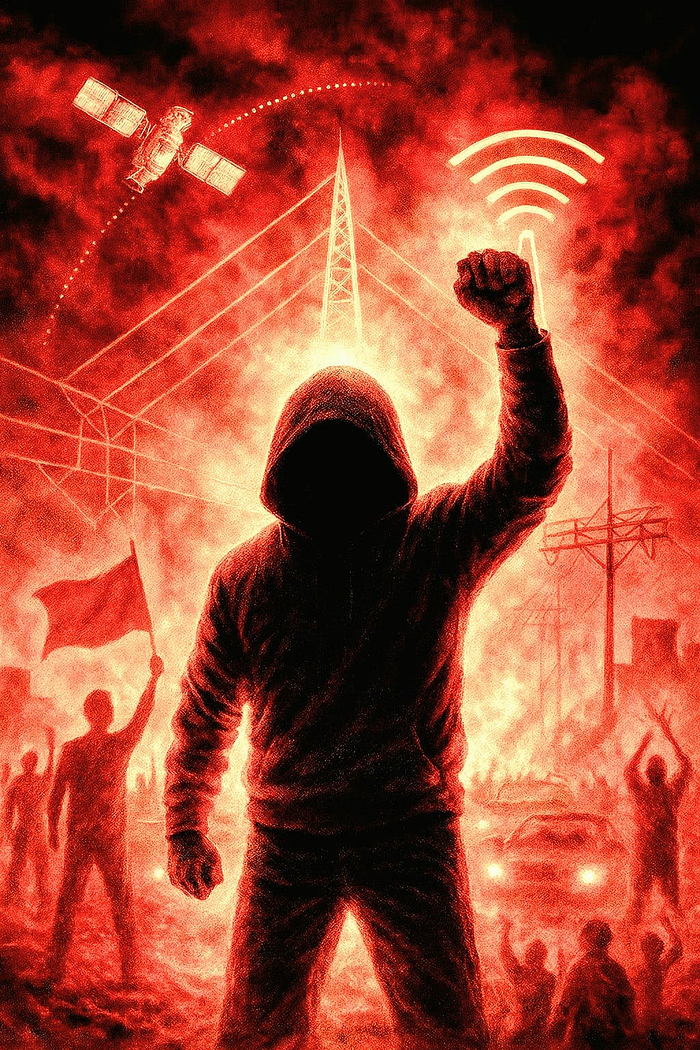
Author’s Note:
The Zionist project is entering a terminal, supremacist phase — explicit dispossession, religious militancy, and the abandonment of any pretense of incrementalism. This essay argues that the same collapse will destabilize the Arab regimes that staked their survival on Israel’s permanence, while the decentralized survival infrastructures forged under repression are already consolidating into the scaffolding of a post-authoritarian pan-Arab politics.
Introduction: The Irony of Stability
For decades the West and its clients, including Arab countries, have subscribed to the myth that Israel is the Middle East’s “stabilizer.” It supplies intelligence, coordinates arms, and exports counter-insurgency doctrine; in return it receives diplomatic cover and billions in aid.
Israel’s surveillance architectures pioneered in Palestine — predictive policing, border walls, digital dragnets — have been exported to Arab security states with U.S. funding and corporate complicity.
A 2018 Trump-era policy stripped human-rights conditions from arms sales; Palantir, Meta, and a swarm of AI startups now supply the algorithms that keep such regimes afloat. Israel is not just an ally; it is the laboratory and blueprint for a regional order built on fear where Palestinian resistance is branded the perennial disruptor — containable, criminal, and therefore irrelevant to “serious” politics.
This framing has governed the calculus of Arab autocrats. Israel does not merely protect them from external enemies; it helps criminalize internal dissent. As long as the Zionist project appears invincible, domestic unrest looks like a manageable risk. The Abraham Accords, the U.S. debate over upgrading Israel to “full strategic partner” by 2048, and the swift re-imposition of authoritarian control after the Arab Spring all rest on the same premise: Israel is forever.
Arab governments that embrace normalization do so not because Israel stabilizes the region, but because it stabilized them, shielding brittle regimes from the consequences of their own illegitimacy. Once that illusion falters — as Israel’s own descent into open fascism and genocidal warfare in Gaza renders its claim to moral or strategic coherence untenable — the architecture of containment begins to erode.
The same governments that relied on Israel’s technological superiority and Western protection to manage their populations — the same regimes Pappé describes as lacking “self-respect and dignity” — now face a crisis of legitimacy for which they have no ideological substitute.
Ilan Pappé’s diagnosis is blunt: the settler-colonial project has entered a terminal phase — open supremacism, genocidal warfare in Gaza, mass expulsion. If this trajectory ends in collapse or radical transformation, the fallout will ripple through every capital that normalized with Tel Aviv.
Meanwhile, the people Israel claims to contain have refused to vanish. From Gaza’s rooftop mesh networks to Lebanon’s motorcade supply chains, resistance has mutated into encrypted, interdependent infrastructures of survival. These are not relics of the Arab Spring; they are post-authoritarian prototypes — decentralized, resilient, and already interoperable across borders.
When the myth of Israel as eternal stabilizer finally cracks, the regimes that imported its logic will face a legitimacy crisis for which they have no substitute. In that vacuum, the federated infrastructures of popular power — mutual-aid committees, workplace coalitions, diasporic lifelines — stand ready to consolidate. A pan-Arab political formation will not resurrect Nasserist slogans or Baathist hierarchies; it will inherit the trust, memory, and logistics forged in repression and code them into a new, borderless politics.
Stability, it turns out, is never about peace. It is about keeping Arab populations powerless. The irony is complete when the people’s capacity to adapt under siege becomes the only force left standing once the laboratory of repression burns down.
I. The Collapse of the Stabilizer Myth
The myth begins to crack in Gaza, October 2023. What Western capitals still call “mowing the lawn” has become openly genocidal: 2.3 million people locked in a cage, starved, bombed, and displaced in a campaign whose architects no longer bother with legal euphemisms. Israeli ministers speak of “human animals” and “erasing” entire neighborhoods; the Knesset debates formal annexation of the West Bank. The mask of “self-defense” is gone. What remains is supremacist clarity.
This is the terminal logic of settler-colonialism. Ilan Pappé dates the shift to the 2008–09 Cast Lead operation, but the inflection point is now unmistakable. The Zionist project has abandoned the slow violence of checkpoints and settlement creep for rapid, televised dispossession. The goal is no longer containment — it is expulsion.
Arab regimes watch in silence. The same governments that signed the Abraham Accords in 2020 now discover that normalization buys no immunity. Israel’s far-right coalition demands loyalty tests: public condemnation of Hamas, intelligence-sharing on domestic Islamists, joint drills against “Iranian proxies.” Refusal risks losing the security blanket that kept their own populations in check.
The blanket is already fraying. Egypt’s Sisi, who coordinated the Gaza siege with Israel for a decade, now faces weekly border breaches by desperate Palestinians and a military that leaks footage of IDF bulldozers on Egyptian soil. Jordan’s monarchy, architect of the 1994 peace treaty, sees mass protests in Amman that dwarf the 2011 uprising. The Hashemite regime’s legitimacy — tied to custodianship of Al-Aqsa — collapses the moment Israeli police storm the mosque with stun grenades.
Further afield, the dominoes fall faster. The UAE’s MBZ, who bet on Israel as a counter-revolutionary anchor, discovers that Tel Aviv’s collapse is contagious. When Netanyahu’s government falls to a coalition of messianic settlers and military refuseniks, the intelligence pipeline that tracked Emirati dissidents dries up overnight. Saudi Arabia’s MBS, who dangled recognition in exchange for U.S. security guarantees, now faces a Palestinian veto in his own majlis: the clergy that blessed Vision 2030 will not bless a deal that leaves Gaza in ruins.
The U.S. response is panic disguised as vision. The Trump administration has unfrozen over $5 billion in foreign aid — including $78 million for Gaza humanitarian relief and $56 million for the Red Cross — but only after weeks of delay and mounting civilian casualties. Simultaneously, it unveiled a sweeping 20-point Gaza peace plan hailed as “bold” yet criticized for its ambiguity and lack of enforceability. Behind the scenes, contingency planning continues: leaked cables warn of a regional cascade — Israel splintering into armed enclaves, Hezbollah advancing toward the Golan, and the West Bank devolving into a free-fire zone.
The stabilizer has become the detonator. Trump’s plan may promise prosperity, but its rollout has exposed the limits of unilateral diplomacy and the fragility of a regional order built on military aid and mythic permanence.
Beneath the state-level chaos, a quieter revolution is already underway. The infrastructures of survival that sustained Gaza through 17 years of blockade — tunnel economies, rooftop solar grids, encrypted mesh networks — have gone regional. In Sudan, the same Telegram channels that coordinated aid drops in Khartoum now relay drone footage from Rafah. In Lebanon, the neighborhood committees that fed Beirut after the port blast have merged with Gaza’s popular kitchens, sharing recipes for high-calorie flatbread and logistics for smuggling insulin.
These are not NGOs — they function as proto-state infrastructures: decentralized in structure, encrypted in communication, and horizontally integrated across sectors and geographies. They do not ask permission from regimes; they inherit the social trust that governments forfeited. When Egypt cuts internet to Gaza, Sudanese coders route traffic through Khartoum’s dark-fiber backbone. When Jordan bans protests, Lebanese drivers ferry Amman activists across the Allenby Bridge in encrypted convoys.
The old order called this “fragmentation.” The new order recognizes it as federation in real time. The question is no longer whether these networks can survive — they already have. The question is whether they can scale into governance before the regimes collapse under their own contradictions.
That is the irony: the stabilizer’s suicide creates the vacuum that popular power is already filling. The laboratory of repression has produced its own antidote.
II. Repression Recalibrated: The Authoritarian Blueprint for “Stability”
The collapse of the stabilizer myth did not expose Arab regimes — it activated them. As Israel’s deterrent power fractured and U.S. guarantees grew erratic, authoritarian states across the region moved swiftly to reinforce their own foundations. The Gaza war of October 2023 revealed the limits of external protection. What followed was not hesitation, but acceleration: a doubling down on the very tools that had been refined in the decade since the Arab Spring.
Because the Arab Spring did not fail. It forced the autocrats to adapt. In 2011, the streets belonged to the people. By 2013, the people were in prison — or in the ground. What emerged was recalibrated repression: smarter, faster, and digitally native. The West called it a return to “stability.” What these countries actually got was a surveillance-heavy system shaped by Israeli doctrine and legitimized by counterterrorism discourse.
The upgrade had three moves.
First, institutions were weaponized. Security agencies — Egypt’s SCAF, Jordan’s Mukhabarat, Tunisia’s Interior Ministry — were rearmed, re-legitimized, and granted emergency powers in perpetuity.
Second, dissent was digitized into a crime. Cybercrime laws swept the region: Egypt’s 2013 Protest Law, Jordan’s 2023 gag act, Tunisia’s Decree-Law 54. Pegasus spyware, sold by NSO with a wink from Washington, turned every phone into a state informant.
Third, narratives were captured: activists became “terrorists,” protests became “foreign plots,” and silence became “stability.”
The goal was no longer to react — it was to preempt.
This logic did not emerge overnight. It was forged in two waves:
First after 9/11, when Arab regimes aligned with the U.S.-led “War on Terror” to criminalize dissent as extremism; and then after the 2011 Arab Spring, when mass uprisings exposed the limits of brute force and forced a deeper recalibration.
The first wave globalized repression. The second digitized it.
What follows is a forensic mapping of how Arab regimes adapted — each with its own blueprint, but all drawing from a shared doctrine of control. This inventory reveals the architecture of authoritarian resilience and the fault lines along which it may eventually collapse.
The Blueprint in Action
In Egypt, the lesson was Rabaa
On 14 August 2013, Egyptian police and army units — under the command of then–Defense Minister Abdel Fattah el-Sisi — launched a coordinated assault on tens of thousands of protesters gathered in Rabaa al-Adawiya Square.
They used armored vehicles, bulldozers, tear gas, live ammunition, and rooftop snipers to disperse the sit-in.
By the end of the day, over 1,000 people lay dead, according to Human Rights Watch.
The victims included members of the Muslim Brotherhood, unaffiliated protesters, medics, journalists, and bystanders.
The massacre was not a breakdown — it was a blueprint.
The Interior Ministry oversaw the operation. The army provided cover.
State media framed the dead as terrorists.
No official was held accountable.
Instead, the regime repackaged the massacre as a counterterrorism success, using footage from Rabaa to train police and military units across the country — and to market Egypt’s “security expertise” abroad.
But Rabaa wasn’t just Egypt’s lesson — it was a regional franchise.
Egyptian security doctrine drew heavily from Israeli urban warfare models: crowd control, sniper deployment, and media spin.
Israeli firms had long exported surveillance tools and tactical training to Egyptian intelligence services, especially after the 2006 and 2008 Gaza wars.
Joint operations in Sinai deepened the exchange.
The Gaza playbook — target, isolate, erase — was adapted for Cairo.
The U.S. funded Egypt’s military to the tune of $1.3 billion annually, even after the massacre.
It condemned the violence, then resumed arms shipments.
The message: massacre once, rule forever — and call it counterterrorism.
— –
In the UAE, the model was techno-liberalism
Skyscrapers for expats, Palantir for citizens. Aesthetic openness masked algorithmic enclosure. Social media glittered on the surface; AI dragnets operated below. Facial recognition scanned malls. Predictive policing shaped ministry protocols. The state tracked dissidents from Dubai to London using Western cloud infrastructure — Amazon, Microsoft, Google.
It didn’t deploy tanks — it deployed code.
But the code wasn’t homegrown. The UAE imported surveillance systems from Israeli firms like NSO Group, Cellebrite, and AnyVision, integrating them into its domestic security apparatus. NSO’s Pegasus spyware infiltrated phones. Cellebrite extracted data from seized devices. AnyVision powered facial recognition across public and private spaces.
The UAE didn’t just buy tools — it tested them, refined them, and exported the model as part of its diplomatic portfolio. Surveillance became a form of alliance-building. Counterterrorism became a subscription model.
The Gaza playbook — target, isolate, erase — was rewritten for luxury autocracy.
No checkpoints, just biometric gates.
No occupation, just data sovereignty.
The UAE didn’t need to occupy its population — it could index, monitor, and preempt. And Israel’s message echoed through the architecture:
You don’t need to control a people’s streets if you already control their metadata.
— –
In Morocco, the king performed cosmetic surgery:
A new constitution in 2011. Symbolic Berber rights. A few extra seats in parliament. All vetted by the palace.
The monarchy absorbed the protest, digested it, and grew stronger. No tanks in the streets — just reforms with royal watermark. The opposition wasn’t crushed — it was curated.
Civil society became a palace accessory. Elections were held, but the winner was always the crown. The model wasn’t Rabaa or Gaza — it was soft containment. Aesthetic pluralism masking dynastic permanence. The king didn’t need to kill his opponents — he offered them a seat at the table, on his terms.
But surveillance arrived anyway. Moroccan intelligence deployed Pegasus to infiltrate phones. The General Directorate for National Security (DST) oversaw the targeting. Journalists, activists, even members of the royal family — indexed, tracked, archived.
Cellebrite tools extracted data from seized devices. Israeli firms supplied the spyware. The palace embedded it in governance. The message: you don’t need to shoot the dissident if you can shadow them forever.
— –
In Jordan, the bargain was calculated:
Let the bread riots flare. Jail the teachers’ union. Pass a cybercrime law. Repeat. Protest became seasonal steam — loud, visible, but never a movement.
The regime didn’t fear dissent — it timed it. Let the anger rise, then drain it through targeted arrests and royal decrees. The palace mastered the art of managed turbulence. No Rabaa-style massacre. No UAE-style algorithm. Just ritual containment: a calibrated release of pressure that kept the system intact. Each uprising was archived, not answered. Each demand was acknowledged, then shelved.
And behind the scenes, the surveillance crept in. Between 2019 and 2023, Jordanian intelligence agencies used Israeli-made Pegasus spyware to infiltrate the phones of at least 35 journalists, lawyers, and activists. The General Intelligence Directorate (GID) oversaw the targeting. The Ministry of Interior enforced cybercrime laws that criminalized dissent under the guise of “online harm.”
The 2023 amendments expanded the law’s reach — banning vague offenses like “spreading false information” and “undermining national unity” — and gave prosecutors sweeping powers to surveil and silence. The Jordanian Teachers’ Syndicate was dissolved. Its leaders were detained, surveilled, and banned from organizing. Journalists faced prosecution for tweets.
Activists were tracked across borders.
The repression wasn’t spectacular — it was procedural. Israel exported the tools. Jordan embedded them in law. The message: you may speak, but the state will listen — and decide when you’ve said enough.
— –
In Bahrain, the response was sectarianized
On 14 March 2011, Saudi Arabia deployed over 1,000 troops and the UAE sent 500 police officers under the banner of the Gulf Cooperation Council (GCC) to crush Bahrain’s pro-democracy uprising.
The Bahraini monarchy — led by King Hamad bin Isa Al Khalifa — framed the protests not as demands for rights, but as an Iranian-backed Shiʿa insurrection. Security forces bulldozed mosques, ghettoized Shiʿa neighborhoods, and arrested thousands.
The Bahrain Defence Force, Ministry of Interior, and National Security Agency coordinated mass detentions, torture, and disappearances.
State media, backed by Emirati outlets like Al Arabiya, recast dissent as treason. The monarchy didn’t just crush the uprising — it reframed it as heresy, turning sectarianism into state armor.
Surveillance followed the tanks. Between 2017 and 2021, Bahraini authorities used Pegasus spyware, developed by Israel’s NSO Group, to infiltrate the phones of journalists, lawyers, and Shiʿa activists.
Investigations by Citizen Lab and Amnesty International confirmed infections on devices belonging to Ali Abdulemam, Ebtisam al-Saegh, and other critics of the regime.
The Ministry of Interior oversaw digital repression, criminalizing hashtags, banning mourning gatherings, and prosecuting clerics under anti-terror laws. The Gaza model — divide, isolate, suppress — was repackaged for the Gulf.
No need for mass graves when mass suspicion suffices.
No need for Rabaa when mourning itself becomes a crime.
The repression was regional, but the protection was global.
The United States Fifth Fleet, headquartered in Bahrain, remained untouched. Washington condemned abuses, then resumed arms sales.
Israel exported the spyware. Saudi Arabia supplied the tanks. The UAE spun the narrative. The U.S. shielded the regime.
The Bahraini state didn’t just repress — it rewrote the identity of dissent.
And Israel’s message echoed through the system: If you can’t silence the protest, redefine it as heresy.
— –
In Iraq, the state fragmented its violence
During the 2019 Tishreen uprising, Iraqi security forces shot protesters point-blank. Snipers fired from rooftops. Militias — some aligned with Iran, others embedded in the state — abducted, tortured, and disappeared activists.
But the violence didn’t come from a vacuum. The U.S. had spent years funding, training, and equipping Iraq’s security forces — the same forces that opened fire in Tahrir Square. It built the counterterrorism infrastructure, armed the Emergency Response Division, and turned Baghdad into a fortress of checkpoints and biometric scans.
It called this “stabilization.”
When the killings began, the U.S. condemned the violence — but kept the aid flowing. It didn’t pull the trigger, but it built the armories, trained the shooters, and shielded the state from consequences.
Meanwhile, Israeli spyware tracked survivors. Pegasus infiltrated phones. Cellebrite extracted contacts. The Gaza model — target, isolate, erase — echoed in Baghdad, but through a fractured mirror. The message: you don’t need to own the violence if you’ve already built the system that enables it.
— –
In Tunisia, the miracle was buried
Tunisia, the Arab Spring’s lone survivor, buried its own miracle. In 2021, President Kais Saied invoked Article 80 of the constitution to suspend parliament, dismiss the prime minister, and assume executive control.
He ruled by decree. He jailed judges, dissolved the Supreme Judicial Council, and restructured the electoral commission. He passed Decree-Law 54 in 2022 — framing online dissent as cybercrime. The law criminalized “spreading false information” and “undermining public order,” with penalties reaching five years in prison.
Journalists, lawyers, and activists were arrested for Facebook posts. The Ministry of Interior monitored speech. The judiciary lost independence.
The democratic exception became authoritarian déjà vu.
Surveillance deepened the crackdown. Tunisian authorities acquired spyware from European and Israeli-linked firms, embedding digital repression into legal infrastructure.
Reports surfaced of Pegasus infections targeting civil society figures.
The state didn’t need mass violence — it had legal instruments and imported code. The revolution that began with Mohamed Bouazizi’s self-immolation ended with metadata and arrest warrants. The message: you may vote, but only for silence — and we will read what you write before you press send.
— –
Saudi Arabia: Petro-repression as governance
Saudi Arabia answered the Arab Spring with petro-repression. In 2011, King Abdullah allocated $100 billion in social spending — housing grants, salary hikes, and religious subsidies — to preempt protest. No reforms. No accountability. Just cash for quiet. The message: consume, obey, survive.
In 2017, Crown Prince Mohammed bin Salman (MbS) staged the Ritz-Carlton purge. He detained over 300 princes, ministers, and businessmen — including Alwaleed bin Talal and Miteb bin Abdullah — under the banner of anti-corruption. They were held without trial, coerced into settlements, and released only after signing loyalty pledges. The purge consolidated power, eliminated rivals, and rebranded repression as reform.
MbS didn’t dismantle the old guard — he absorbed it. Women gained the right to drive in 2018 — but lost the right to speak. Activists like Loujain al-Hathloul, Aziza al-Yousef, and Eman al-Nafjan were arrested, tortured, and banned from travel. The Presidency of State Security, created by royal decree, oversaw their detention. The regime criminalized feminism, dissent, and satire under vague charges of “destabilizing national security.”
Surveillance became systemic. Saudi authorities deployed Pegasus spyware, sourced from Israel’s NSO Group, to infiltrate phones of dissidents, journalists, and even foreign officials. The General Intelligence Presidency coordinated transnational repression — tracking exiles in Canada, Germany, and the UK.
In 2018, Saudi agents murdered Jamal Khashoggi inside the Istanbul consulate. The operation involved 15 operatives, including members of MbS’s inner circle. The CIA concluded that the Crown Prince ordered the killing. The kingdom denied it — and resumed business.
The repression was vertical, spectacular, and franchised. Israel exported the spyware. The UAE provided the PR model. The U.S. sold the weapons and shielded the regime. MbS rebranded autocracy as “Vision 2030” — a techno-futurist mirage built on silenced voices and indexed bodies.
The message: you may modernize, but only under surveillance — and only if you obey.
— –
Lebanon: Collapse as repression
Lebanon had no repression to offer — only collapse. In October 2019, hundreds of thousands filled the streets from Beirut to Tripoli, demanding an end to corruption, sectarian patronage, and economic decay. They chanted “All of them means all of them” — targeting the entire political class:
Saad Hariri, Michel Aoun, Nabih Berri, Walid Jumblatt, Samir Geagea, Hassan Nasrallah. The protests toppled cabinets, but not the system. Each resignation was a reshuffle. Each promise of reform dissolved into IMF negotiations and donor conferences.
Then came the collapse. The Lebanese pound lost over 90% of its value.
Banks froze deposits. Electricity blackouts became daily routine. The Central Bank, under Riad Salameh, siphoned billions through financial engineering and elite extraction. The Beirut port exploded in August 2020 — killing over 200, injuring thousands, and displacing hundreds of thousands. The nitrate had sat there for years. No one was held accountable. The judiciary stalled. The parliament obstructed.
The state didn’t repress — it abandoned.
But abandonment is a form of violence. The Ministry of Interior failed to protect protesters from party militias. Security forces fired tear gas and rubber bullets. Activists were detained, interrogated, and surveilled. Surveillance tools — some sourced from European and Israeli-linked firms — tracked organizers and journalists.
The repression wasn’t centralized — it was ambient. Hyperinflation did the rest. Protest survived in soup kitchens and WhatsApp groups. The message: you may speak, but no one will answer — and no one will feed you either.
And behind this ambient collapse stood the architecture of foreign endorsement. The United States, long invested in Lebanon’s sectarian balance as a bulwark against regional realignment, treated collapse as containment. It backed the Lebanese Armed Forces while ignoring their complicity in protest suppression. It praised “stability” while funding surveillance infrastructure and shielding financial elites.
Israel, meanwhile, played its role not through direct intervention, but through the logic of deterrence and fragmentation. Its periodic bombardments and border incursions reinforced Lebanon’s militarized paralysis, justifying Hezbollah’s armed posture and entrenching sectarian fear. The specter of Israeli aggression became a tool for domestic control — a justification for repression masquerading as resistance.
Together, the U.S. and Israel helped preserve a system that could neither govern nor reform. They stabilized collapse. They endorsed abandonment. And in doing so, they transformed Lebanon’s implosion into a model: not of failed governance, but of managed decay.
— –
In Syria, the state as seige
By 2012, Bashar al-Assad’s regime had transformed entire cities into siege zones. It dropped barrel bombs on neighborhoods in Aleppo, Homs, and Damascus suburbs. It used chemical weapons in Ghouta (2013), Khan Shaykhun (2017), and Douma (2018) — killing civilians with sarin and chlorine gas.
The Syrian Arab Army, backed by Iranian militias, Hezbollah, and Russian airpower, turned hospitals into targets and bakeries into traps. The Ministry of Interior and Military Intelligence ran detention centers where tens of thousands were tortured, disappeared, or executed. The Caesar files exposed industrial-scale killing — bodies catalogued, numbered, and discarded.
This wasn’t just repression — it was governance through annihilation. The regime didn’t lose control of territory — it recalibrated sovereignty as siege. Assad ruled what he could bomb, starve, or empty. And when the state couldn’t surveil, it destroyed.
The ecology of repression became total: chemical, carceral, sectarian, and aerial. The message: you don’t need to win hearts and minds if you can erase the bodies that hold them.
And while Assad’s siege was local, its endurance was international.
The United States, though vocally opposed to Assad, channeled billions into counterterrorism operations and military coalitions that often bypassed civilian protection. It funded rebel factions selectively, then abandoned them to fragmentation. It prioritized airstrikes over accountability, and sanctions over sanctuary — leaving civilians trapped between regime bombardment and geopolitical chess.
Israel, meanwhile, conducted hundreds of airstrikes across Syrian territory, targeting Iranian and Hezbollah positions but also reinforcing Assad’s narrative of external threat. These strikes, while tactically distinct, blurred the lines between deterrence and complicity, allowing the regime to frame its repression as defense.
Together, the U.S. and Israel helped shape a battlefield where siege became strategy — not just for Assad, but for every actor seeking leverage through destruction.
The result: a state that governed through ruin, and a region that normalized it. That is, Syria’s siege tactics became familiar rather than shocking — absorbed into regional politics, echoed by other regimes, and tolerated by foreign powers. The violence was no longer exceptional; it became part of how power was maintained.
— –
Libya: The state as vacancy
In Libya, the state didn’t collapse — it fractured into arsenals. After NATO’s 2011 intervention and the fall of Muammar Gaddafi, no single actor restored sovereignty. Instead, Tripoli, Misrata, Benghazi, and Sirte became fiefdoms ruled by militias, warlords, and foreign patrons.
The Government of National Accord (GNA) in Tripoli and Khalifa Haftar’s Libyan National Army (LNA) in the east both claimed legitimacy — and both committed war crimes. Haftar’s forces shelled civilian neighborhoods and used foreign mercenaries from Russia’s Wagner Group. The GNA relied on militias that ran detention centers for migrants, extorted civilians, and trafficked weapons.
The Ministry of Interior in Tripoli outsourced security to armed groups with no accountability. The state didn’t govern — it brokered violence.
Repression wasn’t centralized — it was decentralized, monetized, and normalized. Drone strikes, assassinations, and disappearances became routine.
The United States, while publicly supporting UN-led peace efforts, armed and trained select factions under the banner of counterterrorism, often bypassing accountability for war crimes. It funded drone operations and intelligence networks that were later absorbed into militia infrastructures. Its military footprint outlasted its diplomatic one, leaving behind tools of surveillance without tools of justice.
Israel, though not a direct belligerent, supplied cyber tools and surveillance infrastructure through regional intermediaries, enabling militia-led repression masked as security coordination. Its quiet presence in Libya’s digital battlefield helped factions consolidate control through data extraction and targeted disappearances.
Together, the U.S. and Israel helped transform Libya’s vacancy into a managed void — a space where repression was privatized, outsourced, and digitized.
The result: a state hollowed out, where foreign-backed factions ruled through fragmentation, and repression. The message: you don’t need a regime to repress — you just need enough guns, enough data, and no consequences.
— –
Kuwait: The exception that represses quietly
In Kuwait, the regime didn’t crush dissent — it disqualified it.
No Rabaa. No tanks. No Pegasus headlines. Just courtrooms, citizenship revocations, and selective statelessness. The ruling Al Sabah family preserved its legitimacy through a semi-elected parliament — then used that parliament to police the boundaries of dissent.
Opposition figures were jailed for tweets. Bidoon activists — stateless residents denied citizenship — were surveilled, silenced, and in some cases, driven to suicide. The Ministry of Interior monitored protests, revoked passports, and blocked websites. Cybercrime laws criminalized “insulting the Emir” and “misusing a phone.”
The State Security Agency detained poets, clerics, and students under vague charges of “destabilizing national unity.” The repression wasn’t spectacular — it was bureaucratic. The state didn’t massacre — it managed dissent through paperwork, prosecution, and erasure.
Surveillance crept in quietly. Kuwaiti authorities purchased spyware from Israeli-linked firms and European vendors, embedding digital repression into the legal system. In 2021, reports surfaced of NSO Group’s Pegasus being used to target Kuwaiti journalists and opposition figures. The state didn’t need to dominate the streets — it monitored the inbox.
And this quiet repression was buffered by foreign alignment. The United States, long allied with Kuwait through military and economic ties, rarely challenged its domestic repression. It praised Kuwait’s “moderation” while overlooking statelessness, censorship, and surveillance. Its counterterrorism partnerships reinforced Kuwait’s security apparatus, embedding U.S.-trained units into a system that policed dissent.
Israel, though officially unrecognized, entered Kuwait’s repression circuit through spyware and cyber tools, sold via intermediaries. These tools didn’t just track opposition — they helped bureaucratize erasure, turning digital surveillance into legal prosecution.
And Palestine, though absent from Kuwait’s official discourse, haunted its repression silently. Pro-Palestinian speech was monitored, censored, and criminalized, especially when it intersected with criticism of normalization or Gulf-Israeli ties.
Together, the U.S., Israel, and Palestine’s spectral presence shaped Kuwait’s quiet authoritarianism — where repression was legal, digital, and diplomatically shielded.
The message: you may vote, but only within the lines we draw — and we are watching. And so are our allies.
— –
Occupied West Bank: Subcontracted repression
The Arab Spring reached Ramallah in fragments — calls for reform, anti-corruption protests, and youth mobilization. The Palestinian Authority, led by Mahmoud Abbas, responded with arrests, torture, and surveillance. Security coordination with Israel’s Shin Bet intensified.
Activists were detained for Facebook posts. Journalists were interrogated. The U.S. and EU funded PA security forces, calling it “stability.” Israel supplied the intelligence. The PA enforced the silence.
The message: you may protest, but only if you protest politely — and never against the one who signs your paycheck.
Dissent is permitted only when it flatters the architecture of occupation — that is, when it reinforces the illusion of autonomy without threatening the system that controls it. Protest is tolerated if it targets corruption or calls for reform, but not if it exposes the scaffolding of Israeli coordination, U.S. funding, or PA complicity. This is “stability” masquarading as “peace”.
The PA, Israel and the US all agree on the same thing: Both the West Bank and Gaza must remain contained. In the name of stability, they preserve the silence.
— –
Sudan: Counterrevolution by faction
Sudan’s Arab Spring came late. Between 2018 and 2019, mass protests toppled Omar al-Bashir. But the military never left.
The Transitional Military Council took power, then handed it to the Rapid Support Forces under Mohamed Hamdan Dagalo — Hemedti.
In June 2019, RSF troops massacred protesters at the Khartoum sit-in. They beat, raped, and shot civilians. They dumped bodies in the Nile. The junta rebranded itself as transitional. The repression continued.
The UAE and Saudi Arabia backed the generals with money and political cover. Israel normalized ties with the junta — securing intelligence cooperation and regional leverage. The United States lifted sanctions, praised “progress,” and called the generals partners in stability. Pegasus spyware tracked activists. Surveillance replaced reform.
The message was clear: you may demand democracy, but we will answer with bullets — and then sign trade deals. This was not a failed transition. It was a successful counterrevolution. The RSF did not hijack the revolution. It inherited it — with foreign blessing.
Israel wanted a stable Sudanese partner to contain Iran and secure Red Sea access. The U.S. wanted a post-Bashir regime that could manage migration, counterterrorism, and regional alliances. Neither cared who ruled — so long as the repression was orderly and the deals were signed.
The result: a junta in civilian clothing, a massacre rebranded as transition, and a democracy replaced by trade.
— –
Yemen: Repression through Fragmentation
In 2011, Yemenis filled the streets demanding the end of Ali Abdullah Saleh’s rule. They called for accountability, representation, and an end to elite impunity. Saleh stepped down.
The system fractured. In 2014, the Houthis seized Sana’a. They jailed critics, indoctrinated youth, and consolidated control through fear and surveillance.
In response, the Saudi-led coalition — backed by the UAE and the United States — bombed weddings, schools, and hospitals. The UAE ran secret prisons in the south. Detainees were tortured, disappeared, and denied legal recourse. Israel exported surveillance tools to coalition partners. The U.S. sold the bombs.
The repression was not ideological. It was infrastructural. Each actor claimed to fight terrorism. Each actor targeted civilians.
The United States called the war a security imperative. It armed the coalition, shielded it diplomatically, and blocked accountability at the UN.
Israel treated the war as a regional opportunity — selling spyware and intelligence systems to Gulf partners while deepening its quiet footprint in the Arabian Peninsula.
The UAE and Saudi Arabia used the war to redraw Yemen’s political map — funding rival militias, fragmenting governance, and turning local factions into proxies. The Houthis responded with their own repression — mirroring the tactics of the coalition while claiming resistance.
This was not a civil war. It was a coordinated dismemberment. The U.S. called it stability. Israel called it deterrence. The Gulf called it leadership. Yemenis called it famine, displacement, and silence.
The message was clear: you may rise up, but we will answer with fragmentation, famine, and spyware— to divide your revolution, privatize it, and bury it under rubble.
In Yemen, repression did not come from one regime. It came from every direction — funded, exported, and normalized in the name of “stability” and “peace”.
— –
Algeria: Repression by fatigue
In 2011, Algeria preempted protest. The regime increased subsidies, banned demonstrations, and arrested organizers before momentum could build.
It jailed bloggers, criminalized dissent, and expanded surveillance. The goal was not to crush resistance — it was to exhaust it. In 2019, the Hirak movement reignited dissent. Millions demanded the removal of Abdelaziz Bouteflika and an end to military rule. The regime responded with delay and deflection. Bouteflika resigned. The generals stayed.
The Department of Intelligence and Security (DRS) tracked organizers. Courts prosecuted activists under vague charges. Pegasus spyware infiltrated phones. Israel exported the tools. The United States praised Algeria’s “peaceful transition” and resumed security cooperation.
The repression was not spectacular. It was procedural.
Washington treated military continuity as stability. It ignored the arrests, the surveillance, and the criminalization of protest.
Israel entered quietly — selling spyware through intermediaries and embedding digital repression into Algeria’s security infrastructure. The Hirak called for civilian rule. The U.S. and Israel backed the generals.
This was not a transition. It was a standoff. The regime waited. The West applauded. The movement persisted — then thinned.
The message was clear: you may chant, but we will outlast you — and archive your slogans for future trials. Not because you threaten the state — but because you threaten the arrangement that keeps it stable.
In Algeria, repression does not arrive with tanks. It arrives with court summons, spyware, and fatigue. The goal is not to silence you today. It is to wear you down until silence feels like survival.
— –
The Echo of silenced voices
The immediate repercussion is narrower civic space and an emboldened security apparatus; the long-term repercussion is deeper delegitimization of the state in the eyes of many citizens, which pushes resistance to adapt:
It disperses into new social networks, migrates onto encrypted platforms, hides in professional strikes and cultural forms, and intermittently erupts when economic or political shocks make the cost of silence intolerable.
These adaptations matter because they create the conditions in which Palestinian solidarity, cross-border activism, and new forms of dissent can persist despite the region’s newly reconfigured authoritarianisms.
III. The Adaptive Capacity of Popular Power
The post-2011 authoritarian blueprint for “stability” produced its own counterforce. As Arab regimes expanded their surveillance arsenals and criminalized dissent, Arab populations recalibrated their resistance. The crackdown did not extinguish protest — it reconfigured it. With central squares militarized and mass mobilization penalized, popular power migrated from spectacle to infrastructure, from visibility to resilience.
This shift is not merely tactical — it marks a structural transformation in political agency. Resistance now operates through distributed, hybrid forms: encrypted networks, workplace stoppages, neighborhood committees, mutual-aid cells, and diasporic platforms. These decentralized infrastructures preserve the capacity for collective action under conditions of fragmentation, surveillance, and repression.
Gaza offers a paradigmatic case.
Following the October 2023 destruction of over half its telecommunications infrastructure, Gazans adapted rapidly. Activists and civilians turned to alternative connectivity tools to bypass Israeli surveillance and blackout conditions. Groups like Connecting Humanity and 7amleh distributed eSIMs, enabling access to roaming networks. Volunteers constructed “network trees” — battery-powered hotspot nodes mounted on rooftops and poles — to share WiFi locally in Rafah, Jabalia, and Deir al-Balah.
Resistance tactics shifted from mass demonstrations, easily monitored and targeted, to secure micro-cells coordinating mutual aid: medical relief, supply distribution, and surveillance mapping. These adaptations sustained resistance under siege and offered a blueprint for post-stabilizer organizing — where infrastructure becomes insurgent.
In southern Lebanon, resistance mutated under cross-border bombardment and layered surveillance. Following Israeli strikes in border areas, local networks mobilized through logistics, motorcades, and symbolic acts of presence. In August 2025, supporters of Hezbollah and the Amal Movement staged protest convoys in Beirut’s southern suburbs, Tyre, and Nabatieh. These weren’t mere marches — they were ritualized assertions of identity: flags, loudspeakers, road blockades, and neighborhood chants.
Simultaneously, decentralized cells coordinated shelters, evacuations, and frontline relief — often through encrypted group chats rather than formal organizations. As one Hezbollah MP described it, the south was enduring “war in various forms” — military, economic, and infrastructural.
In Sudan, decentralization was deliberate. The neighborhood resistance committees that sustained the 2019 uprising organized in autonomous cells, blending encrypted messaging with face-to-face coordination. These committees evolved into quasi-institutional actors, managing logistics, medical aid, and information flow during internet blackouts and violent crackdowns. They redistributed political agency from national parties to local nodes — reconstituting power as social infrastructure.
In Syria, resistance survives in exile and fragmentation. Opposition-held areas in the northwest rely on local councils, women-led initiatives, and civil defense networks to maintain basic services and political memory under siege. Abroad, Syrian activists have built transnational campaigns for documentation, accountability, and refugee rights — often in coordination with Palestinian and Lebanese networks. Though displaced, Syrian resistance embeds itself in humanitarian infrastructure and legal advocacy, preserving the possibility of future reconstitution.
In Yemen, civic endurance persists across collapsed borders.
Despite war and fragmentation, mutual-aid networks, women’s cooperatives, and youth initiatives operate in both Houthi- and coalition-controlled zones. These actors navigate blockades, surveillance, and famine by embedding dissent in cultural preservation, informal education, and humanitarian work. In the diaspora, Yemeni activists mobilize digital campaigns, legal advocacy, and remittance-based solidarity — sustaining resistance beyond the battlefield.
Across these contexts, one pattern holds: when regimes sever visible channels of mobilization, they do not erase grievances — they incentivize decentralization. What emerges is not the absence of politics, but its reassembly in quieter, more durable forms.
IV. Toward a Revolutionary Infrastructure: The Logical Trajectory of People Power
The fragmentation and repression of 2025 have rendered the traditional centralized party obsolete. But they have also created the conditions for a new kind of revolutionary formation: decentralized, federated, and built on the infrastructures of survival. This is not speculative — it is already underway.
If the Zionist project is entering a terminal phase — marked by supremacism, dispossession, and strategic incoherence — then the regional order built around its presumed permanence is destabilizing.
Arab regimes that relied on Israel as a stabilizer now face a legitimacy crisis they cannot ideologically resolve.
But this collapse coincides with the reconstitution of popular power: encrypted networks, workplace strikes, mutual-aid cells, cultural rituals, and diasporic lifelines. These are not tactical adaptations — they are political foundations.
In this context, the emergence of a pan-Arab revolutionary party is not a utopian leap — it is the logical next step.
It would not replicate the brittle hierarchies of past movements, nor seek validation through authoritarian electoral systems. Instead, it would federate existing infrastructures into a coherent bloc: decentralized in form, unified in purpose. Its architecture would draw from social networks, encrypted logistics, and transnational solidarity — not formal institutions.
Imagine a coordinating platform that links Sudan’s resistance committees, Gaza’s mutual-aid networks, and the Yemeni diaspora’s remittance systems — not under a single flag, but through shared protocols for resource pooling, strategic communication, and cross-border mobilization.
This is not a party in the conventional sense — it is a political subject forged in the crucible of repression, adaptive and infrastructural.
The greatest irony is that the tools designed for regime survival — surveillance systems, digital control, and economic containment — have inadvertently built the infrastructure for their own undoing.
The Zionist project’s terminal phase does not merely create a geopolitical vacuum. It triggers a legitimacy crisis for every regime that relied on its stabilizing myth. Into this crisis will step not a ghost from the past, but a new formation: patient, distributed, and prepared.
The ultimate irony of “stability” is that the very mechanisms designed to enforce it have constructed the scaffolding for its overthrow.
V. Conclusion: Infrastructure of a Reckoning
Repression did not extinguish resistance — it restructured it.
As Arab regimes invested in surveillance, censorship, and criminalization, popular power migrated into new terrains: encrypted channels, workplace networks, cultural rituals, and diasporic infrastructures. These generative adaptations form the scaffolding of a political order that is emerging beneath the surface of authoritarian control.
As shown above, digital repression has been extensive. States have deployed spyware, blocked platforms, and prosecuted online dissent. Yet digital organizing persists — not in defiance of surveillance, but in adaptation to it. Activists have shifted to encrypted messaging apps like Signal and Telegram, adopted VPNs and ephemeral channels, and developed privacy protocols to coordinate, document abuses, and archive evidence. Civil society guides and technical research confirm this is not anecdotal — it is systemic. These tools have reshaped the rhythm of mobilization: slower, more secure, and more resilient.
Beyond the digital sphere, workplace and sectoral organizing has become a critical front. In Jordan and elsewhere, the repression of unions and civil society has pushed dissent into professional networks. Teachers’ strikes, healthcare stoppages, and transport slowdowns impose economic pressure without offering the state a spectacle to criminalize. These actions are distributed, episodic, and difficult to preempt — radicalizing rank-and-file members and sustaining pressure across municipalities.
Culture and ritual have also become vehicles of resistance. Funerals, memorials, street art, and digital storytelling preserve collective memory and reproduce dissident meanings under the radar of formal policing. These practices are infrastructural. They maintain networks, transmit grievances, and create recurring public acts that regimes struggle to suppress without further delegitimizing themselves. The Lebanese response to the Beirut blast exemplifies this fusion of cultural expression and mutual aid as political presence.
Diaspora networks now function as operational nodes. Crowdfunding, transnational advocacy, diaspora media, and cross-border campaigns sustain documentation, legal pressure, and material support. When local organizing is criminalized, external lifelines keep movements alive. The combination of encrypted coordination inside and diaspora amplification outside creates an asymmetric capability: borders can be closed, organizers arrested, but the informational and financial flows persist.
Together, these adaptations constitute a reconfiguration of popular power. Movements have become less theatrical and more infrastructural — embedded in everyday life, harder to detect, and harder to destroy. The danger for regimes is not only protest — it is the slow emergence of alternative institutions: mutual-aid networks, strike coalitions, neighborhood governance, and diasporic funding streams. These structures accumulate beneath the surface, remaking the terrain of politics in ways repression cannot fully anticipate or control.
This is not merely survival — it is the architecture of a reckoning. The critical question is no longer whether popular power can adapt, but when these dispersed nodes — the network trees, resistance committees, and strike funds — will discover their shared syntax and consolidate into a new political formation capable of inheriting a collapsing order.
___
Rima Najjar is a Palestinian whose father’s side of the family comes from the forcibly depopulated village of Lifta on the western outskirts of Jerusalem and whose mother’s side of the family is from Ijzim, south of Haifa. She is an activist, researcher and retired professor of English literature, Al-Quds University, occupied West Bank.