
As confrontation with Iran escalates, Israel continues attacks on Gaza and West Bank
Four days after Israel attacked Iran, both countries are widening their attacks. Meanwhile, Palestinians seeking aid in Gaza continue to be gunned down, while Israel shuts down the West Bank.
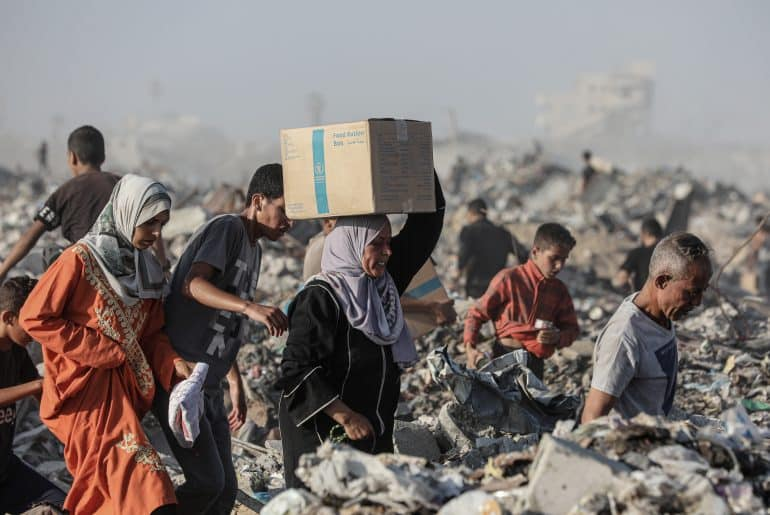
 Palestinians carry food parcels distributed by the Gaza Humanitarian Foundation. Palestinians in Gaza are being routinely killed while attempting to retrieve aid from GHF-run ‘aid distribution’ sites. (Photo by Omar Ashtawy/apaimages)
Alarm sirens and fire tails lighting the sky have become a daily occurrence in Israeli cities for the past four days, as Iran continues to send retaliatory waves of ballistic missiles following Israel’s initiation of war with the country. The Israeli attack on Iran also continues, with both sides pledging to escalate military confrontation.
On Sunday, Israel announced it bombed several targets across Iran, including the airport in the city of Mashhad, more than 2,300 kilometers away from Israeli bases. The Israeli army claimed that it had disabled all Iranian air defenses and had allegedly made Iranian airspace free for Israeli air operations, while Iranian media agencies continue to assert that Iranian air defenses continue to be operational and were activated during every Israeli attack.
Israel also announced having killed more leading figures in Iran’s military and security institutions, including the head of the Iranian Revolutionary Guard’s military intelligence.
On Friday June 13, Israel’s Channel 14 reported that the Israeli war cabinet had approved a plan to force the displacement of Iranians from Tehran in order to put pressure on the Iranian government. Modeled after Israel’s well-worn “Dahiya Doctrine” as implemented in Lebanon and Gaza, the plan intends to destroy civilian infrastructure with overwhelming force and kill civilians, hence pressuring the enemy’s leadership through its civilian population.
On Monday, Israel’s Defense Minister, Israel Katz, said that “the residents of Tehran will pay the price.” He later responded to criticism that he was admitting to attacking civilians, stating that he meant that Israel would notify Iranians to evacuate places near government targets.
On that same day, Israeli strikes targeted the heart of Tehran, including the state television station that aired the moment its on-air anchor had to interrupt the broadcast as the studio shook. Katz admitted in a statement that Israel had in fact targeted the television building, adding that Israel would “continue to attack the Iranian regime everywhere.”
‘Unprecedented destruction’ in Israeli cities
Iranian missiles pounded Israeli cities in repeated volleys of dozens of missiles over the weekend, penetrating Israeli air defenses and striking several targets in Haifa, Tel Aviv, and other cities within the greater Tel Aviv area. Iranian missiles struck buildings in Bat Yam, east of Tel Aviv, destroying and damaging several buildings, while in southern Tel Aviv’s Rohovot, an Iranian missile struck the Weizman Institute of Science, where Israeli media reported significant damage.
Iranian missiles also struck an oil refinery plant in Haifa and the Rafael arms company factory in the gulf of Akka, north of Haifa, as well as the Palestinian town of Tamra, near Haifa, killing four Palestinians with Israeli citizenship.
Israeli officials reportedly told Israel’s Channel 13 that the destruction in the greater Tel Aviv area was “unprecedented” and “has not been seen before.”
Meanwhile, the Israeli Prime Minister stated again that Israel was aiming at destroying Iranian “nuclear and missile threats,” calling on the residents of Tehran to flee. The Iranian Revolutionary Guard, for its part, called on Israelis to leave Tel Aviv, while state media in Iran reported that Iran was preparing for “a big attack” on Israel.
On Sunday, the Iranian Tasneem news agency reported that Iran was studying the option of closing the straits of Hormuz, which lie between the Persian Gulf and the Arabian Sea and through which about 20% of the world’s oil passes. If taken, the decision would have worldwide economic repercussions.
On Monday, the Iranian foreign ministry said that the Iranian parliament was preparing a bill to withdraw from the nuclear non-proliferation treaty.
The war has highlighted the role played by the U.S. and the possibility of direct U.S. involvement in attacking Iran. On Monday, U.S. President Donald Trump told the press at the G-7 summit in Canada that an agreement between Israel and Iran “is still possible,” urging Iran to come back to the negotiating table. Iran, notably, had already been in talks with the U.S. on a nuclear deal when Israel launched its attack on Iran last week. When asked what it would take for the U.S. to enter the war directly, Trump replied that he preferred not to talk about the subject.
Iran-Israel war overshadows Gaza massacres
Meanwhile, Israel continues its onslaught on Gaza, as its relentless bombardment of the Strip has not stopped since it launched its attack on Iran. On Monday alone, Palestinian medical sources reported that 43 Palestinians had arrived dead at medical centers, including the Red Cross field hospital in Gaza. Among the dead were 38 Palestinians who were shot and killed while waiting to receive aid at a site run by the Israeli-backed and U.S.-controlled Gaza Humanitarian Foundation (GHF), the controversial organization tasked with distributing aid to Palestinians instead of the UN. Israeli forces have committed several aid massacres against starving Gazans at the GHF’s distribution points in southern and central Gaza. The massacres have seen the killing of dozens of civilians at GHF sites on a near-daily basis, often after the Israeli army has opened fire on desperate crowds of civilians.
Israel also cut off internet and telecommunications services to large parts of the Gaza Strip on Sunday, imposing an effective media and information blackout on millions of Palestinians as Israeli strikes continue to rain down on them.
Israeli forces also continued to impose a total closure on the occupied West Bank since Friday, including the roads between West Bank towns and cities. Closures have caused a total halt to public transportation in several parts of the West Bank.
Alongside the closures, Israeli forces raided the Palestinian cities of Hebron, Bethlehem, Nablus, and Ramallah, arresting at least 35 Palestinians, including a woman and four children, according to the Wafa news agency. In Hebron, residents reported that Israeli soldiers threatened Palestinian families during the raids with unspecified “consequences” for whoever celebrated Iranian missile strikes on Israel..