
Posted by: John Phoenix
From youth clubs to national government: the rise of Ansar Allah as the leader of Yemen’s anti-imperialist forces.
Following the collapse of the Soviet Union and the resulting loss of foreign support, the People’s Democratic Republic of Yemen in the south, already deeply weakened following a violent civil conflict in 1986, voted for reunification with the Yemeni Arab Republic in the north. This took place in 1990, creating a united Yemen (officially the Republic of Yemen) for the first time in more than 150 years, with the northern Yemeni leader Ali Abdullah Saleh becoming united Yemen’s first president and southern Yemeni leader Ali Salem al-Beidh the vice-president.
As part of the reunification, rules on opposition political parties were eased and the first multiparty elections were scheduled to take place in 1993. As part of the move to combat the spread of wahhabism, the Zaydis formed the al-Haq party, primarily to oppose the powerful pro-Saudi al-Islah party that had been established at around the same time with President Saleh’s blessing.
In 1994, the south under al-Beidh’s leadership attempted to re-secede, citing discrimination and broken promises by Saleh. Saleh immediately mobilised support from influential salafi-wahhabi tribes, who duly announced a ‘jihad’ in defence of Saleh’s rule.
The southern uprising was brutally crushed, leading to longlasting resentment amongst the population that would later be weaponised by imperialism. In contrast to the trigger-happiness of the salafi-wahhabis, the Zaydis of al-Haq, whilst not supporting secessionism, opposed shedding the blood of fellow Yemenis and argued for a peaceful resolution of the matter, angering the Saleh regime.
Lacking any powerful sponsors or foreign donors, al-Haq’s electoral performance was consistently poor, winning at its height in 1993 only two MPs and 0.8 percent of the vote – as opposed to 123 MPs for Saleh’s General People’s Congress (GPC) and 62 MPs for al-Islah. In addition, the party was dominated by cautious elders who generally limited themselves to promoting Zaydi interests and pushing back against salafi-wahhabi encroachment.
A younger and more radical faction of the party argued for a shift in focus, towards calling out the total subservience of the Saleh regime to US imperialism and opposing the USA and Israel as the ultimate sponsors of the salafi-wahhabi threat and the real enemies of the Yemeni people. This faction came to be embodied and led by Sayyid Hussain Badreddine al-Houthi, one of al-Haq’s two MPs and the son of a highly-respected Zaydi elder.
During his time in parliament and beyond, al-Houthi became well-known for his vehement denunciations of US influence over the country, much to the embarrassment of the Saleh regime. Contrary to his contemporaries, who won election campaigns through bribery and patronage, al-Houthi campaigned with the slogan: “I won’t promise you anything, but I promise I will not represent you dishonestly”.
He had a reputation for repeatedly voting against foreign loans that the government wanted to take out, astutely pointing out that whilst the money received would only enrich those favoured by the regime, the crushing service payments would fall squarely on the backs of ordinary folk.
Following the loss of his seat in 1997, al-Houthi abandoned the parliamentary route and began laying the foundations for a mass grassroots organisation in the Zaydi heartlands. He had already helped to establish a youth organisation called Shabab-ul-Mo’mineen (The Believing Youth), which organised popular school clubs and summer camps promoting Zaydi culture.
Under al-Houthi’s guidance, these clubs began to take an increasingly anti-imperialist direction. Al-Houthi helped to establish clinics and hospitals and worked hard to improve electricity infrastructure in neglected rural areas, conscious that people fleeing to the cities to escape poverty were at a high risk of becoming torn from their roots and thus easy prey for pro-western ideologies.
After the 9/11 attacks, President Saleh quickly became one of the most enthusiastic allies of Bush’s phoney ‘War on Terror’. From 2001-04, al-Houthi gave a series of lectures in which he railed against the US presence in Yemen and warned of US-controlled NGO attempts to colonise the country’s education system.
He correctly linked the various conflicts and troubles in the region back to their source: US imperialism and zionist Israel. His lectures chimed deeply with the masses and he became a constant source of worry to the Saleh regime.
Al-Houthi’s rhetoric and worldview was fundamentally based in a return to the values of Zaydi Islam, and a consistent feature of his lectures was his call for muslims to uphold the Qur’an, particularly paying attention to verses calling for muslims to be vigilant against jewish and christian plots, which he linked to the modern-day actions of the USA and Israel. As such, he would very often frame his discussion in terms of “muslims” versus an alliance of “jews” and “christians”.
This is where it is crucially important to judge a movement’s revolutionary potential by objective, not arbitrary, criteria – ie, it’s not about what sounds nice to us or what hurts our feelings, but rather which movement is objectively weakening imperialism and which is objectively helping it.
Apologists for zionism and imperialism will often spread the idea that any individual or movement which paints jews in a negative light is ‘like the Nazis’, as if the sole defining trait of nazism was dislike of jews. Even amongst socialists, particularly in western countries, there is often a tendency to treat anti-jewish prejudice as the ultimate evil, a uniquely evil form of racism worse than all others, because of the atrocities committed by the German Nazis in the 1940s.
Fundamentally this is a reactionary and Eurocentric argument that implies a static, unchanging view of history. Of course, it barely needs saying that for workers to blame all the world’s wrongs on ‘the jews’ is obviously a wrong and silly idea, which is as wrong and silly today as it was 100 years ago. However (and here comes the big ‘but’), 100 years ago, the objective situation internationally was that the main reactionary racist ideology being promoted amongst workers and serving the interests of imperialism was antisemitism. Today, however, the equally racist ideology of zionism serves this divide-and-rule purpose, while antisemitism has taken a back seat.
One hundred years ago, the racist ideology of antisemitism was used to justify genocide, but today it is the racist ideology of zionism that is being used to justify genocide. And in that sense, in today’s context, the racist ideology of zionism is a much greater threat than antisemitism. Therefore, to obstruct the fight against zionism by scaremongering about the supposed danger of ‘slipping into antisemitism’ – as if that is somehow worse than being an apologist for zionist butchery – is objectively a reactionary, pro-imperialist position.
Certainly, to try and attack an organisation like Ansar Allah that plays a leading role in combating zionism, on the basis of concern-trolling about antisemitism – particularly in a country like Yemen that has virtually no jewish population anyway – is an argument that should be dismissed out of hand, regardless of certain people’s ‘feelings’.
One hundred years ago, imperialism was promoting antisemitic ideology everywhere because that suited its agenda. Those promoting antisemitic arguments were the most banal dupes and tools of imperialism. This is not the case today.
Today, imperialism aggressively scaremongers about the danger of antisemitism, not because the system really cares about jewish people’s security but because it needs to justify the existence of the zionist settler-colony, which it needs to keep in place in order to continue to destabilise and dominate west Asia, the region with by far the largest oil reserves on the planet, and geographically crucial for transnational trade and shipping.
If any group today can be compared to the antisemites of 100 years ago, it is the anti-Islam crusaders, as fearmongering about muslim immigration is now the primary racist discourse of the bourgeoisie.
Of course, those few who do still promote antisemitic theories about the world are not suddenly right; their ideas are still wrong and misguided, but they cannot be equated to the antisemites of 100 years ago. In the changed context of today, irrespective of their ideas being wrong or right, it has to be admitted that they have broken out of the propaganda straitjacket of imperialism, and have adopted a position directly challenging the one promoted by imperialism.
That shows they have developed the ability to think for themselves. That means despite their current wrong and misguided ideas they have the potential to become revolutionary if provided with the guidance that only a scientific understanding of imperialism can bring.
Certainly you can contrast this with the countless ‘progressive’ identity politics-obsessed, Pride flag Ukraine flag-waving ‘socialists’ who, despite their loud claims to represent and support all things ‘progressive’, have never allowed a thought that was not sanctioned by imperialism to enter their brains.
Perhaps Sayyid Hussain al-Houthi’s most well-known innovation appeared during his January 2002 lecture entitled As-Sarkhatu fi Wajhil-Mustakbireen (The Shout in the Face of the Arrogant), where he coined his famous sarkha (slogan): “God is greater! Death to America! Death to Israel! Curse be on the jews! Victory to Islam!”
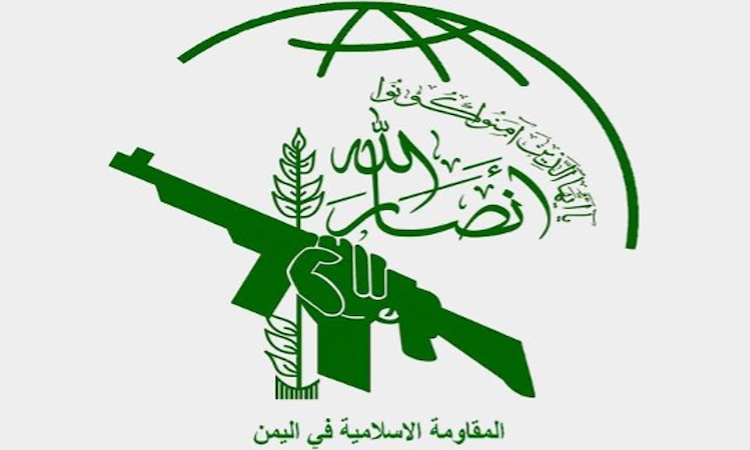
These slogans quickly became the rallying cry of the movement and are emblazoned on its official flag to this day, much to the disgust of ‘respectable’ bourgeois commentators who decry the apparent antisemitism on display.
The fact of the matter is that it is not the apparent meaning of the slogan that is important, but the deeper context and reality that it represents. On the one hand, it is perfectly possible for photogenic young European students to chant slogans of “freedom”, “democracy” and even “socialism”, and yet be mere footsoldiers of the most reactionary elements of international finance capital. We saw this during the so-called ‘Velvet revolutions’ (counter-revolutions) of 1989, when all the fine slogans about workers’ rights and ‘socialism with a human face’ merely masked a pro-US, imperialist-controlled movement bankrolled by the likes of George Soros and assorted billionaires.
On the other hand, whilst al-Houthi’s sarkha may sound offensive to European sensibilities, in the context of Yemen’s very conservative islamic society it undoubtedly contained the nucleus of a blossoming anti-imperialist consciousness, since it identifies Yemen’s main enemies as the USA, Israel and zionism, and calls for a victory to the islamic world (ie, the entire middle east) against these foes.
As always, pro-imperialist commentators will always try to focus on the surface dressing, whilst it is the job of serious revolutionaries to dig beyond that and understand the substance beneath.
As it turns out, US imperialism understood this very well, and US officials in Yemen were deeply disturbed by the rapid spread of the sarkha and of al-Houthi’s soaring popularity amongst the masses. They put pressure on the Saleh regime to crack down on the movement, and hundreds of people were arrested and imprisoned on various trumped-up charges, merely for chanting the sarkha at prayers and other public occasions.
However, al-Houthi refused to back down, pointing out that he had no interest in challenging President Saleh’s rule and that he was only challenging what he saw as the US-Israeli infiltration of Yemen’s institutions.
In June 2004, President Saleh travelled to the US state of Georgia to attend the G8 summit, where he held back-door discussions with US officials. Following his return to Yemen, he immediately launched a large-scale military action with covert US support against al-Houthi’s stronghold in the rural northern regions, bombarding civilian areas with air strikes and killing and maiming hundreds of people.
Al-Houthi and his followers fought back fiercely, but ultimately he was killed by the army in a firefight in August 2004. The army seized his body and refused to return it to his family for almost a decade.
If President Saleh had been hoping that the budding national-liberation movement in the north would die out with the killing of its founding leader, this hope did not last long. Under the leadership of Sayyid Hussain al-Houthi’s father, Sayyid Badreddine al-Houthi, the movement developed quickly into a disciplined paramilitary force and began an insurgency that led to a total of six wars between 2004-10.
The Saudi monarchy, which 40 years earlier had supported Zaydi fighters (owing to their being a reactionary force at that time), once again intervened on behalf of imperialism and began bombing the liberation fighters on behalf of the Saleh regime, whilst the USA and Britain provided logistical support and the international media turned a blind eye to the brutal, scorched-earth campaign.
However, the rebels, who now began to adopt the name Ansar Allah, remained steadfast and secured the support of the masses, allowing them to weather all the attacks.
The inhabitants of the remote northern regions of Yemen are well-known for their rugged hardiness and warrior spirit, and their men are rarely seen outside without a dagger – known as a jambiya – tucked into their waistband. It was in this period that Sayyid Hussain al-Houthi’s younger brother, Sayyid Abdul-Malik, came into prominence and began to take a leadership role, particularly after Sayyid Badreddine’s death in 2010.
The situation in the north remained at a stalemate until 2011, when the so-called ‘Arab spring’ wave of uprisings hit Yemen – one of the few countries where a really popular revolutionary movement took hold of the masses. Following months of relentless huge anti-government demonstrations, Saleh’s powerful tribal backers began defecting to the opposition one after the other, culminating in an assassination attempt on the president that reportedly left him critically injured.
Not long after this incident, Saleh finally agreed to resign and hand over the country to his vice-president, Abdrabbuh Mansur Hadi, bringing an end to his 33-year reign.
Ansar Allah played little direct role in the 2011 revolution, in which the opposition was dominated by pro-western liberals and the Saudi-aligned salafist-leaning al-Islah party. However, it used the power vacuum created during the turmoil to its full advantage by seizing control of large parts of the north, including the key city of Saada.
The movement continued to recruit and organise, pointing out that the regime had not fundamentally changed in any way. A supposed ‘presidential election’ was held in 2012 in which President Hadi was the only candidate allowed on the ballot paper (which did not stop western media outlets later referring to him as the ‘democratically-elected’ leader of Yemen!)
At this time, Sayyid Abdul-Malik al-Houthi was routinely attracting tens of thousands of people to hear his public sermons, in stark contrast to the unpopularity of the distant and technocratic new president. In particular, the Houthi movement became known for its vibrant celebrations of the prophet Muhammad’s birthday – a symbolic rebuke to the influence of salafi-wahhabism which forbids this popular festival as supposed ‘heresy’ (in much the same way that the extreme puritans wanted to ban Christmas in revolutionary England, although the puritans were at least on the right side of the revolution!)
Additionally, in 2013, Sayyid Hussain al-Houthi’s body was finally returned to his family, to be buried with full honours amidst huge crowds of supporters.
One incident that deserves attention in this period is the events at Dammaj. Dammaj was the symbolic stronghold of salafi-wahhabism in the north of Yemen, the home of a salafist seminary founded by Shaykh Muqbil al-Wadi’i in the 1980s. From the USA to Indonesia, ‘students’ would come to ‘study’ salafi-wahhabi ideology at this seminary, located awkwardly in the heartland of the Zaydis.
Matters came to a head when ‘students’ at the seminary reportedly began violently attacking Ansar Allah supporters. The seminary refused point-blank to cooperate with Ansar Allah’s attempts to capture the perpetrators, sparking a conflict that culminated in the destruction of the seditious institute and the fleeing of its extremist occupants – a huge symbolic victory for the Zaydi Yemenis in their national-liberation struggle.
As a response, the local branch of al-Qaeda declared “holy war” against Ansar Allah, once again showcasing that supposedly ‘anti-American’ organisation’s hypocrisy and fealty to imperialism. Saudi salafist propagandists began to spread long-winded claims that Ansar Allah supposedly followed a fringe sect of Zaydism that they claimed was close to Iran’s Twelver shias, thereby making them ‘infidels’ (ie, acceptable targets for annihilation in the eyes of ‘God’) – in reality demonstrating nothing more than the ease with which supposedly ‘religious’ goalposts can be moved by these puppets when it suits imperialist interests.
In late 2014, a fresh wave of mass popular protest broke out against President Hadi following his decision to implement a hike in fuel prices to meet the conditions of an IMF bailout. This was the October moment for Ansar Allah, as the resistance organisation made the fateful decision to order a full-scale march of its supporters and fighters to descend on the capital, Sanaa (which is situated in the north of the country).
Supporters of the controlled-opposition al-Islah party and other government loyalists attempted to halt the advance, but the masses sided with Ansar Allah and they were routed. At the same time, patriotic members of the military defected to support what became known as the 21 September Revolution. Despite the name, Ansar Allah did not immediately seize power, merely stationing its fighters at key positions in the capital whilst President Hadi remained formally in charge.
This uneasy truce broke down in January 2015, following a proposal by President Hadi to divide the country into six federal regions, which Ansar Allah rejected as an ill-disguised attempt at balkanisation.
President Hadi was placed under house arrest and forced to resign. He was replaced by a supreme revolutionary committee set up by Ansar Allah and led by Abdul-Malik al-Houthi’s brother Muhammad, marking the formal victory of what had seemed unthinkable just a few years earlier – Ansar Allah coming to power as part of a national government of Yemen.
As expected, condemnations began pouring in from imperialist governments and their institutions and stooge regimes in the region, all of which refused to recognise the new government. Hadi escaped to Aden, where he declared himself to be the ‘legitimate president’ and was quickly recognised as such by the United Nations, under imperialist pressure.
As the revolutionaries marched southwards from Sanaa, Hadi fled the country entirely and settled in Riyadh, where he would go on to serve as ‘president’ of the so-called ‘internationally-recognised government of Yemen’ – a powerless group of Saudi (ie, Anglo-American)-controlled stooges.
In case the reader has not already realised, the Yemenis are a proud people who do not take kindly to attempts at intimidation. In response to the imperialist pressure campaign, massive demonstrations took place in support of Ansar Allah and the national government across the northern part of the country, and huge crowds (described in the west as “tens of thousands”, but more likely closer to a million) filled the streets of Sanaa as far as the eye could see.
With a major showdown appearing imminent, Yemen’s political parties began choosing their side. As was to be expected, the salafist al-Islah sided with the reaction, as did al-Qaeda, Isis and virtually all salafi-wahhabi figures. Most liberal parties and figures also sided with the imperialist campaign, including at least one Nobel peace prize-winning ‘pro-democracy’ activist (shock horror!)
The leaders of the Yemeni Socialist party (YSP – the former ruling party of the socialist People’s Democratic Republic, now a social-democratic party) also fled to Riyadh to join the stooges.
On the other hand, the General People’s Congress (GPC) – the former ruling party of presidents Saleh and Hadi – despite being an obvious symbol of the old regime, split into patriotic and comprador wings, with the former joining the new government set up by Ansar Allah.
A large grassroots section of the YSP also denounced their leadership’s treachery and pledged loyalty to the revolution under the banner of ‘Socialists Against the Aggression’. And number of small communist parties declared their support for Ansar Allah’s revolution, the most notable of which was the National Democratic Front party, which had previously led a Marxist-Leninist insurgency in the 1970s.
Ansar Allah and associated revolutionary forces continued to advance into southern Yemen at lightning speed, reaching as far as Aden on the south coast. However, the movement had few roots in the southern regions of the country and lacked the mass support it enjoyed in the capital. In these regions, the masses were heavily influenced by the bourgeois-nationalist rhetoric of the so-called ‘Southern Movement’ – a separatist movement that advocated the repartition of Yemen into two separate countries.
Much like their counterparts above a certain age in Germany’s eastern regions, large numbers of people in the south of Yemen remain nostalgic for the old socialist system and the security it provided. The separatists have been exploiting this sentiment to the hilt, despite the fact that their programme and rhetoric makes no mention of socialism or Marxism of any kind; rather, it is built almost entirely on inciting division and tribal prejudice against the ‘northerners’, in whom Ansar Allah are included.
Indeed, one website affiliated with the separatists has openly clamoured for imperialist intervention against Ansar Allah, citing Nato’s “humanitarian bombing” of Yugoslavia in the 1990s as a shining example of what they are seeking for Yemen!
As a result, Ansar Allah faced heavy resistance in Aden and much local hostility. Wisely, they did not persevere in trying to subjugate hostile regions. The national-liberation forces withdrew to roughly where the former north/south Yemen border had been – where they dug in and prepared to face down the inevitable imperialist intervention.
It was around this time that Ansar Allah found support in the most unexpected place imaginable: from former president/tyrant Ali Abdullah Saleh. Despite having murdered the movement’s founder and hundreds of its followers on behalf of US imperialism, Saleh and his significant band of battle-hardened tribal loyalists were apparently hoping to forget the past in their quest for political revenge against those who Saleh saw as having ‘betrayed’ him back in 2011.
This was not an unusual stance in heavily-tribal Yemen. When Saleh had waged war against the southern secession attempt in 1994, some of his main supporters had been former communist leaders whose political grudges eclipsed any concerns about principles or morals.
Given the new government’s total international isolation and the gathering storm clouds of imperialist war, Ansar Allah reluctantly agreed to this alliance. This strengthened the resistance significantly, but at the cost of granting a huge propaganda gift to imperialist-aligned Arab media, which began a massive demonisation campaign to condition their populations in accepting and even supporting a war against Ansar Allah and the national government.
Meanwhile, western media preferred to ignore the situation entirely, focusing instead on promoting Ukraine’s new protofascist regime and its war on the Donbass peoples.
It was also at this time that Isis, until then virtually absent from the country, suddenly decided to announce its presence and declare its ‘jihad’ in typical fashion – not against the US presence of course, but rather against those who dared to resist said presence. A number of devastating terrorist attacks on Ansar Allah supporters followed, killing hundreds of people.
To be continued …
Lalkar writers