
Posted by: John Phoenix
by Geoffrey Roberts – a resumé and review
Over the next few issues of LALKAR we shall be publishing this review of Geoffrey Roberts’ book on Stalin’s library. Although as a bourgeois academic Roberts is obliged to take an anti-communist approach and to repeat may of the usual slanders against Stalin, such as in the sentence; “this book explores the intellectual life and biography of one of history’s bloodiest dictators, Joseph Stalin” (Introduction, p.2), nevertheless, as an honest historian, he has been able to shed a bright light on Stalin as a person, showcasing not only his genius as a political leader but also his untiring and meticulous devotion to the cause of proletarian revolution and the well-being of the toiling masses..
PART 1
By the time of his death, Stalin’s library contained 25,000 books, periodicals and pamphlets. Of these, the 400 books that he had marked and annotated “revealed that Stalin was a serious intellectual who valued ideas as much as power”, who read to “acquire a higher communist consciousness, seen as central to the … goals of Soviet socialism. An ideologue as well as an intellectual, Stalin’s professed belief in Marxism-Leninism was wholly authentic, as can be seen from his library” (p.2).
“Lenin was his favourite author”, but he also read Trotsky and “other arch-enemies”. He was, says Roberts, “…an emotionally intelligent and feeling intellectual”, whose dedication to “Lenin’s memory was unabated” (pp.2-3).
Khrushchev, in his notorious 20th Party Congress speech asserted that Stalin embellished his official short biography to inflate his sense of self-importance. Roberts refutes this lie, saying that actually Stalin “toned down the adulation. Even more striking was the way he reduced his personal presence in the … History of the Communist Party of the Soviet Union (1938)”, though his contribution was “detailed enough for him to be considered a de facto co-author” (p.4).
In the opening chapter of Chapter 1 entitled ‘Bloody tyrant and bookworm’, Roberts, having associated himself with the hackneyed assertioins about Stalin being a “bloody tyrant, a machine politician, a paranoid personality, a heartless bureaucrat, and an ideological fanatic”, goes on to say that Stalin was “an intellectual, … a dedicated idealist and an activist intellectual” who was a voracious reader, “reading for the revolution to the very end of his life”.
While he hated “the bourgeoisie, kulaks, capitalists, imperialists, reactionaries, counter-revolutionaries, traitors – he detested their ideas even more” (p.6). He had absolutely no “compassion or sympathy for those he deemed enemies of the revolution” (p.7).
A voracious reader, he read a lot of left-wing literature, especially works by Marx, Engels and Lenin. In addition he devoured the classics of Russian literature and Western fiction – from Tolstoy, Dostoevsky, Schiller, Heine, Hugo, Thackeray and Balzac. He also read works by his deadly enemies like Trotsky, Zinoviev, Kautsky and Bukharin. In the 1930s he devoted much attention to reading Soviet literature.
The history of revolutionary movements abroad was of great interest to him and he often gave strategic and tactical advice to visiting foreign communists. “Military strategy was an enduring interest”, reading the works “of the foremost French, German, Russian and Soviet strategic theorists. Not surprisingly, this interest became paramount during the Second World War when he became the Soviet Union’s Supreme Commander. Stalin was also attracted to the history of the ancient world, especially the rise and fall of the Roman empire” (p.9).
In addition, he spent considerable time reading about science, linguistics, philosophy and political economy, making notable interventions in debates about genetics, socialist economics and linguistic theory.
Such was Stalin’s reverence for books that, at a gathering of Soviet writers attending a national congress in August 1934, he said: “To build socialism we need civil, electrical and mechanical engineers. We need them to build houses, automobiles and tractors. But no less important, we need engineers of the human soul, writers – engineers building the human spirit” (p.11).
Beginning with Lenin, the Bolsheviks always laid stress on Soviet power, rapid industrialisation, with an emphasis on the development of heavy industry, and mass literacy and cultural enlightenment, for an illiterate person stands outside of politics.
To realise Lenin’s vision, the Bolshevik government created a vast network of libraries, reading rooms and mobile units that secured a supply of books and revolutionary literature to within a ten-minute walk from every person’s home. Libraries were to provide a quick and free service, long opening hours, with easy borrowing facilities and inter-library loans.
During the Great Patriotic War, the Nazis destroyed 4,000 libraries, but by the end of the War there were still 80,000 left in the USSR, with 1,500 in Moscow alone.
The Bolsheviks were keen on persuading the masses to read classics of fiction – both Russian and foreign, and managed to have the classics of world literature translated into Russian.
The reaction of Jonathan Brent (a Yale University press editor) to an encounter with the surviving books in Stalin’s library in the 2000s “verged on the religious”. On being shown some of Stalin’s annotated works, he expressed himself thus:
“Nobody was prepared for what we found … To see the works in his library is somehow to be brought face to face with Stalin. To see the words his eyes saw. To touch the pages he touched and smelled. The marks he made on them trace the marks he made on the Russian nation … Not a single work I inspected was not read by him. Not a single work was not copiously annotated, underlined, argued with, appreciated, disdained, studied … We see him thinking, reacting, imagining IN PRIVATE” (p.15).
Allegations of paranoia
It is typical of bourgeois histiography that it ascribes paranoia to the Soviet leadership and goes on to give the most stupid explanation for this alleged paranoia: “the politics and ideology of class war in defence of the revolution and in pursuit of communist Utopia” (p.16).
In support of this mindless assertion, Roberts cites the even more stupid assertion of Stephen Kotkin: “The problems of the revolution brought out the paranoia in Stalin and Stalin brought out the paranoia in the revolution” (p.16).
In other words, if you want not to suffer from paranoia, don’t attempt a proletarian revolution and the class struggle in entails. What bourgeois scholars characterise as paranoia is merely the vigilance of the proletarian state and its leadership to guard against real, not imaginary, aggression, sabotage, spying and campaigns of murderous activity. In fact, we would be justified in criticising a socialist state if it did not protect itself against such activities, if it did not exercise revolutionary violence to suppress every act of counter-revolutionary activity from sources internal as well as external. If that annoys the flunkeys of imperialism and causes them to accuse proletarian leaders of paranoia, the latter can laugh off such criticism as the ravings of frustrated counter-revolutionaries.
Following Lenin’s teaching, Stalin emphasised that the class struggle intensifies under socialism; that the stronger the USSR became, the more it will drive the bourgeoisie to desperation in an attempt to crush the revolution through a combination of foreign aggression and internal sabotage and internal subversion. This reality obliged the Soviet state to adopt hash measures to thwart attempts at the overthrow of the proletarian state – not any paranoia on the part of the Soviet leadership.
“There was no one whose books he [Stalin] read more assiduously and admiringly that those of Lenin” (p.16).
Stalin’s biography
“Lenin is my teacher, he said repeatedly and proudly.
“’The most important thing is the knowledge of Marxism’, he scribbled in the margin of an obscure military theoretical journal in the 1940s. He meant it: in the thousands upon thousands of annotated pages in Stalin’s library, there is not a single hint that he harboured any reservations about the communist cause. The energy and enthusiasm he applied to annotating arcane points of Marxist philosophy and economics is eloquent – and sometimes mind-numbing – testimony to his belief that communism was the way, the truth and the future”.
All the same, “the vehemence with which he viewed his political opponents never prevented him from paying careful attention to what they wrote” (pp.16-17).
“Stalin kept no diary, wrote no memoirs and evinced little interest in his personal being”, yet in answer to persistent questions from foreign visitors, he occasionally gave answers that gave a small glimpse of his early life. Visiting Stalin in 1931, Emile Ludwig, a German writer who had authored biographies of some famous people, asked Stalin what made a rebel – was it perhaps that he was treated badly by his parents? Here is Stalin’s answer:
“No. My parents were uneducated people, but they did not treat me badly by any means. It was different in the theological seminary of which I was then a student. In protest against the humiliating regime and the Jesuitical methods that prevailed in the seminary, I was ready to become, and eventually did become, a revolutionary, a believer in Marxism as the only genuinely revolutionary doctrine” (p.18).
In 1939 the Soviet dramatist, Mikhail Bulgakov, was keen to write a play about Stalin’s youth, and stage in in connection with celebrations of Stalin’s 60th birthday. Stalin vetoed the project with the modest remark that “all young people are alike, why write a play about the young Stalin?” (p.19).
As Stalin showed not the slightest interest in harping on about his childhood, family life, personal relations and. youthful traits, the gap thus left has been filled by gossip, speculation, “…stereotyping and cherry-picking of partisan memoirs to suit the grinding of many different personal and political axes. ‘When it comes to Stalin’, writes the foremost biographer of his early life, Ronald Suny, ‘gossip is reported as fact; legend provides meaning; and scholarship gives way to sensationalist popular literature with tangential reference to reliable sources’.”
Like many Bolsheviks, Stalin was a firm believer in self-effacement. He lived his life in and through the collective that was the Party. His individual and private life was strictly subordinate to his political life.
Visiting Georgia for a month-long trip in 1936, Stalin gave a speech to railway workers in Tbilisi in which he summed up his political journey. It was the closest he ever ame to writing an autobiography. Replying to the flattering greetings of the workers, he disabused them of the notion that he was the “legendary warrior-knight that they conceived him to be. The true story of his life, he said, was that he had been educated by the proletariat, his first teachers being the Tbilisi workers who came in touch with him when he was put in charge of a study circle of railwaymen in 1898; and from them he received lessons in practical political work: this was his ‘first baptism in the revolutionary struggle’, when he served as an ‘apprentice in the art of revolution’. His ‘second baptism in the revolutionary struggle’ was the years (1907-9) he spent in Baku organising the oil workers. It was in Baku that he became a journeyman in the art of revolution, After a period in the wilderness – ‘wandering from one prison or place of exile to another’, he was sent by the party to Petrograd in 1917 where he received his ‘third baptism in the art of revolutionary struggle’. It was in Russia, under the guidance of Lenin, that he became a ‘master workman in the art of revolution’”.
When Yaroslavsky, a senior Party official wanted to publish a biography of Stalin, the latter gave him short shrift, saying: “I am against the idea of a biography about me”.
The absence of an official biography was a gap in a vista “… that Stalin himself had opened up in 1931, when he published a letter on ‘some questions concerning the history of Bolshevism’, in the journal ‘Proletarskays Revolyutsia’. In it he severely criticised Anatoly Slutsky who had published an article in the journal that criticised Lenin’s policy towards German Social Democracy before the First World War. Stalin denounced the author of this article as an ‘anti-party and semi-Trotskyist’….[and] his criticisms were supported by a textual and historical analysis of the ques-tion concerned” (p.23).
Slutsky’s article became the occasion for Stalin to criticise the writings of certain party historians, Yaroslavsky included: “Who, except hopeless bureaucrats, can rely on written documents alone? Who, except archive rats, does not understand that a party and its leaders must be tested primarily by their deeds … Lenin taught us to test revolutionary parties, trends and leaders not by their declarations and resolutions but by their deeds.”
Although written to counter Slutsky’s outrageous assertions about Lenin, Stalin’s article served to increase the demand for an autobiography of Stalin.
The gap created by the absence of an authorised biography of Stalin was filled by two publications. The first was a book-size lecture delivered by Lavrenti Beria and the second by a semi-official popular biography by the French communist intellectual Henri Barbusse (1973-1935).
Before becoming security chief in 1938, Beria headed the Georgian Communist Party. Beria’s lecture on the History of Bolshevik organisation in Transcaucasia, delivered in July 1935, was serialised in Bolshevik and then published as a book. Beria sent an inscribed copy to his “Dear, beloved teacher, the Great Stalin”. The book soon became a “classic … issued in eight separate editions and remained in print until Stalin’s death in 1953” (p.24).
Barbusse was a famous writer who had been a member of the French Communist Party since 1923; he had helped to organise the 1932 Amsterdam World Congress against war and was head of the World Committee against War and Fascism in 1933. Stalin met with Barbusse on four occasions between September 1927 and November 1934. “I am not so busy that I can’t find time to talk to Comrade Barbusse”, Stalin remarked at their meeting in 1932 (Roberts, p.25).
It was the fame of Barbusse as a writer and a reliable communist that persuaded Stalin to accept the proposal.
The book was published in the USSR and France, as well as some other countries. It was published in French in 1935 and in Russian in 1936. Sadly, by the time of its publication in Russian, Barbusse was no more, having passed away during a trip to Moscow in 1935.
His memorial meeting in Moscow was packed with Soviet intellectuals and party functionaries, and an honour guard escorted the mortal remains of Barbusse to the railway station. An official delegation accompanied them to Paris on the Siberian Express. Stalin issued a brief statement: “I share pain with you, on this occasion of the passing of our friend, the friend of the French working class, the noble son of the French people, the friend of workers of all countries” (quoted at. P.26). At the time of his death, Barbusse was working on a screenplay of Stalin’s life.
Barbusse’s aim in writing the book was “to provide a complete portrait of the man on whom this social transformation pivots so that a reader may get to know him“ (ibid.).
To this end, he had written a very brief history of revolutionary Russia in which Stalin, together with Lenin, is the main character, an in-depth contrasting portrait of the personalities of Stalin and Trotsky. The latter is depicted as arrogant, self-important, fractious, verbose and despotic, while Stalin “relies with all his weight upon reason and practical common sense. He is impeccably and inexorably methodical. He knows. He thoroughly understands Leninism … He does not try to show off and is not worried by a desire to be original. He merely tries to do everything that he can do. He does not believe in eloquence of sensationalism. When he speaks he merely tries to combine simplicity with clearness” (Henri Barbusse Stalin; a new world seen through one man, Macmillan, London, 1935, pp. 175-76, quoted in Roberts p.26).
Barbusse’s conclusion was that, by the time of the assassination of Kirov (the Leningrad party leader), Trotsky had become a counter-revolutionary. His account of Trotsky’s path to counter-revolution, his disputes with Lenin and Stalin, are accurate and convincing. It has been suggested that Barbusse’s biography may have provided a template for the Soviet Short biography of Stalin. Both books emphasise Stalin’s affection for Lenin, his heroic work in the revolutionary and civil war periods; in both Stalin is described as the worthy continuer of the cause of Lenin – “the Lenin of today”; both have references to Stalin’s omnipresence and omniscience; both books praise Stalin in grandiose terms.
Notwithstanding these few biographies, “Stalin remained resistant to biographies or the hagiographies of himself, because he did not want to give too much encouragement to his personality cult, ‘which is harmful and incompatible with the spirit of our party’, as he told the Society of Old Bolsheviks which wanted to stage an exhibition based on his biography” (p.27).
He also forbade the publication of a Ukrainian party brochure about his life. He was particularly opposed to the publication of accounts of his childhood. Most noteworthy was his intervention to stop the publication in 1938 of a children’s book by V Smirnova called Tales of Stalin’s childhood: “The little book is a mass of factual errors, distortions, exaggerations and undeserved praise. The author has been misled by fairy-tale enthusiasts, liars (perhaps ‘honest’ liars) … Most important is that the book has a tendency to inculcate in the consciousness of Soviet children (and people in general) a cult of personalities, great leaders and infallible heroes. That is dangerous and harmful … I advise you to burn the book” (quoted on p.28).
Stalin was committed to historical truth. When Mikhail Moskalev (1902-1965) wrote a feature article ‘JV Stalin at the head of Baku Bolsheviks and workers, 1908’ and published it in a historical journal in 1940 (and was then summarised by a feature article in Pravda), Stalin complained to Yaroslavsky, the editor of the journal, that the article distorted historical truth and contained factual errors. He sent copies of his letter marked ‘not for publication’ to the politburo and to the editor of Pravda. He criticised Moskalev’s use of dubious memoir sources and concluded that “The history of Bolshevism must not be distorted – that is intolerable; it contradicts the profession and dignity of Bolshevik historians” (quoted at p.28).
In a letter to Stalin, Yaroslavsky set out the sources on which Moskalev’s article was based. Two days later, on 29 April, Stalin replied, repeating his objections and pointing out the unreliability of Moskalev’s sources, adding that “An historian has no right to just take on trust memoirs and articles based on them. They have a duty to examine them critically and to verify them on the basis of objective information”. The party leadership, he went on to emphasise, needed to be scientific history, one based on the whole truth: “Toadyism is incompatible with scientific history” (ibid.).
Stalin contradicted Moskalev’s statement that he (Stalin) had been the edited of the Baku workers’ newspaper Gudok (the Siren), saying: “I never visited the Gudok editorial offices. I was not a member of the editorial board. I was not the de facto editor of Gudok (I didn’t have the time)”.
In the light of the above information, it is not difficult to conclude that assertions made by bourgeois falsifiers of history, including the Trotskyites and the Khrushchevite revisionists, about Stalin promoting the cult of his personality are nothing but pure slanderous fabrications and a pack of lies. The real Stalin was a modest, humble and self-effacing man who attributed every achievement of the Soviet Union to Lenin whose pupil he claimed to be all his life.
Publication of Stalin’s Works
A project truly close to Stalin’s heart was the publication of his collected writing, articles, letters, speeches, statements, reports, interviews and contributions to Marxist theory – which doubtless furnish a great deal of material that charts his political journey, its milestones, recording as they do his most important thoughts. The question of publishing these was raised in December 1939 on his 60th birthday. However, for various reasons the project kept on being delayed, and Stalin showed no inclination to hurry the process along. Finally the first volume of his works (Solchineniya) saw its publication in 1946.
As to the size of the print run, in his characteristic modesty he suggested that 30,000 to 40,000 copies would be sufficient. When someone pointed out that the print run for Lenin’s collected works was half a million, he replied curtly that he was no Lenin. In the end, he was persuaded to accept a figure of 300,000.
Stalin wrote a brief preface to the first volume in which he admitted his own mistakes and asked to readers to regard his early writings as the work “of a. young Marxist not yet moulded into a finished Marxist-Leninist”. His two mistakes, he said, were: first that he accepted the then prevailing view that the socialist revolution should only take place in a country where the proletariat was the majority of the population, while Lenin had shown that the victory of socialism wad possible even in a predominantly peasant country like Russia; and secondly, that he had been wrong in advocating the handover of the landlords’ land to the peasants as their private property, rather than taking it into state ownership as favoured by Lenin.
Between 1946 and 1949, 13 volumes of his works were published. Their publication stalled and the project was cancelled by Khrushchev following his scandalous denunciation of Stalin at the 20th Party Congress in 1956.
Meanwhile, even before the publication of the 13 volumes, many of Stalin’s writings such as The Foundations of Leninism, Problems of Leninism, On the national question, The history of the Communist Party (Bolsheviks), and his wartime speeches had been published and circulated in millions of copies. The History of the Communist Party was to have been Volume 15 of his Works, having been acknowledged that it was his work, not that of an anonymous party commission.
Roberts has this concluding observation on the 13 volumes published during his life:
“Their limitations notwithstanding, the thirteen published volumes of Stalin’s Sochineniya were destined to become the single most important source for his biography – ‘fundamental’ to ‘the study of the man and his age’, as McNeal puts it. They have been particularly important for those biographers who see Stalin as he saw himself – primarily a political activist and theorist, whose driving force was his unstinting commitment to the communist ideology that shaped his personality as well as his behaviour.” (p.35).
One of Khrushchev’s assertions was that Stalin edited the second, postwar, edition of his Short biography because it contained insufficient praise of him. Roberts debunks that claim saying that “… he actually toned down the adulation and insisted that other revolutionaries should be accorded more prominence. The same was true of many other texts that Stalin edited.”
Stalin, the ‘bookworm’
From very early on, Stalin was a ‘bookworm’ and an ‘autodidact’. “Books were his inseparable friends; he would not part with them even at meal times”, according to one of his schoolmates (p.39).
By all accounts he was a bright student. In 1894 he matriculated and, on the basis of his results, was recommended for entry into a seminary. At the same time he took his first step to a revolutionary future after visiting a radical bookshop, then only recently opened, in Gori in whose reading room he found alternative literature to that prescribed by his school.
At the age of 15 he moved to the Georgian capital, Tbilisi, to enter Spiritual Seminary which, like his school, was run by the Georgian branch of the Russian Orthodox Church. It was a seminary reserved for bright boys destined for the priesthood. He sailed through the entrance exam and was awarded a place. By the time Stalin arrived at the Seminary there was a well-established tradition of student protest and intellectual rebellion, especially against the school’s russification policies and attempts at suppression of the Georgian language.
In 1896-7 he joined a secret study group organised by an older seminarian, Seit Devdariani, which included in its curriculum, among others, the works of Marx and Engels.
A source of forbidden secular literature was the Georgian Literary Society’s ‘cheap library’ that was run by the editor of Iveria, Ilya Chavchavadze. Stalin’s reading habits were discovered by the seminary inspector, who confiscated Stalin’s copy of Victor Hugo’s Toilers of the sea, in which he found the said library ticket. As a punishment Stalin was confined to a cell for a prolonged period. The Principal noted that Stalin had already been warned about the possession of Hugo’s book on the French Revolution – Ninety-three.
On thirteen occasions he had been found to be reading books borrowed from the ‘Cheap Library’. At the time, his favourite author was the Georgian, Alexander Qazbegi, whose fictional hero Koba was an outlaw who resisted Russian rule in Georgia. Stalin adopted that as his first pseudonym upon joining the illegal revolutionary underground. Only in 1913 did he adopt the name Stalin – the man of steel.
He led the Marxist study circles in his third and fourth years at the seminary, a subversive activity that led him to join the Russian Social Democratic Labour Party (RSDLP) in 1898 and to his ex-pulsion from the seminary in 1899.
As he had failed to graduate, he could neither become a priest nor go to university though he was qualified to teach in a church school. Instead he secured a job at the Tbilisi Meteorological Observatory, on whose premises he lived and kept record of instrument readings. This was his first and last normal job. He continued his study of radical literature and extended the scope of his political involvement. A key influence at this juncture was Lado Ketskhoveli, who became a conduit for his connection to both the underground revolutionary movement and workers’ study circles. According to Roberts, “An intellectual as well as an activist, Lado was Stalin’s first political role model” (p.42).
On religion
Notwithstanding his educational background, when it came to religion, Stalin was a “model of Bolshevik orthodoxy” (ibid.).
On leaving the seminary, Stalin turned his back on religion and became an atheist, an ardent opponent of clericalism and of supernatural thinking. While espousing religious freedom, the Bolsheviks reserved the right to campaign against religion. In Stalin’s words, written in 1906:
“Social-Democrats will combat all forms of religious superstition …will always protest against the persecution of Catholicism or Protestantism; they wil always defend the right of nations to profess any religion they please; but at the same time … they will carry on agitation against Catholicism, Protestantism and the religion of the Orthodox Church in order to achieve the triumph of the socialist world outlook” (p.43).
On coming to power, the Bolsheviks separated the church from the state and schools from the church. Freedom of religion was guaranteed by the Constitution adopted in 1918, as was the right to anti-religious propaganda. In 1922 church valuables were expropriated.
Stalin explained to a visiting American delegation in 1927 that, while the Communist Party stood for religious freedom, it “cannot be neutral towards religion, and it conducts anti-religious propaganda against all religious prejudices because it stands for science … because all religion is the antithesis of science.” He added: “Have we repressed the clergy? Yes, we have. The only unfortunate thing is that they have not yet been completely eliminated” (Works, Vol 10, pp.138-139).
In November 1920, in a speech to the Baku Soviet on the third anniversary of the October Revolu-tion, Stalin said:
“Here I stand on the border between the old capitalist world and the new socialist world. Here, on this border line, I unite the efforts of the proletarians of the West and the peasants of the East in order to shatter the old world. May the god of history be my aid” (Works Vol 4, p.406).
The last sentence in the above quotation has been interpreted by some bourgeois historians as proof of Stalin’s continuing religiosity. That is utter nonsense. Plenty of such references can be found in the works of Marx, Engels and Lenin, but it has not occurred to anyone to attribute religious piety to them. Language lags behind practice and even thought. It will be quite some time before expressions such as ‘Thank God’, or ‘For God’s sake’, fall out of use.
The Bolshevik
Quite early on in his revolutionary life, the Party he belonged to – the RSDLP – split into two factions. Stalin sided with the Bolshevik faction headed by Lenin. The original split was over the conditions (rules) of party membership. While the Mensheviks, headed by Martov, advanced an open party engaged in legal activity, the Bolsheviks argued for a disciplined, highly-centralised, underground party, which alone could hope to succeed in the conditions of illegality and Tsarist repression.
While the Mensheviks viewed socialist consciousness through the experience of everyday struggles of the working class to improve wages and conditions at work, the Bolsheviks asserted that everyday struggles could only produce trade unionist consciousness; socialist consciousness, on the other hand, had to be transmitted by the socialists to the strikers.
Whereas the Mensheviks thought of the socialist revolution as some distant occurrence, the Bolsheviks believed it would occur sooner through an alliance of the proletariat and the poor peasantry. Stalin could have found favour with the Mensheviks, who were quite strong in Georgia, but he chose to join the Bolsheviks because he genuinely subscribed to the policy, tactics and strategy advanced by Lenin’s Bolsheviks. Roberts correctly says that Stalin’s biographers have “tended to neglect the niceties of politics, day-to-day struggles, factions and personalities of the Russian revolutionary underground. Yet this constituted nearly half of his adult life. This was the political and social environment in which his character and personality was formed. As a. young revolutionary Stalin adopted beliefs, acquired attitudes, underwent experiences and made choices”.
He added: “There is no shortage of evidence about the life of young Stalin. The problem is that much of it consists of highly partisan and biased memoirs, very little of his primary personal documentation from this early period having survived. Typically, how nationalists recall Stalin correlates with how they see and judge his later life” (p.49).
All the same, writes Roberts: “As a young man, Stalin was confident and self-assured. He was a faithful member of Lenin’s Bolshevik faction. He was loyal to his comrades and contemptuous of political opponents … he was a skilled polemicist in print. His personal life was strictly subordinate to his all-consuming political passions. Much of Stalin’s youthful political style derived from that of his master and political exemplar, Lenin …” (ibid).
As he was never the emigré revolutionary living abroad, his “presence on the ground in Russia and his work as a grassroots agitator, propagandist and journalist made him so valuable to Lenin and lubricated his rise to the top of the Bolshevik Party. None was fiercer in their criticism of the Mensheviks, but for practical reasons Stalin often favoured party unity’ (p.52).
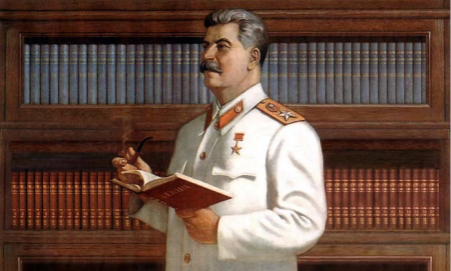
We continue Harpal Brar’s review of Geoffrey Roberts’ book on Stalin’s library, as Harpal had completed it in full before he died in January this year after only one instalment had been published (in the January/February issue). Space did not allow for continuation in the March/April issue, but we are now delighted to be able to continue the serialisation of this interesting work which will run to several parts.
Stalin at work while in exile
As he spent several years in exile, and opportunities for political activity were limited, it provided him with plenty of time for study. He spent much time in local libraries.
In February 1912 he disappeared from his lodgings in Vologda (northern Russia), leaving behind his books on a variety of subjects, ranging from arithmetic, and astronomy to philosophy. Many of the texts included works by or about Voltaire, Auguste Comte, Karl Kautsky, etc.
His longest exile, from 1913 to 1917, was to Turukhansk in Siberia, a harsh place of detention, and he was often suffering from ill health. He complained about the conditions to his comrades and friends and asked for their financial support. But most of all he repeatedly asked them to send him books and journals, especially those to enable him to continue his studies on the national question.
It was Marxist literature that most preoccupied him, especially the works of Marx and Engels. His first published work was a series of articles on Anarchism or Socialism? (1906-7) in which he deployed Marxist arguments against anarchist philosophy. In his ‘Marxism and the national question’ (1913), he subjected to criticism the so-called Austro-Marxist view that nations were a psychological construct rather than historical entities based on land, language and economic life. Apart from Lenin, says Roberts, his favourite Russian Marxist was Georgi Plekhanov, the father of Russian Marxism, whose ‘The Monist view of history’ Stalin read again in later life.
His famous 1913 treatise on Marxism and the national question was published in three parts in the pro-Bolshevik journal Prosveshchenia (Enlightenment) and signed K Stalin, a pseudonym he had just begun to use but which became permanent and replaced Koba as his underground party name. This pamphlet was to become the basis of the Bolshevik policy after the October Revolution and greatly facilitated the solution of the complicated question of nationality in a country that comprised scores of nations and nationalities, with their own languages, culture and traditions.
As the First World War broke, almost all the social-democratic parties deserted the camp of the proletariat for that of the bourgeoisie, i.e., adopting the slogan of ‘Defence of the fatherland’. The Bolsheviks under Lenin’s leadership not only opposed the war but, on the contrary, called upon the socialists of various countries to work for the defeat of their own country and turn the war into a civil war for the overthrow of the bourgeoisie and pave the way for revolution in Russia and all the belligerent states. This policy brought about the Great Socialist October Revolution in Russia, while the bourgeoisie stayed put in other European countries thanks to the betrayal of Social Democracy.
Lenin returned to Russia from Switzerland in April 1917 to insist on outright opposition to the war and to the provisional government that had been set up after the fall of the Tsar, Nicholas II (the February Revolution).
During the most tumultuous, and world historic, months following the February Revolution, Stalin sided with Lenin at every major turning point. He too, like Lenin, believed that the Russian revolution could be the catalyst for a European and worldwide revolution: “The possibility is not excluded”, he said, “that Russia will be the country that will lay the road to socialism… and must discard the antiquated idea that only Europe can show us the way. There is dogmatic Marxism and creative Marxism. I stand for the latter” (Works, Vol 3, pp.199-200).
The October Revolution and the civil war
Many Trotskyite and ordinary bourgeois historians have indulged in gossip to the effect that Stalin was an unimportant figure in the months leading up to the October Revolution (7 November). Roberts puts the record straight:
“Though overshadowed by Trotsky in historical memory, there were few Bolshevik leaders more important than Stalin in 1917. One of the first Bolshevik leaders to reach Petrograd from exile, he was a member of the editorial board of the party’s newspaper Pravda, contributing numerous articles to the Bolshevik press. When Pravda was suppressed by the authorities, he edited the paper issued by the party as a substitute. When the provisional government clamped down on the Bolsheviks in the summer of 1917, and Trotsky was gaoled, while Lenin had fled to Finland, Stalin remained at large. He spoke at all the party’s major meetings in Lenin’s absence and presented the main report to the 6th Congress of the Bolshevik Party in July-August 1917. This was a tough assignment, coming as it did in the wake of the party’s setbacks following the demonstrations of the July days that had provoked the provisional government’s crackdown. Stalin supported Lenin’s proposal for an insurrection and was one of seven party members entrusted with overseeing its preparation. As Chris Read puts it, ‘if Stalin was a blur it might seem to be a result of his constant activity rather than indistinctiveness’” (pp.55-56).
Having seized power, the Bolsheviks were determined to hold on to it at all costs. In March 1918, Lenin’s government signed the Brest-Litovsk peace treaty with Germany and her allies. The negotiations leading to the treaty provoked a deep split in the Bolshevik leadership and broke up the alliance with the Left Socialist Revolutionaries.
One of the first decrees of the Soviet government had been a proclamation on peace which called for a general armistice and negotiation for a “swift end and democratic peace”, i.e., peace without annexations. When the fighting continued, Lenin agreed to sign a separate peace with the Germans and started the negotiations at Brest-Litovsk. Trotsky, the Commissar for Foreign Affairs, led the Soviet delegation. In violation of the Soviet government’s mandate to sign the treaty, he adopted the formula ‘neither war nor peace’ and a unilateral end to hostilities.
Trotsky aimed to spin out the negotiations and use them as a platform for propaganda in the erroneous belief that it would provoke a European revolution. Both Lenin and Stalin were in favour of accepting German terms, as the alternative was losing the war and, with it, the revolution. Opposed to this were Nicolai Bukharin and ‘left communist’ supporters of a revolutionary war against Germany, who argued erroneously that the European proletariat would rise in support of revolutionary Russia. The Left Socialist Revolutionaries were also in favour of continuing the war.
Germany played along with Trotsky’s charade for a while but in January they issued an ultimatum that demanded the annexation of large territories of the western areas of the former Tsarist empire in return for a peace deal. The Russian armies were exhausted and in no position to continue the war. Faced with imminent collapse on the front, the Bolshevik government had little choice but to sign the peace treaty, which now contained far harsher terms than the original ones, for which Trotsky and the ‘left communists’ were entirely to blame.
The conclusion of the First World War in November 1918 was followed by the civil war and the war of intervention, in which the ‘white armies’ led by former generals and admirals, supported by the interventionist imperialist armies, did their best to overthrow the Bolshevik government. The civil war was a close run thing. However, the Soviet government managed to raise a 5-million strong Red Army which was in the end destined to prevail.
During the war, Stalin played “a very important role in providing direction on crucial fronts. If his reputation as a hero was far below Trotsky’s, this had less to do with objective merit than with Stalin’s lack of flair for self advertisement” (L McNeal, Stalin: man and ruler, p.63, cited in Roberts p.57).
“During the civil war, Stalin was Lenin’s troubleshooter-in-chief at the front line” (p.57).
A little earlier, in June 1918, he was sent to Tsaritsyn (renamed Stalingrad in 1924) to protect food supply lines from southern Russia. With the city about to fall to the enemy, he responded by harsh measures against those deemed disloyal and traitorous. He was incensed by the attempted assassination of Lenin by the Socialist Revolutionary Party member, Fanny Kaplan, in August 1918. Stalin cabled to Moscow that he was responding to this ‘vile’ act by “instituting open and systematic mass terror against the bourgeoisie and its agents” (Reed, quoted by Roberts at p.57).
In January 1919 he was sent to the Urals to investigate why the Perm region had fallen to Admiral Kolchak’s White Army. He was accompanied by Felix Dzerzhinsky, the formidable head of Cheka – the agency for countering counter-revolutionaries. This, they reported, was due to the defection of a number of former Tsarist officers to the Whites.
In the spring, Stalin was sent to bolster the defence of Petrograd, which was threatened by General Yudenich’s White Army based in Estonia. For months he was a highly visible figure of authority in the Petrograd area, touring the front line and inspecting military bases.
Stalin played a significant role in bolstering the southern front against General Denikin’s troops in October 1919. His next assignment was the south-west front, threatened by the newly-independent Polish state in April 1920, which was threatening to cross the Curzon line (the boundary between Poland and Russia) in order to grab as much territory as possible while civil war raged in Russia. The Poles won that contest and Soviet Russia was forced in March 1921 to sign the Treaty of Riga which inflicted severe territorial losses on Soviet Russia, including the incorporation of western Belorussia and western Ukraine into Poland. At the 9th Party Conference in September 1920, Stalin was criticised for errors during the Polish campaign. He responded with a dignified statement pointing to his publicly-expressed doubts about the ‘march on Warsaw’ and reiterated his call for a Commission to examine the reasons for the Soviet defeat.
By this time Stalin had, at his own request, been relieved of military responsibilities. By the time the civil war was over, with the White armies and the imperialist interventionist forces having been beaten, he had plenty of work to do. Throughout the civil war he had continued to be the Commissar for Nationalities. In addition, in March 1918, he was appointed to head the People’s Commissariat of State Control, which was later renamed the Worker-Peasant Inspectorate, charged with protecting state property and keeping officials under control.
Appointment as General Secretary
Georgia, ruled by the Mensheviks, was the source of serious differences between Lenin and Stalin, with Lenin favouring a more conciliatory approach to the Georgian nationalists. In the end Stalin’s approach prevailed, with the Red Army marching into Georgia in February 1921.
Despite differences over the Polish and Georgian questions, at Lenin’s insistence Stalin was appointed the General Secretary of the Communist Party in 1922. In view of his experience, his intellectual ability, and his steadfast loyalty to the Party and Lenin, it made a lot of sense to appoint him to this post, which carried tremendous responsibility and an enormous burden of work.
At the 10th Party Congress in March 1921, Stalin supported Lenin in the dispute with Trotsky on the question of the role of Soviet trade unions, as he did over the introduction of the New Economic Policy – which marked the Party’s retreat from ‘war communism’ of the civil war period. And, as a consistent supporter of Party unity, he supported the ban on the formation of factions in the Party – groups in the Party that operated their own internal organisation, rules and discipline.
The resolution was to be resented by the opposition group for years afterwards. In May 1922, Lenin suffered the first of a series of debilitating strokes.
Socialism in one country
After Lenin’s death in January 1924, Stalin emerged as the pre-eminent leader of the Party. Among his demonstrated and administrative capabilities was his ability to inspire in the Party a vision of a bright future through the building of socialism in the USSR, as envisioned and argued for by Lenin. By insisting, as had Lenin, that socialism could be built in the Soviet Union even in the absence of a European revolution, Stalin gave meaning to the lives of Party members and the broad masses of Soviet people. While admitting this, Roberts cannot resist propagating the lie spread by Trotskyists and bourgeois historians that in pursuing the building of socialism in the USSR Stalin was departing from Leninism, and that in doing so he was “…prioritising the construction of socialism at home over the spread of revolution”.
The theory of socialism in one country – the USSR – has nothing to do with Stalin. It is a theory, as any well-informed person knows, given birth to, and followed, by Lenin. Stalin was doing no more than faithfully following the steps of Lenin. Roberts’ assertion that “the failure of the revolution to spread abroad prompted Stalin to fashion a NEW DOCTRINE – SOCIALISM IN ONE COUNTRY” [emphasis added] is totally false, while his statement that they “proclaimed that Soviet Russia could build a socialist state that would safeguard both the Russian Revolution and the future world revolution” (p.64) is perfectly correct.
Stalin correctly stated in 1927: “an internationalist is one who is ready to defend the USSR without reservation, without wavering, unconditionally; for the USSR is the base of the world revolutionary movement, and this revolutionary movement cannot be defended and promoted unless the USSR is defended” (Works, Vol 10, p.53).
The tragic demise of the Soviet Union has served to prove the correctness of Stalin’s statement.
At a time when the anticipated European revolution had failed to materialise, the construction of socialism, far from contradicting the spread of revolution, was the only means of spreading it, as subsequent events were to prove. The strong Soviet state, through its Five-Year Plans, with their spectacular results, and collectivisation, became a base for world revolution. The alternative would have been to shut up shop or send the Red Army into Europe allegedly to spread revolution – both courses would have had catastrophic consequences hardly conducive to world revolution. And yet, that is where the counter-revolutionary theory of so-called ‘permanent revolution’ would have led. No socialism in the USSR and no revolution elsewhere. (For details on this and related questions see Harpal Brar, Trotskyism or Leninism?).
Roberts writes: “Stalin’s workload as general secretary was enormous and continued to grow … The paper trail of reports, resolutions and stenograms passing through his office were endless, as were the frequent visitors, and the numerous meetings he had to attend” (pp 64-6).
His leadership in the construction of socialism, which enabled to country to shed its medieval integument, and join the ranks of highly industrialised countries, his inspiring role as the commander-in-chief of the Red Army that routed the allegedly invincible German army, resulting in the crowning victory of the Soviet Union in the Great Patriotic War – a victory which, in addition to freeing the USSR from the Nazi hordes, brought liberation to the peoples of eastern and central Europe – will forever remain an eloquent proof of his correct line and leadership of the world communist movement. People all over the world owe a debt of gratitude to Stalin, and the USSR which he led, for their role in liberating humanity from the jackboot of German fascism and for weakening imperialism.
Setting up the library
In May 1925, Stalin entrusted his staff with the task of classification of his personal book collection, with the request that the books be classified not by author but by subject matter. The list of subjects to be classified is simply staggering, ranging from philosophy, political economy, Russian history, history of other countries, to military affairs., the national question, the history of revolutions in other countries, the February and October Revolutions of 1917, Lenin and Leninism, the history of the Russian Communist Party and the International, fiction, art criticism, political and scientific journals. Excluded from this classification and to be arranged separately were books by Lenin, Marx, Engels, Kautsky, Plekhanov. Trotsky, Bukharin, Zinoviev, Kemenev, Lafarge, Luxemburg and Radek.
All the rest, he instructed could be classified by author.
His grandiose scheme envisaged a grandiose personal library, “one that could contain a vast and diverse store of human knowledge, not only the humanities and social sciences, but aesthetics, fiction and natural sciences. His proposed scheme combined conventional library classification with categories that reflected his particular interests in the history, theory and leadership of revolutionary movements, INCLUDING [emphasis added] the works of anti-Bolshevik socialist critics such as Karl Kautsky and Rosa Luxemburg, as well as the writings of internal rivals such as Leon Trotsky, Lev Kamenev and Grigory Zinoviev. Although pride of place went to founders of Marxism – Karl Marx and Friedrich Engels and to its pre-eminent modern exponent, Vladimir Lenin” (p.68).
Stalin’s library was a personal working archive that “sprawled across his offices, apartments and dachas” (p.71). From the early 1920s he had accommodation and his office in the Kremlin and another working space just a few miles away in the Party’s central committee building on Staraya Ploshchad (Old Square).
During meetings, “Stalin was fond of plucking a volume of Lenin’s off the shelves, saying ‘Let’s have a look at what Vladimir Ilyich has to say on this matter’. Stalin’s daughter Svetlana recalled that, in his Kremlin apartment, there was no room for pictures on the walls – they were lined with books” (p.71).
The Bolsheviks put a huge premium on education and spreading knowledge among the population. By 1928, the number of books published in the USSR surpassed the Tsarist peak of 34,000 titles, which was second to Germany’s. That same year, the Soviet Union printed 270 million copies of books – more than double the rate of Tsarist times.
In addition to his own vast collection, Stalin liked to borrow books from other libraries, both personal and institutional – a favourite source being the Lenin Library.
Death of Stalin’s wife
There is a lot of gossip about Stalin’s family life, but “By all accounts the 1920s were a fairly happy time for the Stalin family”, but the family idyll ended abruptly when Nadezhda (‘Nadya’) Alli-luyeva died in November 1932 – the reason and circumstances of her death remained unclear. However, the stories about her bad relations with Stalin and political differences between them are the work of the fevered imagination of Soviet emigrés and Stalin’s political opponents. Her death was announced in Pravda:
“On the night of 9 November, active and dedicated Party member Nadezhda Sergeyevna Alliluyeva died”. The dedication that followed was signed by top Soviet leaders and their wives.
“We have lost a dear, beloved Comrade with a beautiful soul. A young Bolshevik with strength and boundlessly dedicated to the Party and the Revolution, is no more … The memory of Nadezhda Sergeyevna, dedicated Bolshevik, close friend and faithful helper to Comrade Stalin, will remain forever dear to us.”
Further tributes came at the time of her burial at Novodevichy cemetery on 12 November, and a few days later Stalin publicly replied to all the sympathy messages he had received.
“With heartfelt gratitude to all organisations, comrades and individuals who have expressed their condolences on the death of my close friend and comrade Nadezhda Sergeevna Alliluyeva – Stalin” (pp.76-77).
Stalin’s dacha
A new dacha was constructed for Stalin in 1933-34 – the Kuntsevo mansion only 10 minutes drive from the Kremlin. Hence its colloquial name ‘Blizhnaya” (close by). After Nadya’s death, Stalin’s daily life acquired a new pattern. Hardly ever staying overnight in his Kremlin apartment, he worked in the Kremlin apartment until late and was then driven to Blizhnaya. Not until the early hours of the morning did he go to bed.
Apart from the rooms, the “centrepiece of the [new] dacha, however, was its library, a 30-square metre room with four large bookcases whose shelves were deep enough to take two rows of books. But the bulk of Stalin’s collection … were stored in a separate building nearby”.
Questions of geography
“The dacha’s vestibule displayed three large multicoloured maps: a world map, a map of Europe and one of European Russia. The Yugoslav, Djilas, reported that during his visit to the dacha in June 1944, Stalin stopped before the world map and pointed at the USSR, which was coloured red, exclaiming that the capitalists could ‘never accept the idea that so great a space should be red, never, never!”.
At the 20th Party Congress, where Khrushchev launched his slanderous anti-Stalin campaign, he accused Stalin of planning military operations on a globe. While Stalin did have a big globe in or near his Kremlin office, “…Khrushchev’s calumny has been rejected by members of the Soviet high command who worked with him closely during the war” (pp.77-78).
While Stalin focused on countries and territories bordering the Soviet Union, “his geopolitical outlook was global. As a Bolshevik internationalist he paid attention to revolutionary struggles across the world, Among the remnants of his library are many books on Britain, France, Germany, China and the United States and a good number of texts on Ireland, India, Indochina, Indonesia, Italy, Japan and Mexico (including a translation of John Reed’s book on the Mexican revolution) as well as volumes on imperialism, colonialism, slavery, and oil and world politics” (p.79).
A tireless worker
His dacha was a secure extension of his Kremlin office which served as a place where his children could play, and where he could receive visiting foreign communists; where he could listen to his vast collection of gramophone records; it was a place to relax and do some gardening. “But, above all, the time spent at the dacha was a break from affairs of state and an opportunity to browse his books.
“Never was downtime more necessary than during the war when Stalin worked twelve to fifteen-hour shifts in the Kremlin”. Roberts goes on to quote the following paragraph from Deutscher’s biography of Stalin which gives a graphic picture of the workload that Stalin carried on his shoulders during the long years of the war: “He was in effect his own commander-in-chief, his own minister of defence, his own quartermaster, his own foreign minister, and even his own chef de protocole … Thus he went on, day after day, throughout four years of hostilities – a prodigy of patience, tenacity, and vigilance, almost omnipresent, almost omniscient”.
Roberts adds that: “Research in the Russian archive has amply borne out Deutscher’s graphic picture of Stalin as the ever-busy warlord”. The last word in this sentence is a gratuitous insult mind-lessly hurled at Stalin. There can only be one of two explanations. First that Roberts does not know the difference between a wartime leader and a warlord, which is unlikely considering that he is an erudite person and a serious scholar. Why should this epithet be applied to Stalin and not to Churchill and Roosevelt, we may ask.
The second, and plausible reason, for this, as well as other anti-Stalin slurs sprinkled in the pages of his book, is that he is attempting to please his publishers, as well as academia and the powers that be, and to assure them that, while he may have portrayed Stalin truthfully as an erudite, first class intellectual and theoretician, apart from being the brilliant leader of socialist construction and commander-in-chief of the Red Army and its crowning achievement in the Great Patriotic War resulting in the defeat of Nazi Germany, he, Roberts, is by no means partial to Stalin.
Stalin died at his dacha on 5 March 1953. A decision was taken by the Soviet leadership in September 1953 to establish a Stalin museum at his dacha, but the plan was dropped after Khrush-chev’s anti-Stalin ‘secret’ speech at the 20th Congress of the CPSU(B).
But Stalin remained popular in Georgia where in 1957 a museum in his honour was opened in his home town of Gori, which continues to exist to celebrate Georgia’s most glorious son – notwith-standing the downfall of the USSR.
According to biographer Yevgenia Zolotukhina, “… Stalin was an educated person. He got extremely irritated whenever he came across grammar and spelling mistakes, which he would care-fully correct with … a red pencil” (p.82).
He read all the emigré literature that appeared in Russian, written by White Guards, works by the opposition – those whom Stalin regarded as ideological opponents or simply as enemies, and he read them with great attention.
He read fiction and often used characters from these works to mock foreign critics of the Soviet Constitution, for example, who claimed that the Constitution was a fraud. Like the fake ‘Potemkin villages’ built to impress Catherine the Great as she travelled through the Russian countryside:
“In one of his tales the great Russian writer Shchedrin portrays a pig-headed official, very narrowminded and obtuse, but self-confident and zealous to the extreme. After this bureaucrat had established ‘order and tranquillity’ in the region ‘under his charge’, having exterminated thousands of its inhabitants and burned down scores of towns in the process, he looked around him, and on the horizon espied America – a country little known, of course, where, it appears, there are liberties of some sort or other which serve to agitate the people, and where the state is administered in a different way. The bureaucrat espied America and became indignant:
“What country is that, how did it get there, by what right does it exist? (Laughter and applause). Of course, it was discovered accidentally several centuries ago, but couldn’t it be shut up again so that not a ghost of it remains! (General laughter). Thereupon he wrote an order: ‘Shut America up again!’ (General laughter)” (pp.83-84)
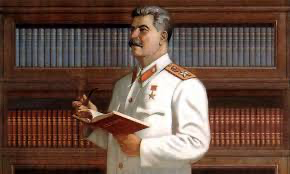
Roberts calculates that the size of Stalin’s library at some 25,000 books, pamphlets and periodicals.
In Stalin’s collection, “Apart from the works of Marx, Engels, Kautsky and Luxemburg, there are few foreign translations in Stalin’s collection. Notable exceptions include Russian translations of Winston Churchill’s book about the First World War, ‘The World Crisis’; three books by the German revisionist social democrat Eduard Bernstein; two books by Keynes, including ‘The economic consequences of the peace’; Jean Jaurès’s ‘History of the great French revolution’; Tomáš Masaryk’s ‘World revolution’; the German economist Karl Wilhelm Bucher’s ‘Work and rhythm’; an early work by Karl Wittfogel on the ‘awakening’ of China; John Hobson’s ‘Imperialism’; Werner Sombart’s book about modern capitalism; some works of the founder of modern Turkey, Kemal Ataturk; the Italian Marxist Antonio Labriola on historical materialism; John Reed’s ‘Insurgent Mexico’; several works by the American writer Upton Sinclair, and the letters of executed US anarchists Sacco and Vanzetti. Among the many works on economics in the collection is a translation of Adam Smith’s ‘The wealth of nations’; in his heavily marked copies of David Rozenberg’s three volumes of commentary on Marx’s ‘Capital’, Stalin displayed a particular interest in the sections on trade and Adam Smith” (p.86).
Some of the writers in Stalin’s collection were purged, but their writings remained part of the collection.
Included in the collection are about 150 foreign language books, mostly in French, German and English, including a book about the Spanish civil war; a signed copy of the 1935 edition of Sidney and Beatrice Webb’s Soviet communism: a new civilisation; various translations of works by Lenin, Stalin, Trotsky, Bukharin and Radek.
One book that combined Stalin’s interests is the 1923 text on the history of revolutionary armies by Nikolai Lukin (1885-1940) based on his lectures to the Red Army’s General Staff Academy. This book dealt with the French Revolution and the Paris Commune, but it was the chapter on Cromwell and his New Model Army that most interested Stalin. Stalin made good use of his knowledge of English history in an interview with HG Wells in July 1934:
“’Recall the history of England in the seventeenth century. Did not many say that the old social system had decayed? But did it not, nevertheless, require a Cromwell to crush it by force?’ When Wells objected that Cromwell acted constitutionally, Stalin retorted: ‘In the name of the constitution he resorted to violence, beheaded the king, dispersed Parliament, arrested some and beheaded others!’ In that same interview he lectured Wells about eighteenth-century British history and the role of the radical Chartist movement in the democratic political reforms of that era” (p.88).
Stalin’s most striking pronouncement on Russian history came in his February 1931 speech on the urgency of the drive for modernisation and industrialisation:
“The history of old Russia consisted, among other things, in her being beaten for her backwardness. She was beaten by the Mongol Khans. She was beaten by the Turkish beys. She was beaten by the Swedish feudal rulers. She was beaten by the Polish-Lithuanian lords. She was beaten by the Japanese barons. Everyone gave her a beating for her backwardness. For military back-wardness, for cultural backwardness, for state backwardness, for industrial backwardness, for agricultural backwardness. They beat her because it was profitable and could be done with impunity … Such is the law of the exploiters: beat the backward because you are weak – so you are in the wrong and therefore can be beaten and enslaved ., We have fallen behind the advanced countries by 50 to 100 years. We must close that gap in 10 years. Either we do this or we will be crushed” (p.89).
Memoirs and diaries were another category of books that interested Stalin – among them the memoirs of the British spy RH Bruce-Lockhart, the First World War German General, Erich Ludendorff, and Annabelle Bucart, who defected to the Soviet Union from the American embassy in Moscow in 1948, thereafter becoming a star of Radio Moscow’s English language broadcasting.
TASS bulletins from various countries were one of Stalin’s most important sources of international information in the early 1930s and he paid special attention to reporting from and about Japan. During the Second World War his staff produced an information bulletin for him containing translated and summarised material from the foreign press, particularly reports on the Soviet Union (see p.90).
In the light of the foregoing, notwithstanding the denigration of Stalin as a mediocre tyrant, Stalin emerges as an intellectual giant, committed in every fibre of his body to the cause of socialism and the liberation of humanity who, in the midst of unbelievable burden of his responsibilities, found time to read a monumental amount of books and have such a large collection of books covering various aspects of human knowledge.
“The idea that Stalin was an intellectual who had read and collected a lot of books was not uncommon, Trotsky’s caricature of him as a mediocrity notwithstanding. He was, after all, a published author”, whose reputation as a Marxist theoretician was acknowledged and “a succession of bedazzled Western intellectuals, diplomats and politicians had publicly hailed his knowledge and erudition … But the discovery of his personal library focused attention on the intellectual aspect of Stalin’s persona and identity. Crucially his biographers now had a source they could use to explore the workings of his mind alongside their studies of his exercise of power” (p.90).
One of the common failings of Stalin’s opponents had been to underestimate Stalin’s intellect and erudition. The discovery of his library put an end to that nonsense and shed light on the multi-faceted talents of this intellectual and revolutionary giant.
After the collapse of the USSR, Russian people began to appreciate Stalin’s contribution and to discard the calumnies about him spread by Khrushchevites, Trotskyites, bourgeois academics and suchlike scoundrels. No wonder, then, that, according to a March 2018 opinion poll, Stalin was voted “the greatest leader of all times for Russians” (p.96).
Spymania
For obvious reasons, Stalin was distrustful of spies – Soviet fears of foreign intelligence operations were perennial. The cultural Cold War was as fierce as the east-west political struggle. In 1949, the Soviet Union published a book entitled The truth about American diplomats, written by Annabelle Bucar, an employee at the American embassy in Moscow who had defected to the USSR in February 1948. Having read the book in its Russian translation, Stalin gave permission for the book to be published as long as it was published in English, Spanish and French as well.
This book caused a sensation; its three prints, published in quick succession, numbering in all just over 300,000 copies, were lapped up by the readership.
Bucar’s book gave details of how the US embassy in Moscow was a nest of spies: “The American diplomatic service is an intelligence organisation”, she wrote, a sentence which Stalin underlined in his copy of the book. The chapter which most attracted his attention was entitled ‘The leadership of the anti-Soviet clique in the state department’.
Duly noted by Stalin was the chief culprit, George F Kennan, the former chargé d’affaires in the Moscow embassy, who had published an anonymous article in the influential magazine Foreign Affairs in 1947, in which he argued that the USSR was a messianic, expansionist state that should be contained by skilful deployment of countervailing power. Kennan’s article was widely regarded as a key influence for America to turn towards confrontation with the Soviet Union in the late 1940s. The book characterised Kennan as the representative of aggressive anti-Soviet circles in the US.
Another sentence in the book underlined by Stalin was Kennan’s statement that “war between the USA and the Soviet Union was inevitable” and that the US could not bear the continued existence of a successful socialist system. The policy of containing communism advocated by Kennan, wrote Bucar, was a guise to justify American world domination.
It is interesting to note Kennan’s observation of Stalin, whom he met on two occasions, and penned his portrait of Stalin in the following words::
“His words were few. They generally sounded reasonable; indeed they often were … Stalin’s greatness as a dissimulator was an integral part of his greatness as a statesman. So was his gift for simple, plausible, ostensibly innocuous utterance. Wholly unoriginal in every creative sense, he had always been the aptest of pupils. He possessed unbelievably acute powers of observation … I was never in doubt, when visiting him, that I was in the presence of one of the world’s most remarkable men – a man great, if you will, primarily in his iniquity: ruthless, cynical, cunning, endlessly dangerous, but for all of this – one of the truly great men of the age” (p.121).
Kennan returned to Moscow in 1952 as the US ambassador. Pravda quite correctly attacked his slanderous words and he was declared persona non grata as a diplomat – the only US ambassador ever expelled from the USSR. He supposedly dropped his headline anti-Soviet views soon thereafter and is regarded as being the foremost advocate of détente with the Soviet Union in the 1950s and 1960s – not hard to believe as the Soviet Union by that time had recovered from the devastation of the Second World War and become a powerful nuclear state.
Stalin read a Russian edition of the memoirs of Otto von Bismarck. With his approval it was published in the Soviet Union. Stalin was deeply interested in diplomatic history; so reading Bismarck’s biography would have made sense. Another book about Bismarck that attracted Stalin’s interest was Wolfgang Windelband’s Bismarck and the European great powers, 1879-1885. At Stalin’s suggestion it was translated into Russian and published.
Stalin’s interest in diplomacy was legendary. As the foreign policy decisions in the Soviet Union were the function of the Politburo, and as General Secretary, he was closely involved in these decisions.
Books on international relations in Stalin’s library included a Russian translation of the diary of the British diplomat Viscount D’Abernon. With the start of the Second World War, Stalin became intimately and directly involved in the conduct of diplomacy. He became keen to have written a Soviet history of diplomacy. Vladimir Potemkin, a prominent Soviet diplomat in the 1920s and 1030s, was put in charge of the project. He had an hour-long meeting with Stalin in May 1940; the same day the Politburo passed a resolution mandating the production of the history.
When the first volume was published in early 1941, with a print run of half a million copies, Stalin telephoned Potemkin to personally congratulate him and his team:
“It is well-known that Napoleon’s Talleyrand said the speech was given to diplomats so that they could conceal their thoughts. We Russian Bolsheviks see things differently and think that in the diplomatic arena one should be sincere and honest”, he told the visiting Japanese foreign minister in April 1941, with whom he had just agreed a neutrality pact.
He had also read Machiavelli’s The prince and his copy of the book was heavily marked.
Caesars and Tsars
In October 1945 Stalin retreated to his dacha near Sochi on the Black Sea – the first of a series of long holidays he gook in the postwar years. There, he invited two Georgian historians, Nikolai Berdzenishvili and Simon Dzanshiya, to discuss their textbook History of Georgia. When they arrived, Stalin was ready and waiting for them with a copy of their book in his hand. Their conversation lasted an incredible four days, with wide ranging discussions on the origin of Georgia and its connections with the people of the Ancient East, the feudal era in Georgian history; the formation of Georgian society during the struggle against Tsarism; and the 18th century monarchy of Heraclius II whom Stalin considered a modernisers and state-builder.
“Berdzenishvili wrote a near contemporary account of his encounter with the man he considered a genius. He was bowled over by Stalin’s knowledge and erudition, wondering where he found the time to read so much about the Ancient East. He waxed lyrical about Stalin as both a Georgian and a Soviet patriot, and dutifully noted his preferences when it came to historians: ‘he likes Turaev and Pavlov and does not like Struve and Orbeli’” (p.127).
Stalin’s interest in the Roman Empire was not a fleeting whim. He possessed a number of books on the history of Greece and Rome in classical times. He read Herodotus’s Histories. At the 17th Party Congress in January 1934, he made excellent use of Roman history to mock Nazi racism:
“It is well known that ancient Rome looked upon the ancestors of the present-day Germans and French in the same way as the representatives of the ‘superior race’ now look upon the Slavonic tribes. It is well-known that ancient Rome treated them as an ‘inferior race’, as ‘barbarians’ destined to live in eternal subordination to the ‘superior race’ … Ancient Rome had some grounds for this, which cannot be said of the representatives of the ‘superior race’ today … The upshot was that the non-Romans … united against the common enemy, hurled themselves against Rome, and bore her down with a crush … What guarantee is there that the fascist literary politicians in Berlin will be more fortunate than the old and experienced conquerors in Rome?” (p.129).
Included in Stalin’s books on ancient history were three books by Robert Vipper in Russian, namely Ancient Europe and the East; Greece in classical times; and Essays on the history of the Roman Empire. He liked very much the section on Sparta in Vipper’s book on Greece.
“Roman history has been a rich repository of lessons for rulers throughout the ages, but, as a Marxist, Stalin would also have appreciated Vipper’s effort to tell the deeper story. Based on Vipper’s lectures at Moscow University in 1899, the book’s aim was to describe Roman polity and society and explain the class forces that drove the imperial expansion and the political crises that led to the Republic’s downfall. Economic and financial issues are addressed as much as the power plays and political manoeuvres of Rome’s rulers. Combining theme and chronology, events and processes, the general and the particular, was a feature of Vipper’s historical writings, as was his exploration of the material basis of politics and ideologies” (p.130).
At a Politburo meeting attended by a number of historians, discussing the preparation of new textbooks, expressing his dissatisfaction with Soviet school history textbooks, Stalin apparently said:
“They talk about the ‘epoch of feudalism’, the ‘epoch of industrial capitalism’, the ‘epoch of formations’ – all epochs and no facts, no events, no people, no concrete information, no names, no titles, no content … We need textbooks about the ancient world, the middle ages, modern times, the history of the USSR, the history of colonised and enslaved people” (p.131).
Stalin on Russian history
Stalin also objected to Russia’s history being reduced to that of revolutionary movements:
“In school textbooks, Stalin complained, history was replaced by sociology and class struggle by periodisation and the classification of economic systems. Also unacceptable to him was that Russian history was reduced to that of revolutionary movements.
“We cannot write such history! Peter was Peter, Catherine was Catherine. They rested on certain classes, expressed their moods and interests, but they acted, they were historical figures. While they were not our people, it is necessary to present the historical epoch, what happened, who ruled, what sort of government there was, the politices that were conducted and how events transpired” (p.131).
In the end the Politburo resolved to establish a group of historians to work on new textbooks. The history of the USSR interested Stalin above all. The progress on the book being so slow that the leadership resolved on the organisation of a public competition and invited submission of several textbooks. As a guide to the contestants, Pravda published two sets of notes, jointly authored by Stalin, the late Kirov and Andrei Zhdanov, the Party’s chief ideologist, which commented on the previously submitted outlines of proposed books. The main criticisms of the outline for a book on the history of the USSR were, first, that it was not a history of the Soviet Union and all its peoples but of Great Russia and the Russians; second, it did not emphasise sufficiently that on the home front Tsarism was a ‘prison of people’ and in its foreign policy a reactionary ‘international gendarme’; and, third, the authors had “forgotten that Russian revolutionaries regarded themselves as disciples and followers of the noted leaders of bourgeois revolutionary and Marxist thought in the West” (see Roberts, p.132).
In the end, a twelve-strong group headed by Andrei Shestakov, an agrarian historian, was awarded a second-class prize (worth 75,000 roubles at the time). The result was announced in August 1937, just in time for the 20th anniversary of the October Revolution. As a result, Shestakov’s book became a designated secondary school text on the history of Russia and the USSR. Millions of copies of the 223-page book, Short course history of the USSR, were printed.
This book was aimed at third- and fourth-grade pupils. Textbooks with like approaches were subsequently produced to be used by older people and university students.
Stalin edited a dummy of the book. “As he habitually did, Stalin toned down and reduced the coverage and adulation of him and his life. Finding his date of birth in the book’s chronology of important events, he crossed it out and wrote beside it ‘Bastards’” (p.133).
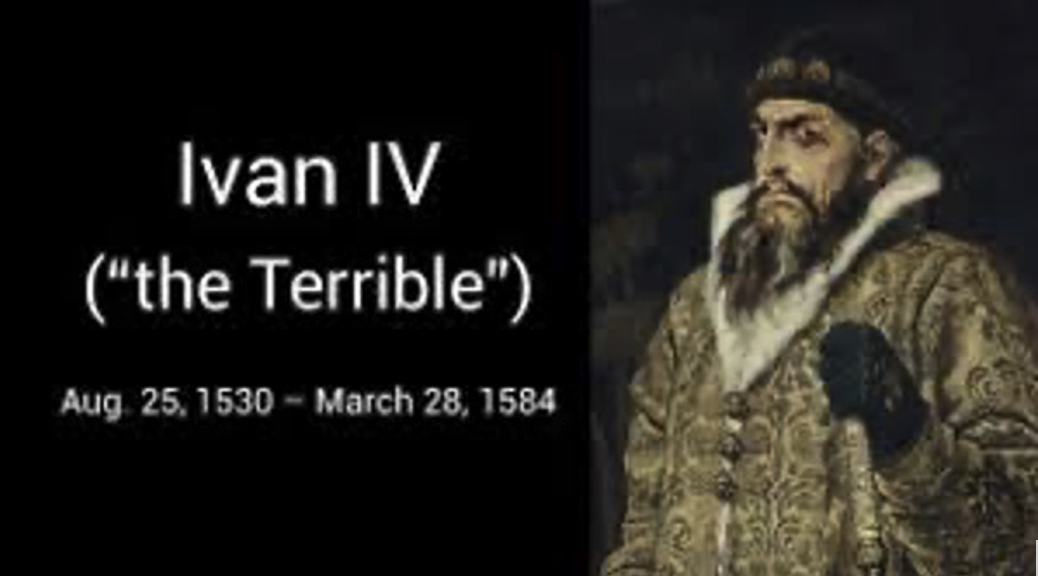
His most important changes were to the book’s treatment of Ivan IV (Ivan the Terrible, 1530-1584) but he approved of the authors’ view that Ivan had established the autonomous power of Tsarism by destroying the aristocratic boyars, but with the addition that in doing so he had completed the task of forging a scattered collection of principalities into a single strong state that had been set in motion by Ivan I in the fourteenth century. The verdict was that under Ivan his “kingdom became one of the strongest states in the world” (p.135).
The final result was a “stirring story of a thousand-year struggle by Russia and its Soviet successor to build a strong state to defend its population from outside incursions” (ibid. p.134).
While Stalin never stopped criticising the Tsars, his view of the state created by them was summarised during the course of a toast to the twentieth anniversary of the October Revolution:
“The Russian Tsars did a great deal that was bad. They robbed and enslaved the people. They waged wars and seized territories in the interests of land-owners. But they did one thing that was good – they amassed an enormous state, all the way to Kamchatka. We have inherited that state. And, for the first time, we, the Bolsheviks, have consolidated and strengthened that state as a united and indivisible state, not in the interests of the landowners and the capitalists, but for the benefit of the workers, of all the peoples that make up that state. We have united the state in such a way that if any part were isolated from the common socialist state, it would not only inflict harm on the latter but would be unable to exist independently and would inevitably fall under foreign subjugation” (p.135).
In the same anniversary year, Alexander Pushkin was lionised as a revolutionary writer. “For the new masses conquering the heights of culture, Pushkin is an eternal companion, declared the magazine ‘Contemporary Literature’. A 1931 piece by the late Anatoly Lunacharsky was reprinted.
“’It is Pushkin who, among others, must become a teacher of the proletarians and peasants in the construction of their inner world … Every grain that is contained in Pushkin’s treasury will yield a socialist rose or a socialist bunch of grapes in the life of every citizen’. Also revived was the heroic reputation of Peter the great in a biopic based on Alexei Tolstory’s 1934 novel. Peter was lauded as ‘a strong national figure who won territory through war and defended it through diplomacy’ and praised for ‘the achievement of raising Russia to the status of a great power in the European arena” (p.135).
Although a historian of the ancient world and of early Christianity, Robert Vipper’s most influential book was Ivan the Terrible (Ivan Gozny). It challenged the prevailing view that Ivan IV was a bloodthirsty tyrant.
“Vipper’s Ivan was fearsome and menacing towards the Russian state’s domestic and foreign foes. Strengthening the monarchy was necessary to empower the Russian state and external threats and pressures motivated his harsh internal regime. His struggle for power against Russia’s barons was just and his security apparatus – the much-maligned ‘Oprichnina’ – as honourable as it was effective. He was also a great warlord and diplomat who had built Russia into one of the greatest states in the world” (p.136).
Vipper’s book played a significant role in turning opinion in Ivan’s favour, with him getting an approving mention in the 1939 Great Encyclopaedia. The renowned film director, Sergei Eisenstein (1898-1948) was commissioned to direct a film about Ivan IV and Alexei Tolstoy to write a play.
This was just the right time for Vipper, who had emigrated to Latvia in the early 1920s, to return to Moscow in May 1945. Upon his return he sent Stalin a telegram expressing his “fulsome thanks for helping him and his family’s joyful return to the land of socialism and pledging his eternal loyalty to the country’s ‘great leader’” (pp. 137-8).
He was given a post at the Moscow Institute of Philosophy, Literature and History before being evacuated to Tashkent where he joined other historians. In 1942 he published a second edition of Ivan Grozny, to which he added a new chapter entitled ‘The struggle against treason’, in which Vipper stated clearly that the traitors Ivan had put to death were real, not imagined, enemies of the state (see p.138).
To the common perception of Ivan as a cruel tyrannical figure, Vipper’s view was that Ivan was a majestic and powerful figure and the greatest statesman of his time; that to understand his harsh actions, people needed to appreciate the extent of domestic opposition to his endeavours to create a centralised state, as well as opponents who had allied themselves with foreign enemies.
Vipper was elected a member of the Soviet Academy of Sciences. In 1944 he was awarded the Red Banner of Labour and in 1945 the Order of Lenin.
The aesthetic rehabilitation of Ivan the Terrible turned out to be more problematic than the historical. There were three parts to Alexei Tolstoy’s projected play. Tolstoy’s version was criticised along these lines:
“’Ivan IV was an outstanding political figure of sixteenth century Russia’, wrote Shcherbakov. ‘He completed the establishment of a centralised Russian state … successfully crushing the resistance of representatives of the feudal order’. Tolstoy’s ‘confused play’ had numerous historical inaccuracies and had failed ‘to rehabilitate the image of Ivan IV’. The main flaw was not showing Ivan as a major, talented political actor, the gatherer of the Russian state and an implacable foe of the feudal fragmentation of Rus’ and of the reactionary boyars” (p.139).
In response to criticism, Tolstoy rewrote part one and carried on working on part two, using Vipper’s book. Part one premiered in Moscow’s Malyi Teatr (little theatre) in October 1944, but was not a success. So it was restaged to great acclaim. Part two was staged by the Moscow Arts Theatre in June 1946. The final part of the trilogy, dealing with Ivan’s last years, apparently remained unwritten.
Part one was again printed in November 1933 when Stalin took a more active interest and marked a few passages from Ivan’s dialogue, especially this:
“They want to live in the old way, each sitting in a fiefdom with their own army, just like under the Tatar yoke … They have no thoughts or responsibility for the Russian land … Enemies of the state is what they are, and if we agreed to live the old way, Lithuania, Poland, Germans, Crimean Tatars, and the Sultan would rush across the frontier and tear apart our bodies and souls. That is what the princes and boyars want – to destroy the Russian kingdom” (p.139).
Eisenstein’s part one of Ivan the Terrible was premiered in January 1945, and in 1946 he too was awarded a Stalin prize.
Stalin did not like the part 2 film and in March 1946 its screening was banned on the grounds that it was historically and artistically flawed. Stalin gave the following reason for his dislike of part two at a meeting of the Central Committee’s Orgburo in August 1946:
“The man got completely distracted from the history. He depicted the ‘Oprichniki’ as rotten scoundrels, degenerates, something like the American Ku Klux Klan. Eisenstein didn’t realise that the troops of the ‘Oprichnina’ were progressive troops. Ivan the Terrible relied on them to gather Russia into a single centralised state, against the feudal princes, who wanted to fragment and weaken it. Eisenstein has an old attitude towards the ‘Oprichnina’. The attitude of old historians towards the ‘Oprichnina’ was crudely negative because they equated the repression of Ivan the Terrible with the oppression of Nicholas II … In our era there is a different view … Eisenstein can’t help but know this because there is a literature to this effect, whereas he depicted degenerates of some kind. Ivan the Terrible was a man with a will and character, but in Eisenstein he’s a weak-willed Hamlet” (p.140).
At Eisenstein’s request, Stalin met him in February. After that meeting, Eisenstein and Nikolai Chekasov, the film’s lead actor, reported their conversation with Stalin to the writer, Boris Agapov, and his notes constitute the only known record of their conversation with Stalin. Ivan, said Stalin, “was a great and wise ruler … His wisdom was to take a national point of view and not allow foreigners into the country, protecting it from foreign influences … Peter I was also a great ruler but he was too liberal towards foreigners, he opened the gates to foreign influences and permitted the Germanisation of Russia. Catherine allowed it even more … Was the court of Alexander I a Russian court? Was the court of Nicholas I a Russian court? They were German courts.
“Stalin made the same point again later in the conversation. ‘Ivan Groznyi was a more nationalist Tsar, more far-sighted. He did not allow foreign influence into the country. Unlike Peter, who opened the gate to Europe and allowed in too many foreigners.
“On Ivan’s cruelty, Stalin had this to say:
“’Ivan the Terrible was very cruel. One can show this cruelty but it is also necessary to show why he had to be so cruel. One of his mistakes was not to finish off the five big feudal families. If he had destroyed these five boyar families there would not have even been a Time of Troubles…’
“At this point Molotov interjected that historical events needed to be shown in their correct light using the negative example of Demyan Bedny’s comic operetta, ‘The Bogatyrs’ (1936), which had made fun of Russia’s conversion to Christianity. Stalin agreed: ‘Of course, we aren’t very good Christians, but we can’t deny the progressive role of Christianity at a certain stage. This event had a major significance because it meant Russian state turning to close ranks with the West, instead of orienting itself towards the East. We can’t just toss history” (pp.141-2).
After talking to Stalin, Eisenstein and Chekrasov were keen to rework the film. Although given a few pointers, Stalin was happy to leave the matter in their artistic hands, insisting only that they be as historically accurate as possible.
In the event, Eisenstein, who had suffered from ill health for some time, died of a heart attack in February 1948. The film remained unrevised and was not released until 5 years after Stalin’s death.