
Posted by: John Phoenix

The executive order which was set to take effect at 12:01 a.m. Eastern Standard Time on January 30, 2026, ramps up the confrontational posture.
Click here to read this article in Spanish/Español.
You can also read this article in other languages by clicking the Translate Website button below the author’s name.
The Trump administration 2.0, with Secretary of State Marco Rubio, has swiftly moved to sharpen its focus on Latin America, explicitly singling out the governments of Cuba, Venezuela, and Nicaragua as primary targets of its foreign policy. This renewed offensive follows months of escalating regional tension, punitive siege on the Caribbean since August 2025 using lethal force against individuals on small boats, the seizing of Venezuelan related oil tankers stealing their cargo and the kidnapping of Venezuelan president Nicolas Maduro. Now the administration continues to double down with this sweeping executive order declaring a national emergency over Cuba, a move that continues a maximalist pressure campaign aimed at compelling political capitulation across the hemisphere.
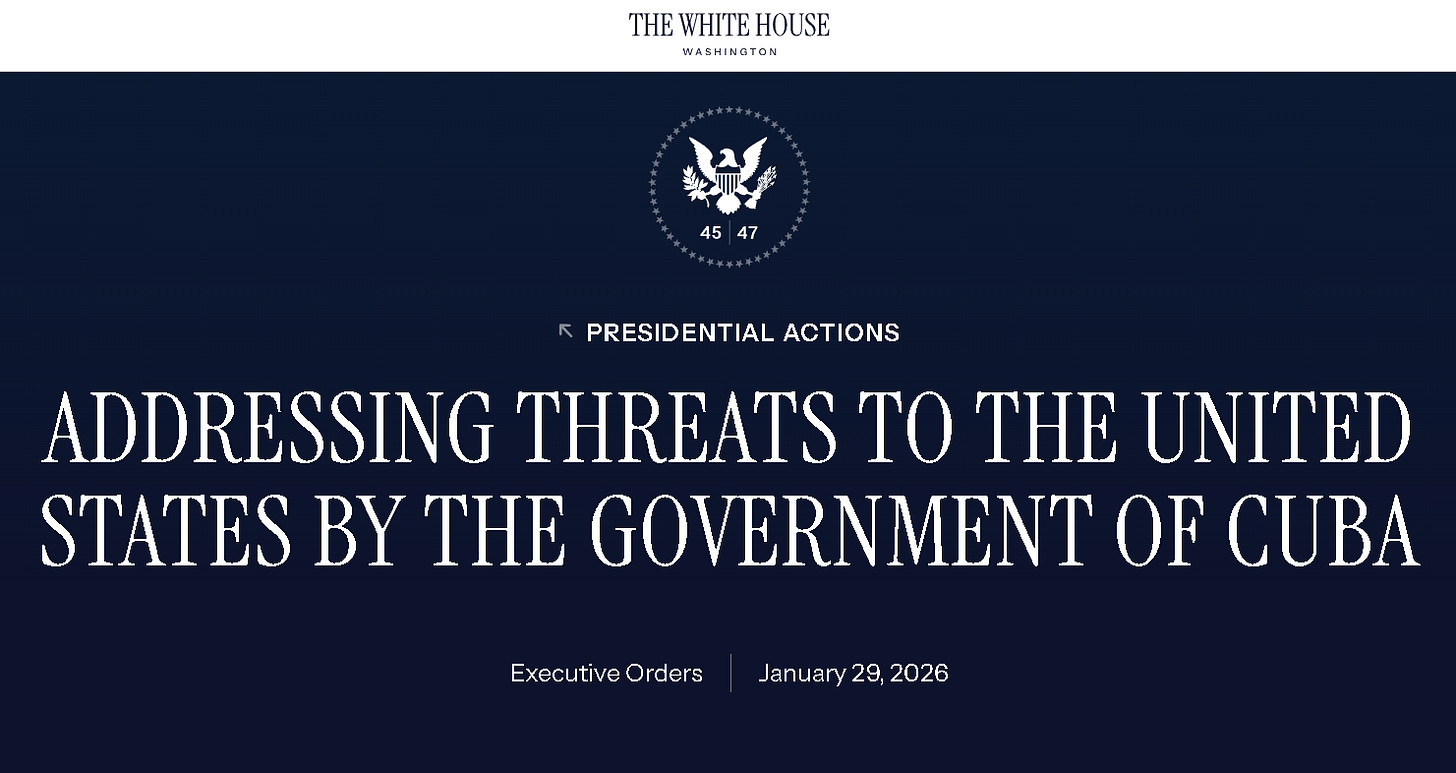
On January 29, 2026, the White House issued an executive order titled “Addressing Threats to the United States by the Government of Cuba,” declaring a national emergency and instituting a novel tariff system against any nation providing oil to Cuba. The document presents a sweeping indictment of the Cuban government, accusing it of many dubious things such as hosting hostile military intelligence facilities, supporting transnational terrorist groups, destabilizing the hemisphere, and committing severe human rights abuses. The text suggests its primary goals are not those stated. Instead, the order appears to be a political instrument designed to achieve several strategic US objectives, with the accusations serving as justification rather than causation.
.
.
A day prior, on January 28, 2026, Secretary of State Marco Rubio’s Senate testimony justified the recent US intervention in Venezuela and outlined the post-operation political and economic roadmap, in which it mentioned Cuba. The testimony constructs a foundational mythology for intervention by relentlessly criminalizing the Venezuelan state, and Cuba and Nicaragua by proxy, explaining the existing governments not as a political entity but as an illegitimate “regime operated by an indicted narcotrafficker” that served as a hemispheric base for every US adversary. This narrative of pervasive criminality and existential threat, encompassing drug trafficking, terrorism, and strategic subversion, creates a necessary pretext, transforming a geopolitical scenario into a simple story of lawless contagion that morally and strategically justifies external action to restore a “friendly” and “stable” order aligned with US interests.
From the get-go the Trump administration 2.0, thru its Secretary of State Marco Rubio, has singled out Venezuela, Cuba and Nicaragua and moved forward with restoring Cuba’s designation as a State Sponsor of Terrorism, re-issuing the Cuba Restricted List to block resources from reaching the Cuban military, including adding Orbit, S.A. to the list. Following the ousting and kidnapping of Nicolás Maduro in Venezuela in early 2026, Rubio suggested the Cuban government should be “at least a little concerned” and has not ruled out regime change operations and expanded sanctions to include visa restrictions for Cuban officials, global collaborators involved in medical missions and also threatened tariffs on countries that supply oil to Cuba which it has now moved to do.
The order levels a familiar yet intensified series of accusations against Havana, claiming the Caribbean island “blatantly hosts dangerous adversaries,” specifically naming Russia, China, Iran, Hamas, and Hezbollah. The document asserts that Cuba hosts “Russia’s largest overseas signals intelligence facility” and is deepening military cooperation with Beijing, while also providing a “safe environment” for designated terrorist groups to operate in the Western Hemisphere.
However, the core of the order is its novel and aggressive economic enforcement mechanism, moving way beyond traditional sanctions that target Cuba directly, this policy establishes a system of secondary sanctions. The US Secretary of Commerce is tasked with identifying any nation that directly or indirectly provides oil to Cuba. Following that identification, the Secretary of State can recommend, and the President can approve, imposing additional tariffs on all goods imported from that country into the United States.
This “tariff trigger” represents a significant geopolitical gambit. It effectively forces third-party nations, including potential suppliers like Venezuela, China, Russia, or intermediaries in the global oil trade, to choose between their commercial relationships with Cuba and maintaining unrestricted access to the lucrative US market. The immediate apparent goal is to severely constrict Cuba’s already fragile energy supply, a move analysts predict could cripple the island’s economy and exacerbate domestic hardships.
The order does include a potential off-ramp. Section 3(c) states that the President may modify the order if the Cuban government “take[s] significant steps to address the national emergency” and aligns “sufficiently with the United States on national security and foreign policy matters.” This vague condition suggests the policy is intended as leverage to force a fundamental shift in Cuba’s foreign alliances, potentially demanding it distance itself from Russia and China.
The executive order which was set to take effect at 12:01 a.m. Eastern Standard Time on January 30, 2026, ramps up the confrontational posture. The move is likely to provoke strong condemnation from regional allies and trading partners, who may view the extraterritorial tariffs as an overreach of US authority. But it’s clear these moves are meant as a deliberate strategy to induce economic collapse and unrest in Cuba. The question is will Cuba coordinate with China and Russia to supply it with oil, and steadier overall trade relations. Both China and Russia have expressed their desire to do this, but it remains unclear if Cuba will accept all the help it’s been offered or if its afraid deeper relations with China and Russia will incur the wrath of the US.